Théoden Janes: What’s really behind Plaza Midwood’s parking frustrations?
If you want to understand Plaza Midwood’s parking wars, start at Midwood Smokehouse.
Read more Bus driver killed in multi-vehicle crash caused by debris on road, NC police say
Hardly a week goes by, Frank Scibelli says, without someone coming inside to complain to his staff after returning to find a boot on their car.
“They regularly blame the restaurant. That it’s our fault.”
It isn’t — although he lives with the consequences. On one hand, enforcement helps keep parking available for their customers. On the other, it can make Midwood Smokehouse the face of a system they don’t control.
But it hasn’t always been this way.
Since May 2011, the original Midwood Smokehouse has anchored a somewhat nondescript retail complex at 1401 Central Ave., sharing a parking lot with a handful of other businesses and offices.
Initially, he says, parking wasn’t much of a problem there. Even if the lot filled up, customers could use overflow parking across the street or find on-street parking nearby. Then came new apartments, new restaurants and more development. Soon the lot had become a microcosm of Plaza Midwood itself, where local restaurants, neighboring businesses, apartment residents, construction workers and wandering customers all compete for the same finite number of spaces.
Today, he says, “You’ll have times we open at 11 o’clock and at 10:40 there’s not a parking space available.”
As far as Scibelli is concerned, parking isn’t a perk; it’s part of what his restaurant pays to lease. That’s why, he argues, some form of parking enforcement has become necessary.
At 1401 Central, however, that job falls not to him, but to Wheel Blockers, the private company that patrols for unauthorized vehicles in many Plaza Midwood lots. It has become one of the neighborhood’s most controversial fixtures, drawing regular complaints from visitors who find themselves booted — or worse, towed.
But Wheel Blockers doesn’t answer to him at all. So if Scibelli and Midwood Smokehouse aren’t dictating who should be booted, who is?
Like most private parking enforcement companies, Wheel Blockers doesn’t make the rules.
Rather, property owners or their managers decide where enforcement applies, when it applies, and whether violators get booted or towed. Wheel Blockers is hired to carry out those decisions.
“I don’t wake up hoping that cars get booted,” says Jack Dunn — managing partner at Raleigh-based Chartwell Property Group, which owns the building — adding that his job isn’t to punish customers but to make sure tenants who pay to lease space there have somewhere for their customers to park.
He offers an analogy:
“If your neighbor parks in your driveway, you’d be upset,” he says. “And if he took great offense to the fact that you were offended that you parked in his driveway, I think you’d be perplexed. So … it’s always important to just look at the other side of the coin. I don’t wake up hoping that cars get booted. My real hope is that we’ve signed the property sufficiently that no one gets booted.
“But I do need to make sure that our tenants have the parking that positions them to be successful.”
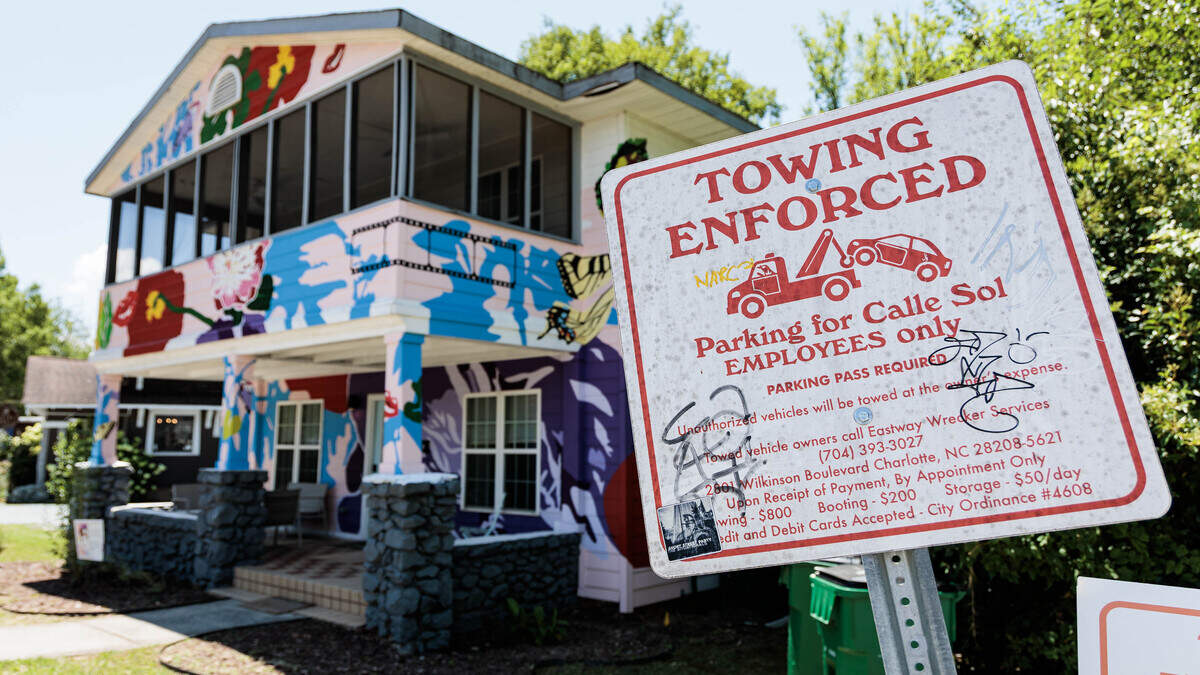
Dunn tells me Chartwell does not receive a share of the boot and tow fees, which are set by Wheel Blockers. Signs on the property list boot-removal fees of $175 to $300 and towing fees of $275 to $1,500, plus additional charges.
He also points out that he feels booting, while unpopular, is the lesser of two evils because drivers can usually get back on the road much more quickly than if their vehicles are towed.
It’s a perfectly rational explanation. It also doesn’t stop the angry emails, the one-star reviews or the social media posts accusing Wheel Blockers of running a legal shakedown.
Even some Plaza Midwood business owners are deeply critical of what they view as “predatory” parking enforcement practices, such as unclear signage, questionable tows and excessive fees.
“I mean, they’re just horrible,” says Zach Current, who owns the Central Avenue restaurants Moo & Brew and Painted Rooster (and who says he doesn’t police parking in his own small lots). “It’s really bad for the scene. It makes people not want to come back. The signs aren’t as visible as you’d want them to be. … People, they get their cars towed and they get them booted, and it makes them hate Plaza Midwood.”
Which raises another question: If so many people believe the system is predatory, why is it allowed to operate this way?
Read more Carolina Panthers will bring in a veteran QB for a workout during training camp
Although he’s got his sights set much more broadly than just Plaza Midwood, state Attorney General Jeff Jackson has made the unethical private towing companies one of his public targets.
On July 15, he posted a video on social media announcing a severe, court-ordered financial punishment against A-1 Towing in Charlotte for towing vehicles the company wasn’t authorized to tow, charging over $4,000 to release vehicles, double-booting vehicles to double its fees, and engaging in racial targeting.
“I’m not putting up with any of that,” he said in the video.
“If you’re a towing company that follows the rules, you’re good to go. But if you’re making a buck by breaking the law, we’ve got a new playbook for going after you — and we will.”
In addition to his efforts, a couple of House Bills related to cracking down on towing and booting practices have been filed with the General Assembly and are on the table.
The irony is that many of the practices people complain about aren’t necessarily illegal.
In North Carolina, private property owners have long enjoyed broad authority to control who parks on their land — and relatively few statewide rules have governed how private companies enforce those decisions. And so Plaza Midwood remains caught in a reality almost everyone agrees on: The neighborhood needs parking enforcement, almost nobody enjoys the way it’s being done, and everyone seems to blame someone else.
If almost everyone agrees there’s a problem, what does a better system actually look like?
Several people I interviewed for this story suggested the real challenge isn’t parking itself. It’s what parking says about a place.
For Tom Hanchett, the neighborhood historian, Plaza Midwood’s parking headaches are the inevitable byproduct of becoming exactly what so many people want it to be — a dense, walkable neighborhood packed with restaurants, bars, shops and apartments.
“You can’t have thriving restaurants, dense housing, independent retail and walkability while still expecting plentiful free parking,” he says. “Those things are fundamentally in tension.”
Or, as he puts it more simply: “If you’re worrying about parking, it means you’re a success. Places that are not a success have all the parking in the world.”
In other words, Plaza Midwood isn’t wrestling with a parking problem so much as a success problem.
And to be fair, nearly everyone I interviewed agreed that some form of parking enforcement is necessary. They also agreed the neighborhood could do a better job of protecting parking without alienating the very customers its businesses depend on.
Certain fixes seem achievable, including better signage, clearer rules and newer technology that could make it much harder for visitors to violate parking policies without realizing it. Current points to Optimist Hall’s license-plate recognition system, which automatically gives customers 90 minutes of free parking before paid rates begin. He says it’s transparent, easy to understand and far less likely to leave visitors feeling ambushed.
But Common Market founder Blake Barnes thinks the bigger problem is that much of Plaza Midwood still treats parking as though each business exists on its own island. He argues the neighborhood works best when someone parks once, then wanders from business to business throughout the evening.
“Man, your customers are my customers,” he says he’s told fellow merchants. “We’re all working off each other.”
Parking decks could add capacity, though they’re expensive and often unpopular. Better transit, safer streets for pedestrians and more bike infrastructure could gradually reduce dependence on cars.
Absent significant government intervention, expect some semblance of booting and towing to continue in Plaza Midwood. Because if enforcement disappears without solving the underlying shortage, the shortage doesn’t disappear. It simply gets redistributed.
Which means that until Plaza Midwood finds a better balance, someone will keep walking out of dinner, finding a boot on their car — and blaming Midwood Smokehouse for something it can’t control.
Read more Two more people accuse brother of NASCAR legend of failing to restore classic cars
This story was originally published July 29, 2026 at 5:00 AM.