Is uptown Charlotte safe? Why city’s leaders, residents grew nervous about crime
Nathan Hoffman sees the headlines: Shooting at Romare Bearden Park. A teen takeover disrupting the streets.
Read more Cornelius board backs Lake Norman developer’s $20M ‘English countryside’ inn
And he hears the comments, too. Uptown is noisy, people say. There’s traffic.
Above all else, it’s dangerous.
But those aren’t the first things that come to mind when Hoffman, a 30-year resident of uptown’s Fourth Ward neighborhood, thinks of Charlotte’s city center.
“I live it 24/7. The guy that works at Bank of America, or the person coming to the play, or the person coming to dinner with their date, they only live it a small portion,” Hoffman said. “I’ve learned how to make sure that the small minutiae of negative stuff that happens doesn’t overshadow all the wonderful things.”
Charlotte has undergone a public safety reckoning over the past year, with uptown centering in the debate over whether crime perceptions match reality.
On the one hand, uptown is an entertainment hub that’s always buzzing with something, be it a Panthers football game at the Bank of America Stadium or a play at the Blumenthal Theater. But crime still happens.
The fatal stabbing of Ukrainian refugee Iryna Zarutska on a light rail in Charlotte’s trendy South End neighborhood, just south of uptown, thrust the city into the national spotlight last August. Some pundits suggested President Donald Trump deploy the National Guard in Charlotte to restore order to its supposedly crime-ridden streets.
Last summer, a cross-section of top leaders from business, city and county government, courts, police and healthcare quietly began meeting to find solutions and repair the city’s image, including new initiatives intended to crack down on all levels of crime. They’ve had some success, according to data provided by the Charlotte-Mecklenburg Police Department.
“The world needed grace” after the COVID pandemic, said Michael Smith, president and CEO of economic development nonprofit Charlotte Center City Partners. Charlotte and other cities extended that grace.
“And in doing so inadvertently lowered our standards for public safety,” Smith said. “It’s general disorder that creates environments that are more welcoming to misbehavior.”
Small things started to pile up. Hoffman noticed the flower baskets that once adorned trees around Fourth Ward disappeared. Lights burned out and weren’t replaced. More people showed up to panhandle on the streets.
And the Charlotte Transportation Center gained a reputation for violence and loitering, which added economic stakes to the discussion. Smith recalled a period where potential investors shared concerns about what they saw at the center while visiting. He’s not sure if Charlotte ever lost a project over safety.
“But sometimes you don’t know what you never got the chance to look at because of a reputation,” Smith said.
The business community grew increasingly concerned about crime, both real and perceived.
David Longo, former board chair of the Charlotte Regional Business Alliance, said safety problems could derail Charlotte’s thriving public-private partnership ecosystem if not checked.
“I don’t rattle very easy, but I can tell you there would be times where I’d be walking along and people like aggressively panhandling and getting in your face,” said Longo, the CEO of CBI Workplace Solutions, a business that designs and builds interior office spaces. “That’s not good at all levels for businesses, for tourism, for people coming up to all of our events.”
Longo also pointed to citywide violent crime as an area of concern. The annual homicide rate roughly doubled between 2015 and 2020, surging past 100 lives lost. Numbers still hover much higher than the previous baseline, although they have shown slight year-over-year improvement, Longo said. There were 96 homicides in 2025 compared to 110 the year before, according to CMPD.
Longo and Smith helped launch the Center City Public Safety Task Force in July 2025 as a collaboration between law enforcement and business leaders to tackle the issue from all sides, and from its work came a host of new initiatives.
The task force completed a nightlife audit last November. Between 11:30 p.m. and 3 a.m., the group explored the city and its patrons.
“We found a lot of darkness,” Smith said. “It was really surprising how lighting in your entertainment center is insufficient.”
The city worked with Duke Energy to identify public and private places that required better lighting. The energy company is about three quarters of the way through replacing 3,000 light fixtures with smart LEDs that will alert the company when they burn out, Smith said.
Read more New Charlotte concept promises a ‘nomadic dining experience.’ What to know
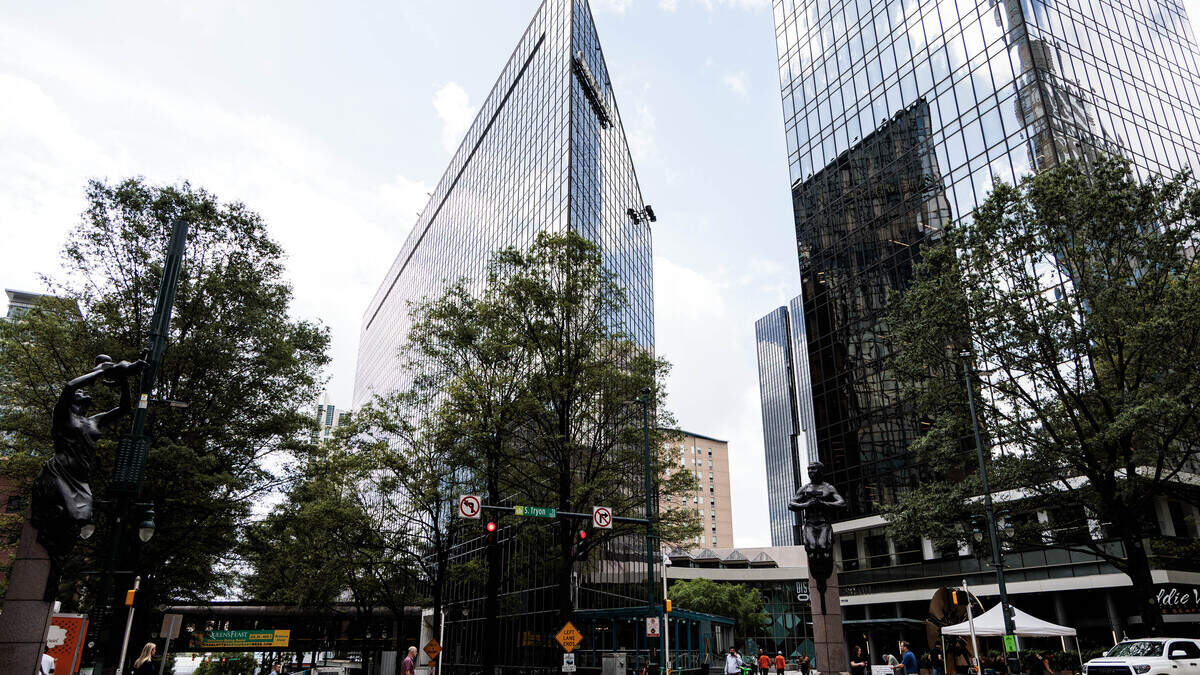
CMPD launched CROWN, which focused on minor infractions and quality of life crimes such as panhandling, illegal street vending and public disruption within a half-mile radius of Trade and Tryon streets.
Police also revived the Entertainment District Unit to address trends of violent crime near bars and nightlife spots. The specialized unit operates at peak nightlife hours around entertainment districts and venues where police said crime is most likely to happen.
Charlotte Center City Partners also launched the Own Your Block Initiative, which recruits building owners to raise standards for cleanliness and beauty on their block and invest in more free programming. It also asks participants to move their private security from behind the desk and get them outside to provide curb-to-curb visibility.
“Those components allow every block to then be more beautiful, more patrolled, more active. Safer,” Smith said. “We are a much safer place than we were 12, 18 months ago.”
CMPD’s Central Division, which covers uptown and part of South End, reported a 23% year-over-year decrease in total crime during the first six months of 2026. Violent crime is down by more than 30%.
There have been 30 fewer burglaries and aggravated assaults this year, CMPD data shows. There’s been one fewer homicide, from three to two. And vehicle thefts plummeted from nearly 200 to 110.
Smith praised CMPD for the rapid turnaround. Longo credits Estella Patterson, the new chief who took office in December, for being “willing to try stuff.”
CMPD declined to participate in this story.
Whether uptown is actually unsafe is a matter of perspective.
Al Austin was born in a hospital where the Bank of America Stadium now stands. The former city councilman has seen the city grow and change, and he spent time living in other major cities, too, before landing back in Third Ward.
He’d gladly trade the sound of cicadas for sirens any day of the week.
“Give me my train, give me my ambulance going down the street, the fireworks at Truist field, the activity,” Austin said. “If you come from an environment where you don’t have all that, that might be a little unsettling for you.”
As with any big city, being uptown requires awareness. People should be conscious of their surroundings, Austin said. He cringes when he sees people running late at night with their ear buds in.
“You gotta understand we’re not living in a cul-de-sac in Davidson,” said Hoffman, the president of neighborhood development nonprofit Friends of Fourth Ward. “We’re a large city. We’re a combobulation of a lot of different people and things, and so I think you have to be aware. Whether you’re a tourist, or a convention goer, or a CEO, or you’re a resident, you have to be aware.”
To an outsider dropping by for a convention or evening show, the nightlife might be intimidating.
“On Friday and Saturday nights, it’s like being on Bourbon Street in New Orleans,” Hoffman said. “So for some people, they’re like, ‘What are all these people doing walking around, and there’s noise coming out of the bars and stuff?’ Well, it’s where all the bars are.”
But it’s that livelihood and accessibility that attracted Hoffman and his husband all those years ago, and has kept them ever since.
Hoffman likes being able to walk out his front door and immediately be immersed in the vibrancy of city life. He can walk to the gym or to the grocery store, or run home for a cocktail during the intermission of plays.
He takes his Jack Russell terrier, Finn, for a walk five times a day and stops to chat with near anybody he sees, from the CEO of Truist to the unhoused woman who camps nearby. Strangers routinely become friends.
While taking the Observer on a brief walking tour of Fourth Ward in July, Hoffman was stopped four times by people he knew. One suggested he run for mayor. Another updated him on plans for her next disco party. A food vendor greeted him from inside his truck. And a fourth asked if the Observer was doing a documentary on Hoffman.
“Oh my god, I didn’t plant these people, I promise,” Hoffman said. “That’s why I love coming out my front door, ‘cause you never know who you’re gonna meet. For me, it’s rewarding.”
Read more Charlotte-area high school football schedule changing due to weather. What’s moved?
“It’s really a very wonderful life.”
This story was originally published August 18, 2026 at 5:00 AM.