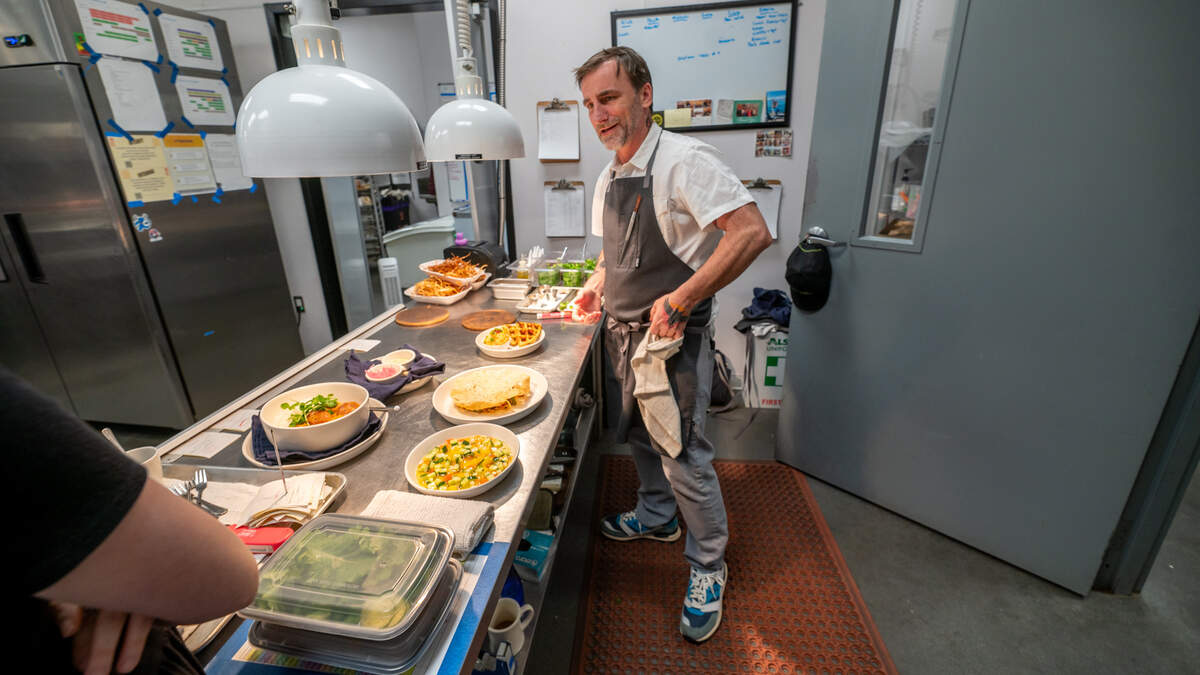
Why does it cost so much to eat out anymore? Charlotte chefs blame ‘economic whack-a-mole’
If you’ve looked at a restaurant menu in Charlotte lately and done a double take on the prices, you’re not alone.
Read more Popular restaurant and lounge temporarily closes in Charlotte. ‘A brief pause’
From burgers and sandwiches to cocktails and appetizers, menu prices have climbed steadily over the past few years — and the increases aren’t just in people’s heads.
Restaurant prices nationwide have continued to rise faster than overall inflation in recent years. According to S&P Global Market Intelligence, prices for food away from home — a category that includes restaurants — increased 39.3% between January 2019 and January 2026. During that same period, overall inflation rose at a much slower pace.
The result has been sticker shock for many customers and tough conversations for restaurant owners who say they are balancing higher costs with diners’ growing sensitivity to menu prices.
To better understand what’s driving menu prices higher, we spoke with Flen Purvis, the operations manager at Romeo’s Vegan Burgers, chef Sam Diminich, a Charlotte restaurateur who operates multiple concepts in the city and Andres Kaifer, executive chef and owner of Customshop and Emmy Lou’s.
While food costs often get the most attention, restaurant operators say the reality is more complicated.
Labor, rent, insurance, utilities, equipment, packaging and ingredient costs have all increased in recent years, creating pressure on already-thin profit margins. Industry data shows restaurant inflation remains elevated even as broader inflation has slowed. Food-away-from-home prices rose about 4% from January 2025 to January 2026, according to S&P Global.
According to the National Restaurant Association, menu prices in the South increased 3.7% over the past year, reflecting ongoing cost pressures facing operators across the region.
“It’s the overall volatility of the market as a whole,” Diminich told CharlotteFive. “One week it can be dairy, the next week it can be beef, the next week it can be something else. It’s just constant volatility across the restaurant industry.”
Diminich said those fluctuations make it difficult for operators to plan long-term pricing.
“It’s literally a game of economic whack-a-mole, and I never win,” he said.
He added that rising labor and overhead costs have compounded the issue.
“Labor will always cost more. Always,” Diminich said. “Rent is another big bucket, and then sometimes there’s a fourth bucket — repairs. Things are always breaking.”
While ingredient costs often draw the most attention, Diminich said the pressure extends across nearly every category.
“It was hard before, and it hasn’t gotten any easier. In fact, it’s gotten a lot harder,” he said.
At his restaurants, he said even individual ingredients can carry significant cost before they ever reach the plate.
Behind rising menu prices in Charlotte are continued increases in wholesale food costs, which vary widely depending on the ingredient and can shift significantly over time.
For example, wholesale beef prices remain elevated despite a slight month-to-month decline, falling 0.8% from March to April 2026 but remaining 14.2% higher than a year earlier, according to the U.S. Department of Agriculture. Looking ahead, wholesale beef prices are projected to increase another 8.0% in 2026.
That volatility extends well beyond beef. According to Food & Wine, coffee prices saw some of the biggest increases over the past year. In May, the median price of a hot coffee rose 6.9% to $3.74, while cold brew increased 3.7% to $5.60. Burger prices climbed 2.4% to $14.73, and beer rose 2.5% to $6.60.
According to the National Restaurant Association, many common restaurant ingredients saw sharp price swings from May 2025 to May 2026, with some categories rising dramatically while others declined:
Largest increases:
Largest decreases:
Local restaurateurs say those shifts are reflected in their day-to-day purchasing decisions. Kaifer said proteins have been among the most noticeable areas of inflation.
“You really see a lot of the increases in proteins, fish specifically, but beef also has increased,” he said. “Imported goods also have increased over time.”
He pointed to scallops as one example.
“We used to pay around $35-$38 per pound, and now we pay $40-$44 per pound,” he said.
Imported specialty products have also become more expensive. Kaifer said white chocolate that once cost roughly $100 per case now costs nearly $200 per case. Because many higher-end ingredients are sourced from Europe, he said increased fuel costs and tariffs have added further pressure.
Other seafood prices have also become a growing concern for some local operators.
“Right now, grouper filets are $35 a pound,” Diminich said. “We have a lobster roll right now with a $10 supplement charge, but that’s because lobster is $47 a pound.”
Read more Which Charlotte neighborhood has the most gay pride? We want to hear from you
“Before I put any salt, pepper or olive oil in the pan, that piece of fish is already costing me about $10 to $12,” he added.
Diminich said his restaurant has experienced many of the same cost pressures, with rising prices affecting both seafood and imported ingredients.
“Something like yuzu juice used to cost one price, and now it’s about three times what it was pre-tariffs,” he said.
Another example is Impossible Foods products, which Romeo’s uses in some of its burgers. Purvis said the cost of Impossible products has increased over time despite his efforts to work closely with suppliers and provide forecasts to help secure favorable pricing.
The restaurant has also felt pressure from rising costs associated with Beyond Meat products and ingredients used in its house-made black bean burgers. Because many of those ingredients are purchased through the same supply chains that stock grocery stores, increases at the supermarket can eventually show up in restaurant kitchens as well.
Some operators have looked for alternatives to frequent price hikes, including simplifying menus, negotiating with suppliers, reducing waste or adjusting portion sizes. Others say there is little room left to absorb additional costs without passing at least some of them on to customers.
For Kaifer, rising costs have also influenced menu development. “It becomes challenging sometimes to figure out what we should price something on a menu given that we try to stay within a certain range to be an approachable neighborhood restaurant,” he said. “We have had to go away from using certain products because the rising costs have made them a bit too pricey for us to put on our menu. For me, it’s more important to provide value than to use an expensive ingredient.”
Diminich said adapting to those rising costs has required creativity and flexibility in the kitchen.
“We just have to be really, really creative in how we design menus and compose dishes,” Diminich said. “We’ve built relationships with farms over time, and that helps us absorb some of the cost increases.”
“We change menus two or three times a month — sometimes it’s a full overhaul,” he added. “We just have to be more intentional and more strategic because the costs of goods keep rising.”
As prices have risen, many consumers have started changing their habits.
S&P Global reported that roughly four in 10 consumers reduced how often they visited restaurants in 2025, while more than 60% of restaurant operators said customer traffic declined compared with the previous year.
As restaurant prices rise, many customers are becoming more careful about when and where they spend their money.
“Over the last six months, and even more over the last two months, it has been harder to get customers to keep coming back to the store because of the economy, rising gas prices, rising grocery costs and childcare,” Purvis said.
Even so, restaurant owners say many customers don’t realize how expensive it has become to operate a food business.
“It’s extremely difficult for me to do these numbers and report them based upon the market,” Purvis said. “I have to pay close attention to that so that we stay above water.”
Diminich echoed that sentiment, saying customers often underestimate underlying costs.
“It’s almost something I hear in diners, of all places,” he said. “People ask how a diner can charge $12 for breakfast, but the eggs alone cost me $2 before I even add bacon or anything else.”
According to the U.S. Department of Agriculture, restaurant prices have consistently outpaced grocery-store inflation in recent years, with food-away-from-home prices increasing nearly 4% annually in 2025.
While Charlotte diners may hope prices will return to pre-pandemic levels, local restaurant operators say that’s unlikely. While the pace of increases may slow, many of the higher labor and operating costs that drove menu increases appear here to stay.
“I don’t see this changing anytime between now and 2027,” Purvis said. “We’re taking a hit, but we still want people to be able to continue to eat healthy.”
Diminich said the broader issue goes beyond individual restaurants.
“What kind of city do we want Charlotte to be?” he said. “Do we want to grow, or do we want to be greedy?”
He added that long-term stability will require collaboration across the industry.
“We’ve talked a lot about building a great food city, but what are we actually doing to support it?” Diminich said. “Do we support local suppliers who have skin in the game, or just buy the cheapest product available?”
Read more Krispy Kreme adds strawberry cake & lemon bar doughnuts. When can you get them?
This story was originally published June 25, 2026 at 5:30 AM.