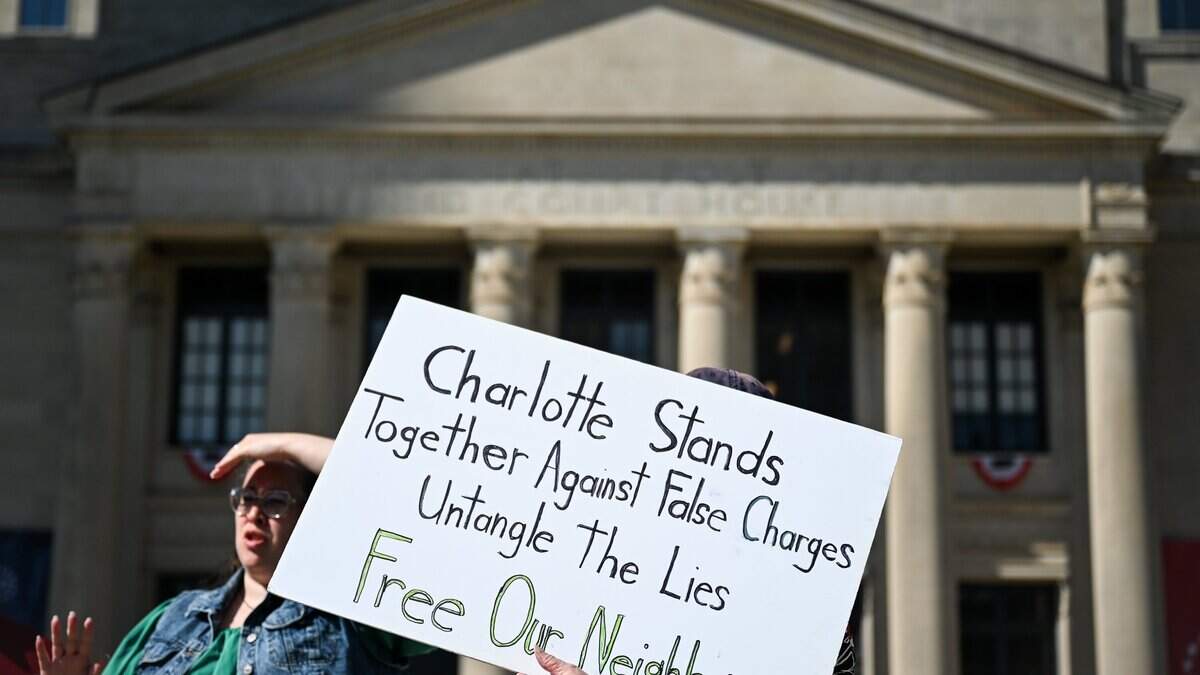
Jury splits verdict for Charlotte protesters charged in ICE confrontation
In an immigration protest case that hinged on bystander video and federal agents’ conduct and credibility, a federal jury sided mostly with the U.S. government Wednesday. In a split verdict, the jury found two protesters guilty of three petty offenses while finding one guilty of misdemeanor assaulting and impeding officers outside a south Charlotte Department of Homeland Security office last fall.
Read more South End sushi spot closes, will reopen as fusion steakhouse after $4M sale
Heather Morrow, a Charlotte-Mecklenburg Schools bus driver and unsuccessful county commissioner candidate, is guilty of misdemeanor assaulting or impeding officials when she touched an officer who was trying to arrest William Donovan Stanley outside a building housing DHS and Immigration and Customs Enforcement offices on 6130 Tyvola Centre Drive on Nov. 16.
Stanley, a local college student, faced the same misdemeanor assault charge but was found innocent by the nine-woman, three-man jury in the U.S. District Court for the Western District of North Carolina Wednesday afternoon.
The jury found both Morrow and Stanley guilty of petty misdemeanor charges of obstructing federal property, disrupting government officials’ duties and failing to comply with officials’ orders. Those charges are each punishable by a maximum of a month in prison or a $5,000 fine.
Morrow’s misdemeanor assault charge is punishable by a maximum of a year in prison or a $100,000 fine. Morrow and Stanley will be sentenced at a later date set by the court. Both have been on probation for 10 months, and Morrow has continued to work as a bus driver for Charlotte-Mecklenburg Schools as this case — the last one tied to “Operation Charlotte’s Web” — played out in the uptown federal court.
Other U.S. citizens charged with assaulting officials during that weeklong operation in November saw their charges dropped soon after they were charged. Morrow, too, saw her original felony assault case dropped when cellphone video contradicted ICE officers’ claims that she tried to jump on a federal agent’s back.
While they faced the same charges, the case against Morrow was built on allegations that she blocked the office entrance with her car and body and touched an officer trying to arrest Stanley. Federal prosecutors said Stanley did not follow orders to move out of the entrance and instead put his hands on the hood of an officer’s car, punched the car’s window and resisted arrest.
Assistant U.S. attorneys Caryn Finley and Kenneth Smith told jurors during closing arguments that ”this is a simple case.” Morrow and Stanley went to an area they knew was federal property, did not follow the rules, failed to comply when officers asked them to move and disrupted ICE officers from being able to carry out orders from the Trump administration.
“You can protest,” Finley told jurors in her closing argument. “You can’t keep a federal officer from doing their job.”
Finley at one point compared Morrow and Stanley to children who threw a temper tantrum when their parents said they couldn’t have cookies. In the analogy, ICE officers were the parents.
One of Morrow’s attorneys, Xavier de Janon rebutted in his closing argument: If they were children, then they were children playing on a public driveway when their parents showed up, cursed at them, threatened them with pepper spray, tackled them and then made false statements about what happened.
Read more Rebuilding I-40 after Helene will cost more, take longer than previously thought
Jim Cooney, one of Stanley’s attorneys, also argued that the signs identifying the area as federal property were not visible from where the protesters were and reminded jurors that the protesters did not go past the “no trespassing” signs they could see. Officers also gave inadequate warnings, Cooney argued, and did not specifically tell Morrow and Stanley that they were on federal property.
When Officer Jason Rajabi first arrived, he told protesters through his car’s speakers that they were “hindering my duties” and would be arrested if they did not move.
Defense attorneys argued that they did move, and video shows the same. Video also shows Stanley, after moving to the side, ran back in front of Rajabi’s car and put his hands on the hood.
Rajabi told FBI agents that Stanley punched his window, too, but video did not show that. Footage does show a detail Rajabi did not offer to FBI agents investigating the case:
When he got out of the car to arrest Stanley, Rajabi did not tell him he was under arrest, video shows. He said “come here motherf—er,” and then grabbed Stanley from behind and picked him up. While testifying, Rajabi said it was reasonable for Stanley to try to protect himself —perhaps by initially resisting — if someone he didn’t know came up from behind, cursed at him and grabbed him.
During opening arguments, attorneys Rob Heroy (representing Morrow) and Claire Rauscher (representing Stanley) repeated the officer’s explicit phrase to jurors. Eventually, U.S. District Judge Matthew Orso put a “motherf—er” moratorium over the trial. During closing arguments, attorneys on all sides simply said “m” and “f.”
Finley acknowledged that “we may not like” their word choice, but at the end of the day, officers were doing their jobs and trying to protect their property.
Judge Orso rejected arguments from defense attorneys that the lease between the federal government and the owners of the office building did not extend to the parking lot entrance. Attorneys unsuccessfully argued the government only had jurisdiction power over a specific square-footage and some parking lots.
Jurors also were not privy to the fact the ICE officers failed to follow FBI orders to preserve building surveillance video that may have more fully captured parts of the protest — a detail that came out during a lengthy interview of the special agent in charge of the case before trial.
Orso, recently appointed by President Donald Trump, also shot down Morrow’s attorneys’ argument that the case should be dismissed because Morrow, specifically, was protected by the First Amendment. It was not her words that were on trial, Orso said; it was her actions.
Read more James Comey briefs are in. NC judge now weighs fate of ‘86 47’ case
This story was originally published September 2, 2026 at 5:05 PM.
