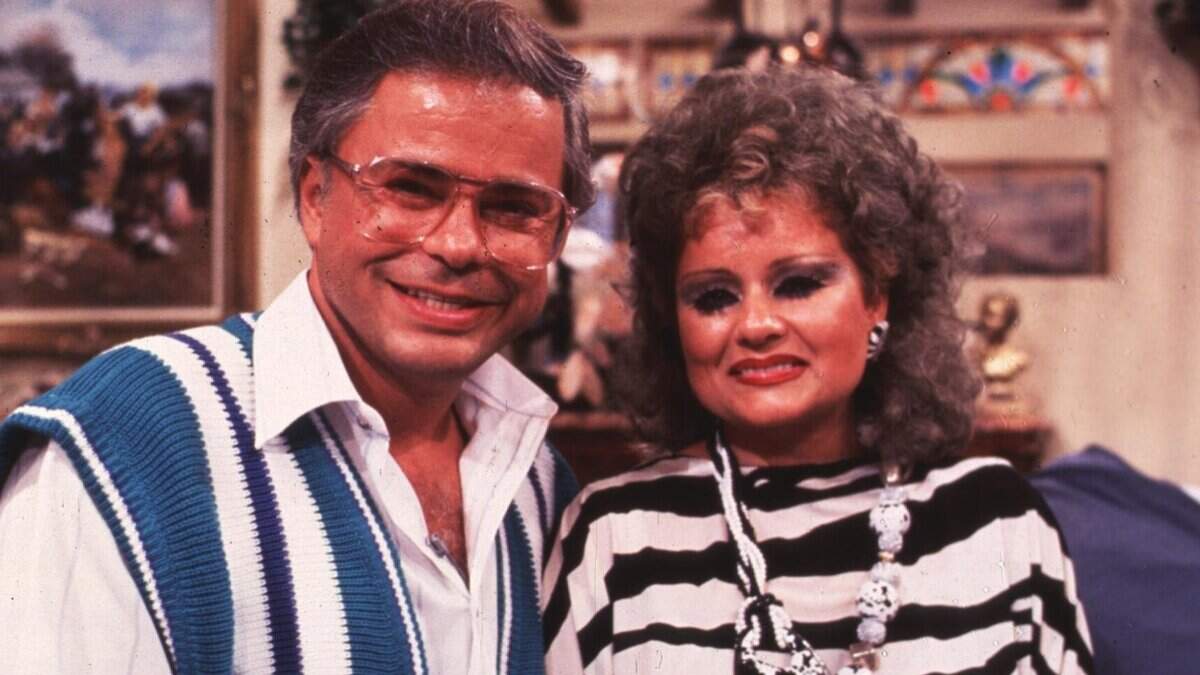
Jim Bakker, ‘Praise the Lord’ evangelist brought down by scandal, dies at 86
Jim Bakker, the pioneering TV evangelist who became a symbol of the glitz and greed of the 1980s when his PTL empire near Charlotte collapsed amid sex and money scandals, landing him in prison for fraud, died Monday, according to his wife, Lori, on his Instagram page. She did not say how he died or where.
Read more Vote for The Observer’s high school football offensive player of the week
He was 86.
With first wife Tammy Faye, Bakker went from hosting a puppet show on a small TV station in Virginia to launching The PTL Club, a Christian version of the Tonight Show that was eventually re-branded “The Jim and Tammy Show.” Starting in 1974, the daily TV program featuring contemporary Gospel music, chats with “born-again” Christian celebrities and the Bakkers’ tearful pleas for donations, was beamed around the world on the PTL Satellite Network.
Soon to be flush with fundraising dollars from this first-ever Christian satellite network, the couple broke ground in 1978 in Fort Mill, S.C., on Heritage USA — yet another innovation that Bakker cast as a Christian Disneyland. At its peak in 1986, reported the Charlotte Observer, the 2,300-acre campus was the third most popular theme park in America, drawing nearly 6 million visitors. Their flock came to splash in the water park, pray in a stone-faced Upper Room meant to suggest the site of Jesus’ Last Supper and cheer on televangelism’s most famous couple as they taped their TV talk show, which always ended with Bakker telling viewers, “God loves you. He really does.”
PTL was short for “Praise the Lord,” though critics of the Bakkers’ opulent lifestyle — they bought vacation homes, high-priced cars, even an air-conditioning unit for their doghouse — suggested it should stand for “Pass the Loot.”
“Their religion fit the culture of the Go-Big ‘80s,” said John Wigger, author of “PTL: The Rise and Fall of Jim and Tammy Faye Bakker’s Evangelical Empire” and a professor of history at the University of Missouri. “They lived large. They spent large. They projected a Reaganesque confidence.”
The Bakkers’ fall was as dramatic as their rise, though it played out much more quickly and with much bigger headlines: In March 1987, Bakker resigned from PTL just ahead of revelations that he had had a 15-minute tryst in 1980 with a 21-year-old church secretary named Jessica Hahn and that PTL had paid her more than $250,000 in hush money.
In a phone call to a roomful of editors and reporters at the Charlotte Observer, which had published stories for years raising questions about PTL operations and finances, Bakker cast himself as a victim: “I sorrowfully acknowledge that seven years ago, in an isolated incident, I was wickedly manipulated by treacherous former friends and then colleagues who victimized me with the aid of a female confederate.”
It was a tale made for the tabloids in a celebrity-obsessed decade in which “Lifestyles of the Rich and Famous” debuted on TV and “Greed is … good” became one of the era’s most quoted movie lines.
The Bakkers’ crash led the network newscasts and the couple became the butt of jokes on late-night TV.
“Jim and Tammy Faye Bakker and the continuing saga of the PTL Club have taken on the irresistible dimensions of a national soap opera,” Ted Koppel, the anchor on ABC News’ “Nightline” told viewers in May 1987, just before conducting the first interview of the Bakkers since their exit from PTL. “It is, in its own way, as awful, as fascinating and as impossible to ignore as a gigantic traffic accident.”
Jessica Hahn, whose life was turned upside down as she, too, was drawn into the media glare of that national soap opera, said the financial and sexual scandals that toppled Bakker’s PTL empire tainted televangelism.
“People were so anxious to damage evangelists,” she told the Observer in 2020. “I think they were dying for (Baker and other evangelists) to fail.”
PTL’s demise, she added, gave such critics “a solid reason to say, ‘I told you. They’re all bad.’’’
But Bakker did not hit bottom until two years later, when he was sentenced to a federal prison in 1989. He ultimately spent nearly five years behind bars for bilking PTL followers.
After his release, Bakker wrote a book titled “I Was Wrong,” in which he appeared to repudiate the so-called Prosperity Gospel that he preached and lived during his time heading PTL.
In prison, he wrote, he’d become “physically nauseated” when his deeper study of Jesus’ tough words about wealth in the Bible convinced him that he was “contradicting Christ.”
But Bakker eventually returned to his roots, spending his final years co-hosting another Christian TV show near Branson, Mo. Along with second wife Lori — Tammy Faye divorced Bakker in 1992 and died in 2007 — Bakker hawked freeze-dried food and survivalist gear for the coming Apocalypse on “The Jim Bakker Show.” The state of Missouri sued him in March 2020 for pitching unproven products as a potential cure for Covid-19, the disease caused by the coronavirus.
Hahn, who said her anger with Bakker gave way to forgiveness many years later, said she came to believe that Bakker genuinely changed in prison and eventually returned to his true calling as a teacher and a preacher.
In prison, she said, Bakker “studied (the Bible) a lot and came out differently.”
Hahn said her view of “The Jim Bakker Show” changed, too. At first, after sampling the Missouri-based show, she told the Observer in 2017 that Bakker was still more focused on “sell-sell-sell” than on preaching.
But Hahn, who rediscovered her own evangelical Christian roots decades after PTL, said her opinion changed later after a deeper viewing of the show and of Bakker’s preaching about the End Times. “He actually ended up where he began, preaching the Bible,” she said.
Scholars say Bakker also had his eye on money and audience. In returning to TV, they say, the savvy Bakker was changing with the times to tap into new opportunities.
“The Prosperity Gospel, with all its glitz and money, fit the culture of the 1980s and Jim found that was a very successful component of his message,” said John Wigger, whose book on PTL also devoted some space to Bakker’s later TV show, told the Observer in 2017. “In the post-9/11 era, he’s found that the Apocalypse and survivalism make for a very compelling message that will gain him an audience.”
Charles Shepard, who anchored the Charlotte Observer’s Pulitzer Prize-winning coverage of PTL in the 1980s, said history will recall Bakker for his rise and his fall at PTL.
“He’ll be remembered as a high point in the arc of the televangelism industry,” Shepard told the Observer, “and as a catalyst in the decline that followed.”
James Orsen Bakker was born Jan. 2, 1940 in Muskegon, Mich. He was the youngest of four children in a blue collar family that counted itself Pentecostal — a Christian movement that emphasizes direct personal experience with God through baptism with the Holy Spirit.
Bakker was a middling student, but did exhibit an early interest in showbiz and a talent for salesmanship. According to “Forgiven: The Rise and Fall of Jim Bakker and the PTL Ministry,” a book by former Observer reporter Shepard, Bakker produced a variety show every year for three years to raise money for his high school.
And young Bakker, who watched “I Love Lucy” at a friend’s house, approved when his father finally bought their family a TV set — a controversial purchase in a Pentecostal household in the 1950s, Shepard wrote.
Bakker’s grandfather referred to TV as “hellevision,” according to Shepard’s book, and Bakker’s mother nearly cried at the idea of her husband buying one. “I never thought you’d weaken,” she told him.
Bakker, meanwhile, surprised friends and family when he decided to attend North Central Bible College, a school in Minneapolis affiliated with Assemblies of God, a Pentecostal denomination. But he soon found a way to combine religion with the broader culture, telling a former girlfriend during a trip back to Michigan that he was interested in TV ministry — with a modern twist. “I want to do something different,” he told her, according to Shepard’s account. “I want a female partner. Nobody’s done that.”
Enter Tammy Faye LaValley, a fellow student at the school. The oldest of eight children, she grew up in small-town Minnesota in a house that had no indoor plumbing.
On their third date, Bakker asked her to marry him.
“Yes, Jim! Yes!” was Tammy Faye’s answer, according to her account in “I Gotta Be Me,” her 1978 memoir. “I said I had no doubts. … I felt in the spirit that it was of the Lord.”
By the mid-1960s, the Bakkers were hosting a puppet show for kids and raising money on telethons for Pat Robertson’s Virginia-based Christian Broadcasting Network (CBN).
Years later, in a cover story on Bakker, People magazine offered this telling snapshot of him on CBN in 1966: “Tears streaming down his face, (Bakker) looked into the camera and announced, ‘We need $10,000 a month or we’ll be off the air. … Christian television will be no more.’ The dollars came flooding in.”
By 1976, the Bakkers had moved their ministry to the Carolinas, first to Charlotte, then to Fort Mill.
Read more Vote for The Observer’s high school football defensive player of the week
The televised PTL Club had pleasing personalities, wholesome content and songs from Tammy Faye, who often performed while shedding happy, mascara-tinged tears about Jesus. The show offered a welcome mix for Christians turned off by other TV offerings in the 1970s that reflected a culture changing too fast for them, said James Goff, a professor of American Church History at Appalachian State University.
There was also the draw of celebrity guests who talked about their faith, including Billy Graham, Colonel Sanders, Mr. T, Little Richard, and Mickey Rooney.
The Bakkers, with their outward trappings of success, also appealed to some Pentecostals and evangelicals who had aspirations to be upwardly mobile themselves, said Wigger.
“So, when some people looked at Jim and Tammy, they saw what they wanted to become,” Wigger told the Observer. “‘Preaching the Gospel, but driving a Rolls Royce? Cool. How do I get one of them?’”
Others, though, were put off by the Bakkers’ seeming celebration of wealth — and by their suggestion that God also wanted people to make lots of money.
“What Bakker represented was an American twist on ‘Get rich quick.’ It’s that the desire to get rich quick is sanctified because that’s what God wants,” said Grant Wacker, a former professor of Christian history at Duke Divinity School. “(The Bakkers) tarnished the reputation of evangelicals in general and televangelists in particular.”
And especially after news of his sexual encounter with Hahn came out, many in the secular audience dismissed Bakker as “a cartoon character,” wrote Shepard in his book, “(and) the latest hypocrite to sully the revival tent with greed and adultery.”
Still, Heritage USA was a hit with many Christians looking for a sense of community with like-minded believers and for some family-friendly fun. They could enjoy the $12 million water park with its state-of-the-art wave pool. Or take in the nightly Passion Play, complete with real camels.
Inside the Heritage Grand Hotel, the Observer reported at the time, was a pretend Main Street, with a two-block-long domed ceiling that suggested permanent blue skies. In the shops along Main, people could buy palm-size Jesus dolls, 24-carat gold crosses and “Heavenly Fudge.”
From their tinted-window penthouse above, the Observer reported, Jim and Tammy would sometimes wave at the shoppers, occasionally accompanied by celebrities such as cowgirl Dale Evans and actor Efrem Zimbalist Jr., who starred on TV’s “The FBI” in the 1960s.
Some Christians even moved into one of the surrounding subdivisions, with their $380-per-month apartments, $60,000 duplexes and $100,000 homes, reported the Associated Press in the mid-1980s.
Resident Archie Fowler told AP in 1985 that his Heritage USA house was “heaven on earth. … The Lord led me here.”
But behind the scenes, PTL was also a piggy bank for the Bakkers. They’d ask for more money from their “partners” even as they were spending lavishly on themselves. An example: Between 1983 and the fall of 1986, the Observer reported in 1987, the couple acquired more than $900,000 in cars (including Rolls Royces and Mercedes) and real estate.
In 1979, the Federal Communications Commission had launched an investigation of PTL after the Observer reported that $280,000 raised to set up a ministry in Korea was used to pay other bills. PTL fought back, according to a report by ABC News, even producing a documentary called “Under Investigation” that suggested the probe was an affront to God.
In 1982, during the Reagan administration, the FCC voted to drop the investigation. The Republican president had courted the Religious Right, even saluting PTL during a convention of televangelists. “The PTL TV network is carrying out a master plan for people that love,” Reagan said, invoking a second meaning of PTL used by the Bakkers.
Then there was Bakker’s “construction addiction,” in the words of journalist Lauren Ober, who kicked off her “Spectacular Failures” podcast in 2019 with an episode on PTL.
In January 1987, according to Wigger’s book, Bakker was about to break ground in Fort Mill on his biggest project ever — a 1.25-million-square-foot ministry center that was to be a replica of London’s 19th century Crystal Palace. With a price tag of $100 million, it would have been the biggest church in the world, Wigger wrote.
Construction had already begun by then on two other mega-projects on the same campus: A sand castle with a 10-story turret that would house the world’s largest Wendy’s restaurant, and a high-rise 500-room hotel to be called the Heritage Grand Towers.
Two months later, in March 1987, Bakker resigned. He asked fellow televangelist Jerry Falwell to take over PTL with an eye to eventually returning after weathering the storms.
But Falwell, after getting a look at PTL’s books and hearing complaints about the Bakkers, turned on the couple. During a nationally televised news conference, he accused Bakker of “fiscal irregularities,” of plunging PTL deeply into debt even as he enriched himself, and of making “homosexual advances” to unnamed men.
“Jim,” Falwell said, speaking to the cameras, “I would be doing a disservice to God and to the church at large to allow you to come back now or ever.”
In a “Nightline” interview, Bakker said he and Tammy Faye made “a lot of mistakes,” but denied Falwell’s charges and said they felt “betrayed and deceived.”
Falwell tried to save PTL, even plugging Heritage USA by going down the water slide in his suit and tie. But he and the board he empaneled quit in October 1987. A ruling from a bankruptcy judge, Falwell said, made rebuilding PTL impossible.
Things got worse for Bakker.
He was dismissed as an Assemblies of God minister.
And in 1989, he was convicted on 24 counts of fraud and conspiracy. The prosecution said Bakker had diverted millions of dollars to pay for his and Tammy Faye’s grandiose lifestyle. The government also said he bilked nearly 160,000 PTL “lifetime partners,” each of whom paid $1,000 for a free room in the PTL hotels for three nights a year for life — a promise Bakker didn’t have enough rooms to keep.
The trial in Charlotte was postponed for a week after Bakker had a panic attack upon being taken into custody. “Please don’t do this to me,“ he sobbed in his lawyer’s office as federal marshals placed chains around his waist and feet. A psychiatrist at a federal prison in Butner, N.C., judged Bakker mentally competent to stand trial, People magazine reported at the time, but said the news crews covering his trial looked to Bakker like “giant ants with antennas waving.”
The presiding judge, Robert “Maximum Bob” Potter, sentenced Bakker to 45 years and opined, according to a Washington Post report, that the defendant “had no thought whatever for his victims and those of us who do have a religion and are ridiculed as being saps (for) money-grubbing preachers or priests.”
Even People magazine piled on in 1980s fashion, putting a photo of the panic-stricken and “chipmunk-cheeked” Bakker on its cover with the snarky headline: “Jim Bakker’s bizarre trial. Oh, Lordy, Lordy!”
Citing Judge Potter’s remarks, which were “too intemperate to ignore,” a federal appeals court in 1991 upheld Bakker’s conviction but reduced the harsh sentence. In July 1994, Bakker became a free man.
Those who have chronicled Bakker’s story have often cast it as a cautionary tale.
“When religious leaders let the opportunity for ‘success’ seduce and define them, they’re in trouble,” said James Goff, the American Church History professor at Appalachian State University.
Charles Shepard, the award-winning journalist who wrote a book on Bakker, said there’s also a lesson for would-be followers: Beware the Prosperity Gospel.
Such a theology, he said, “risks providing divine ‘cover’ for the excesses of leaders who are seeking to build wealth for themselves.”
John Wigger, the history professor at the University of Missouri who also wrote a book on PTL, said he believes Bakker’s transformation in prison was real if short-lived.
“Once he got distance from prison, he went back to his roots. And his roots were televangelism,” Wigger told the Observer. “He was still trying to do the things he did in the ‘80s.”
Read more Vote for The Charlotte Observer’s high school athlete of the week
This story was originally published October 5, 2026 at 11:49 PM.