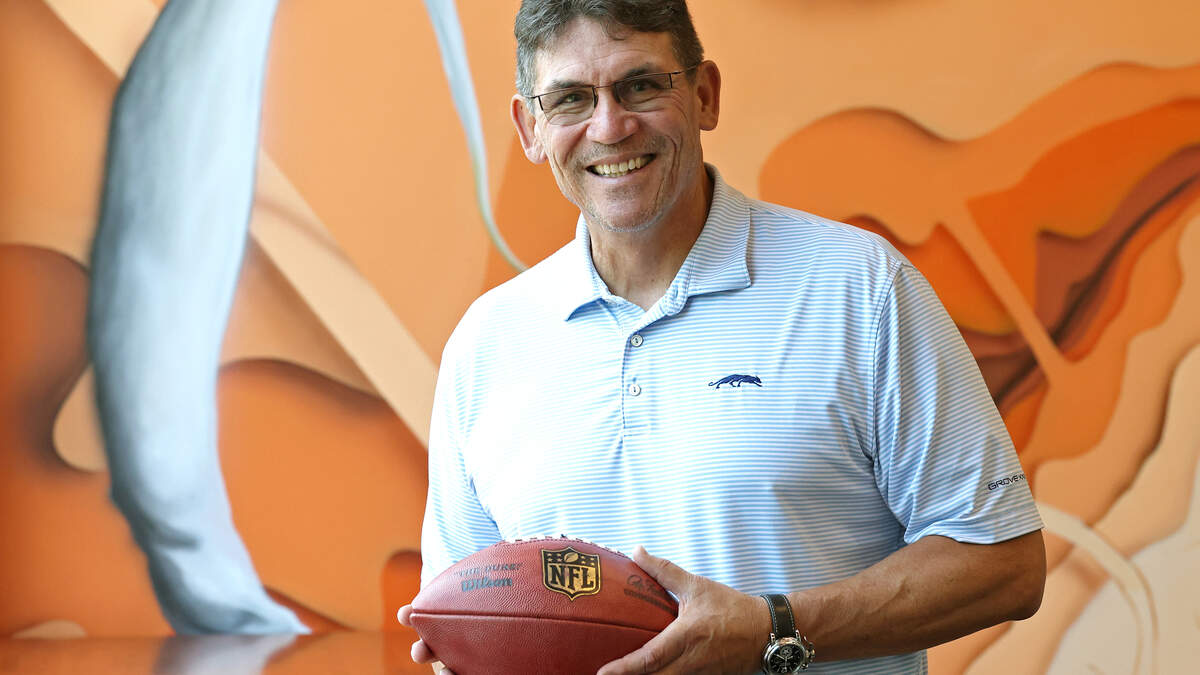
Former Carolina Panthers coach Ron Rivera opens up on Luke, Cam, Madden and Tepper
AI-generated summary reviewed by our newsroom.
As the 2026 NFL season approaches, I sought out the winningest coach in Carolina Panthers history: Ron Rivera.
Read more NC’s Laurie Buckhout suspended from Kalshi after betting on her own campaign
Rivera won a Super Bowl ring as a player with the Chicago Bears, and was hired as the Carolina Panthers’ coach in 2011, after John Fox was fired.
Rivera became the NFL’s Coach of the Year — twice! — while picking up the nickname “Riverboat Ron” and directing the Panthers to the playoffs four times in a five-year stretch, from 2013-17.
That remains the most successful period the Panthers have ever had. It also included a Super Bowl appearance — and loss — during Carolina’s 17-win season of 2015. With four games left in the 2019 season, Rivera was fired by Panthers owner David Tepper. He later coached Washington’s NFL franchise and beat cancer.
Now 64, Rivera lives in California with his wife Stephanie.
In our interview, Rivera told stories about Cam Newton, Luke Kuechly, Walter Payton, and the happiest and most disappointing moments of his career.
Our full conversation can be found on the “Sports Legends of the Carolinas” podcast as well as on The Observer’s YouTube channel. Here are some excerpts, edited for clarity and brevity.
Scott Fowler: Before we get into the past, can you update people on what you’re doing now?
Ron Rivera: I’m back in the Bay Area. I’m at my alma mater, the University of California in Berkeley, helping Cal football as their general manager (Rivera was once an All-American linebacker at Cal). My duties are anything from working with the coaching staff, working with the players, scouting some players. Probably the primary thing that I’m doing is really just working with our alumni and donors and trying to help to fundraise.
SF: What’s college football like now compared to when you played?
RR: A completely different scenario… Right now there are not a lot of rules that keep everything in place.
Until we get some guardrails up, you’re going to see the chaos that you see right now. That’s college football. But I do really enjoy getting up in front of the student-athletes, talking about what it takes and what you need to do. I have some validity with them and that helps me.
SF: Luke Kuechly was just inducted into the Pro Football Hall of Fame. What makes him so special?
RR: I think, first of all, who he is as a human being. If you know his mother and father, you know exactly who Luke is. He’s a very thoughtful person. He thinks about other people before he thinks about himself.
(He’s) an elite athlete. And in one word, discipline. And I’m not talking about rigidity. I’m talking about discipline: Doing what he’s supposed to do, what he has to do, what he needs to do, and what he wants to do to be successful.
SF: If you were to pick out a play or two from Kuechly’s career that still stick out in your mind, what would you choose?
RR: The interceptions he made when we played Dallas in Dallas (on Thanksgiving Day in 2015). It was one of those things that you could see he was going to make the play once the ball was snapped.
He recognized the formation and the pattern that was going to be run, and he ran underneath the intended receiver and intercepted the pass. He understood the game so well.
SF: What was life like growing up for you?
RR: I grew up in a military family. My father was an Army engineer. He was an officer. I had three brothers and was born in Fort Ord, Calif. Monterey Bay is my hometown area. I was born on the Army base…. The best teammates I ever had were my three brothers. Because when you move from Army base to Army base, the people you’re always closest with are your brothers. Your first playmates are your brothers.
SF: Were you highly recruited out of high school?
RR: Yes. I had 28 scholarship offers. On the same day, I turned down Ohio State, Michigan, and Notre Dame, and then the next day I had to call UCLA, USC, Stanford and Washington. I told them I was going to Cal. I chose Cal for two reasons: It was close to home, and the academic side of it.
SF: In the pros, you played on the 1985 Chicago Bears team that went 18-1 and won the Super Bowl. Do you believe that’s the greatest team ever assembled?
RR: I really do.
For our time, we were the greatest. The hardest thing is that one blemish everybody talks about — the Miami game (the 1985 Miami Dolphins upset Chicago in the regular season to deny the Bears a perfect season — the 1972 Dolphins remain the only team to have accomplished that feat in the modern era).
It was on a Monday night against a formidable team and one of the greatest quarterbacks of all time (Dan Marino). But if you play that game on a neutral site or in Chicago, we win.
SF: The happiest moment of your football career was…
RR: The night we won the NFC championship. That was phenomenal, being able to share it with so many people.
Stephanie (Rivera’s wife) and I had a love affair with this city. And when I look back at how the community supported us, it was one of the most phenomenal moments in my coaching career.
SF: The biggest disappointment in your football career was…
RR: Oh, the Super Bowl loss, without a doubt. Because I still believe we were the better team (in Carolina’s 24-10 loss to Denver in Super Bowl 50). I really do.
You’ve got to give them (Denver) credit for what they had done defensively. They knew we didn’t have a true No. 1 receiver… So they played almost exclusively man (defense) with a spy on Cam the whole night. That was probably the one difference.
That loss still bothers me. Stephanie and I loved it here and the way the fans really, truly got behind us.
And to this day I still feel like we let them down. So it’s probably the most disappointing moment in my coaching career, in my playing career — in my total NFL career.
Read more Tropical Storm Edouard has formed in the Gulf of Mexico. Could it impact NC?
SF: Describe Cam Newton’s personality — that childlike demeanor he had that made the game so much fun.
RR: Mike Shula (the Panthers’ former offensive coordinator) deserves the credit for this: (When Newton scored), Mike said, ‘Why don’t you give it to a kid?’
And then Cam started doing it, and the rest of the players wanted to score, too, so they could give the ball to kids. One of the greatest articles I ever read is one you guys did on all the kids that got a ball from Cam. That was a tremendous article, and I still remember that to this day. In fact, I have a copy of it at home.
(To read more of Rivera’s thoughts on Newton, click here).
SF: You are filling a big dinner table with fascinating players or coaches, living or dead, from your NFL career. Who’s coming to dinner?
RR: I will tell you this right now: (former Panthers linemen) Ryan Kalil and Jordan Gross would come together. They would have to be there. The next one would have to be Walter Payton. Walter was a tremendous character. Bigger than life. Helped get me into coaching.
I’d also bring my travel roommate for my entire career (with the Bears): Jim Morrissey. And (former Bears teammate) Steve McMichael. He was a great storyteller. The thing about both he and Walter, they both passed away early, which is very, very sad.
And I’d also like (former linebackers) Luke Kuechly, Thomas Davis and Mike Singletary as well. Brian Urlacher, who is a guy I coached. (Former Bears and Panthers safety) Chris Harris is a good guy to have around as well.
SF: You were a conservative coach in your first two seasons here. Then you started gambling more and picked up the “Riverboat Ron” nickname after finding John Madden as a mentor. How did that help?
RR: I went out to California and we had a conversation. Madden said, “Hey, I understand you’re (2-14 at the time) in games decided by one score or less. Why don’t you go back and watch those games and see what you could have done better?”
So I watch those games. In my mind, I’m supposed to write a report. So I wrote a 22-page report on it… The bottom line was there were certain situations when I could have gone for it.
I fly out to see Coach Madden again, and I was talking about this game where I kicked a field goal, then they went down and scored a touchdown to beat us. I said, “Well, I went by the book.”
And he goes, “What book?” And then he says, “Ron, do you ever think about going for it?”
That’s when it hit me. I was doing what was safe. What you’d get the least criticized for, supposedly. It made me realize I was just putting it back on the players instead of giving them every opportunity to win. So that’s when, in 2013, it all started to change.
SF: You got fired by owner David Tepper four games before the 2019 season was over. Do you have any regrets as to how it ended at Carolina?
RR: The hard part is I went through it twice (being fired; the second time was with Washington). When you have new ownership, they want to do things their way, which is fine. I respect that. And I respect the way Mr. Tepper handled my release. He and I had a great conversation about it, and I’ll always respect him for that.
The other thing I was hoping for: He (Tepper) gave me the opportunity to speak to the players before I walked out.
That was one of the hardest things I’ve ever had to do, to say goodbye to my team. But it was special, to be able to get in front of them and say “Thank you” for that time. I walked out with my head up, and I walked out without burning bridges.
SF: When you’re off the clock and completely unplugged, what do you like to do?
RR: Golf with Stephanie. And we have two dogs, Tahoe and Sierra. We walk them in Monterey and in Pebble Beach, where there’s a reserve and it’s off-leash. So either going out there with the dogs or golfing is my favorite.
SF: You’re 64 now. If you could talk to Ron Rivera as a teenager, what advice would you give that version of yourself?
RR: Be a better student. I was a good student, but I should have been a better student… With the technology we have today, you have to learn to use it and make it work. Don’t ever waste a great opportunity to learn.
I also want to say this: Everyone, in my opinion, has impostor syndrome at some point. You wonder if you belong. It happened to me as a head coach. One year we were taking a photo of all the NFL coaches at some event, and I was kind of standing to the side.
Andy Reid sees me and says, “Ron, come on over here!” It made me realize: “Wow. I do belong.”
This was after the 2013 season. Because early on (in his first two years as Panthers coach), the decisions I made were all safe.
It took until 2013 before I realized it’s not about being safe. It’s about trying to get yourself in position to succeed.
This is the 50th interview in The Charlotte Observer’s “Sports Legends of the Carolinas” series. All 50 episodes are available wherever you get your podcasts. The most recent interviews are posted on The Charlotte Observer’s YouTube Channel. The next episode is scheduled to be published on Sept. 22nd.
Read more Shooting of 16-year-old is small town’s first murder in a decade, NC police say
This story was originally published September 1, 2026 at 5:00 AM.
