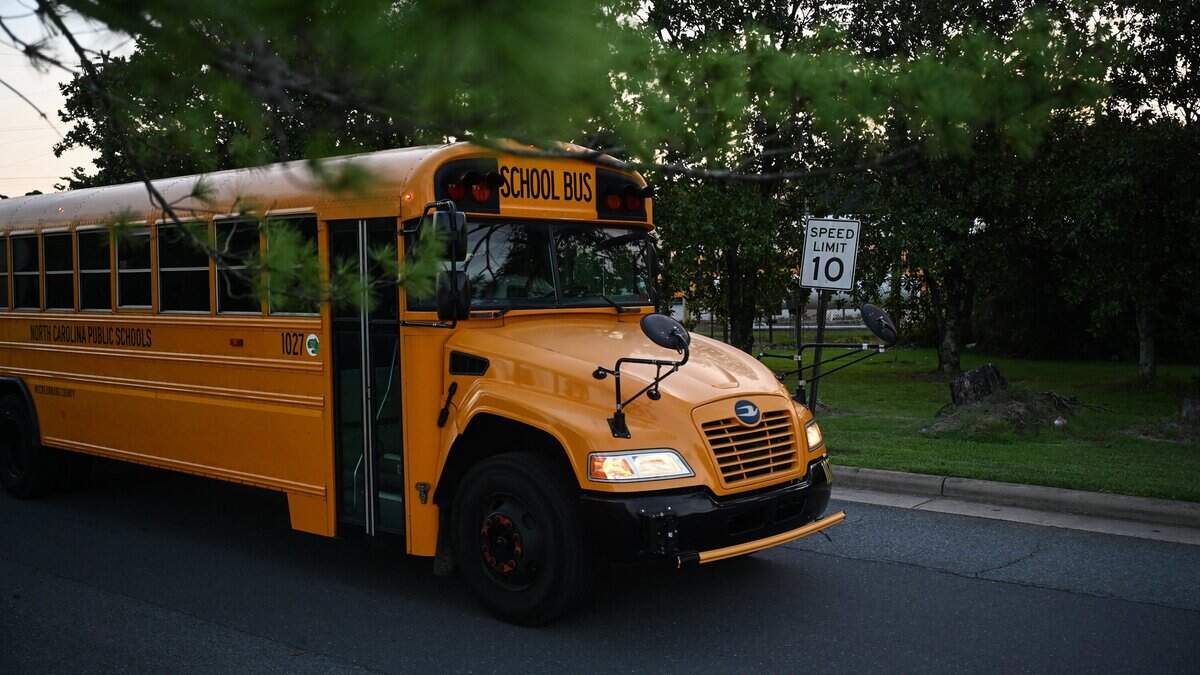
For thousands of Charlotte teens, school starts at 7:15. But does it have to?
When five Myers Park High School students decided to spend the 2025-26 school year studying teen sleep deprivation, they started out thinking small.
Read more Charlotte’s rule tweak could mean a ticket if your car sticks out of driveway
They had plenty of ideas about what contributed to the problem, and imagined tackling something they could change themselves. Maybe they could put together sleep kits for students, with blue-light-blocking glasses, nose strips and other inexpensive tools that might help teenagers get better rest.
But as the five students dug deeper, they concluded that the sleep kits wouldn’t make a big enough impact. Simply encouraging students to put away their phones or teaching them better sleep habits wouldn’t move the needle either.
Because none of those ideas changed what time thousands of Charlotte-Mecklenburg Schools teenagers were expected to be sitting in class every morning:
7:15.
That’s unusually early even by high-school standards. And for students who ride buses long distances to school, the morning can begin considerably earlier than that.
The most recent federal data on public high schools found that only about 10% started before 7:30 a.m.; the national average was 8 a.m. And leading medical organizations have for years recommended that middle and high schools start no earlier than 8:30.
So what had begun as a high school problem-solving project became something considerably more ambitious. Over the course of the year, Wortham Cone, Bubby Hall, Charlotte Marston, Violet Salameh and Ella Shaller would take their case all the way from Myers Park classrooms to the Charlotte-Mecklenburg school board and, eventually, Superintendent Crystal Hill. They wanted CMS to seriously explore starting high school later.
But the question mattered to the students for reasons that went beyond school schedules.
Myers Park students have endured a series of suicides in recent years, including the death last fall of Parker South, a friend of members of the Community Problem Solvers team. Hall says the five of them, all seniors as of this week, have been careful about what they believe that means. They aren’t arguing that sleep deprivation caused Parker’s death or any of the other deaths that have shaken Myers Park. Suicide is far too complicated for that, they say, and their own proposal explicitly acknowledges as much.
Instead, the tragedies gave greater urgency to a question the students were already asking.
At a time when concern about teenagers’ mental health seems nearly universal, is there anything schools themselves can change that might make their lives a little healthier?
Sleep, they quite simply decided, was one place worth looking.
Rosie Smolowitz, who graduated from Myers Park in 2025 and now studies global health and psychology at Duke University, remembers sleep as something that barely registered in conversations about student wellness. She says students were constantly trying to fit academics, extracurricular activities, friendships and everything else expected of ambitious teenagers into the same 24 hours.
Sleep was what gave.
“When you couple that pressure … with the fact that school starts so early, there’s really just no time for sleep,” Smolowitz says. “It feels like the day is the day, and the night is just, like, a nap. It’s not really a full night of sleep. You don’t ever wake up feeling restful. You wake up feeling like, Here we go again.”
And at Myers Park, she says, getting by on too little sleep could even become a kind of “badge of honor.”
Only after arriving at Duke and hearing about her classmates’ high school experiences did she realize something else: Starting school at 7:15 wasn’t normal everywhere.
Smolowitz’s experience tracks with what researchers know about adolescent sleep.
Adolescents generally need eight to 10 hours of sleep each night. But puberty also shifts teenagers’ internal clocks later, making it biologically more difficult for them to fall asleep early — even as many high schools require them to wake before dawn.
A major study published in the journal Pediatrics in June underscored just how widespread the problem has become. Researchers examining more than 400,000 American adolescents over three decades found that teen sleep has continued to decline. Among adolescents surveyed from 2021 through 2023, only about 37% of 12- and 13-year-olds and 22% of 18- and 19-year-olds reported regularly getting even seven hours of sleep.
The researchers did not attribute the decline to school schedules alone. Smartphones, social media, academic demands, family responsibilities and broader societal changes can all play a role. But they specifically identified early secondary-school start times as one potentially modifiable factor — and changing them as a population-wide intervention worth considering.
Dr. Marla Shapiro, a Charlotte psychologist and board-certified behavioral sleep medicine specialist, sees an important distinction there.
Later school starts aren’t a cure for adolescent mental-health problems. They won’t guarantee that teenagers get enough sleep, and no responsible expert would suggest that changing a bell schedule could prevent every tragedy. But unlike so many forces affecting teenagers’ mental health, Shapiro says, this one involves a decision adults actually control. “This is one of the few things we can actually do,” she says.
After surveying students and teachers across CMS, the Myers Park group sought out sleep specialists and eventually connected with Phyllis Payne, implementation director for Start School Later, a national nonprofit advocating for healthier school hours.
“The team in Charlotte is exceptional,” Payne says, “because they came already having done a lot of reading and research.”
Unlike many students who contact her with basic questions about the issue, Payne says, the Myers Park group had moved on to something harder.
Their questions were becoming more complicated. They dug into transportation, athletics and other objections to later starts. They created a video aimed at other teenagers. They spoke publicly before the school board, met with board members and district officials and eventually presented their proposal to the superintendent. They even met with state Rep. Brandon Lofton to explore whether later starts might someday be pursued through state policy.
By springtime, Bubby Hall was beginning to understand what his mother — Ashley Hall, the Community Problem Solvers’ team’s coach — had warned him about when he and his classmates started their project.
It wasn’t simply a matter of convincing someone that later starts were a good idea.
“I think after we spoke in front of the school board, we realized that it’s more complicated than just, Oh, somebody doesn’t want to change it, and we need to convince them,” he says. “There’s a million moving steps.”
Read more This change is coming to Walmart checkout lanes. What NC shoppers should know
There are reasons school districts that accept the science on adolescent sleep still hesitate to change their schedules.
Fairfax County, Virginia, offers a useful example. The sprawling district outside Washington considered changing high school start times repeatedly before finally moving them from 7:20 to 8:10 a.m. in 2015.
Jeff Platenberg, then Fairfax County Public Schools’ assistant superintendent for facilities and transportation, spent years wrestling with the logistics of starting school later. But he also learned that what sounded like one enormous transportation problem was often a collection of smaller ones.
Take bathrooms.
At one point, Platenberg was told Fairfax needed to preserve roughly 30 minutes between bus runs. When he started asking why, he discovered one surprisingly mundane reason: Drivers needed time to find somewhere to use the bathroom because they weren’t necessarily allowed to use restrooms inside the schools.
So Fairfax gave them access.
Not every problem was so simple. But the experience taught Platenberg to break apart seemingly immovable constraints and determine which ones truly were.
Patrick Kneib, director of client services for the school transportation consulting firm TransPar Group, says the biggest misconception about changing school start times is that it must be either easy or impossible.
“It’s neither,” he says.
Move high schools later and the effects ripple through the rest of the day. Older siblings may no longer be home to meet younger children at the bus stop. Athletics can stretch later into the evening. Parents may have to rethink work and childcare arrangements. And because districts often use the same buses for several schools each morning, changing one bell can require changing several.
Magnet and choice programs add another layer of complexity by sending students farther from home — particularly relevant in CMS, which operates such programs across a county of more than 500 square miles.
Other districts have found that some obstacles look different once they actually test the assumptions behind them.
When Tatia Prieto, chief operating officer of Charlotte-based Prismatic Services, worked with Anne Arundel County Public Schools in Maryland, an early estimate suggested that changing start times would require more buses and cost roughly $9 million.
Instead of stopping there, the district modeled routes and tested alternatives. Ultimately, Prieto says, it made the change without adding buses.
That doesn’t mean CMS could do the same thing. It means districts don’t necessarily know what their true obstacles are until they study them. And sometimes the answer is compromise.
New Canaan Public Schools in Connecticut wanted its high school to start at 8:30 a.m. After confronting transportation and scheduling constraints, it couldn’t get there. So the district moved from 7:30 to 8.
“I think people hesitate because they think, Gosh, I’ll never get to 8:30 with my secondary school. How can I do this?” New Canaan superintendent Bryan Luizzi says. “You can’t let perfect be the enemy of the good here. I think we can do better than we are, and that’s our goal.”
Luizzi says changing the bell wasn’t the only measure that mattered. He also wanted to know how early the first student had to board a bus.
In her interview with the Observer, Prieto independently raised the same question about CMS, pointing out that one CMS student who interned with her was getting up around 4:30 a.m. to catch a 5 o’clock bus. “That’s a good question for you to ask CMS,” Prieto says: “‘What is the earliest pick-up time for a middle or high school student going to one of your magnet programs or a choice program?’”
The Observer submitted the question to CMS. The district didn’t answer it.
Nor did CMS respond to repeated requests over several weeks to make an operations or transportation official available to discuss whether the district has studied later starts, what logistical challenges a change might pose or what would have to happen for the district to consider one.
That includes the most important question for the Community Problem Solvers team at Myers Park: Would CMS ever seriously consider changing the schedule?
The students gave CMS a way to begin answering that question without changing a single bell time.
They proposed that CMS spend the 2026-27 school year studying whether later starts could work — beginning with a task force, followed by community engagement with students, families and other stakeholders. Only if and when that process was complete did their proposed timeline envision a possible change.
Yet it’s unclear how seriously the proposal was taken.
Crystal Hill recently returned to her job after nearly two months on temporary paid administrative leave, during which time the students were left unsure whether they would have to make their case all over again to a new superintendent. Now Bubby Hall says he and his classmates plan to resubmit their proposal to Hill after giving her some time to settle back in.
Their immediate goal remains the same: persuade Hill to create that task force.
In the meantime, when high school students across CMS return from summer break Tuesday, they’ll once again be expected in class by 7:15 a.m.
Hall hopes those first early mornings after summer break will remind people why his team started asking questions about the schedule in the first place.
Still, he says he’s actually more optimistic now than when the project began. He’s heard from people who tried unsuccessfully to change school start times years ago, but he doesn’t necessarily see those efforts as wasted. “I think that every single failed attempt,” he says, “is just getting CMS to put it more on their radar.”
Even if his team doesn’t make the headway it would like before its members graduate next spring, Hall already sees a possible next generation. A group of experienced Community Problem Solvers entering eighth grade this year could pick up the project when they reach Myers Park in fall 2027.
Read more Vote for The Observer’s high school athlete of the week
“I have faith in them that they’ll be able to follow through,” Hall says.
And maybe, eventually, 7:15 will stop being something everyone simply accepts.