Charlotte changed. So did what ‘Baptist’ meant to one of its oldest churches.
Over the years, visitors walking into Myers Park Baptist Church increasingly introduced themselves with an informal confession along the lines of “I never thought I’d set foot in a Baptist church” — until church leaders were hearing it often enough that they found themselves pondering an uncomfortable question:
Read more Carolina Panthers sign a QB with Haynes King hurt, waive two other players
If people had to get past the word “Baptist” before they could discover what the church was actually like, was the name still doing its job?
It wasn’t a question that would have occurred to previous generations of Charlotteans.
For decades, church affiliation was woven into the city’s identity. “What church do you go to?” was as much a social question as a spiritual one, and names like Myers Park Baptist, Covenant Presbyterian and Myers Park United Methodist carried histories that longtime residents instinctively understood.
But Charlotte changed.
Hundreds of thousands of newcomers arrived from across the country, bringing different religious experiences, different politics and different assumptions. Increasingly, church leaders say, visitors weren’t hearing “Baptist” as a centuries-old tradition emphasizing religious liberty and local church autonomy.
They were hearing headlines.
And what began as a practical question about a church’s name eventually became a much larger one about its identity: If the church itself hadn’t changed — but what its name communicated to a changing Charlotte had — what should it do?
Marcy McClanahan’s father spent three decades as minister of music at Charlotte’s St. John’s Baptist Church, where she grew up learning the historic Baptist freedoms she still believes today.
She says Baptist wasn’t simply a denomination for her family. Baptist was part of her family’s identity.
So when Myers Park decided to remove “Baptist” from its name, McClanahan — a member of the church for nearly 25 years — admits: “I grieved a little bit about that.”
“But I also understand that the majority of people in the world, when they hear Baptist, they think a more-conservative, Southern Baptist kind of bent,” says McClanahan, who recently chaired the church’s deacons and now serves on the committee searching for Myers Park’s next senior pastor.
Particularly in recent years, she says, “The name Baptist was a real barrier to people coming to our church. We’ve had many, many people tell us, ‘I would have never come to a Baptist church, ever, unless you invited me.’”
McClanahan came to believe that while her church hadn’t changed, what many Charlotte newcomers understood the word “Baptist” to mean had.
In one of America’s fastest-growing cities — where residents frequently arrive from outside the South with assumptions shaped by today’s political and religious divisions — that reality became harder for Myers Park to ignore.
So earlier this year, when the congregation voted to remove “Baptist” from the church’s name, McClanahan was among those supportive of the decision. Then in June, she joined an overwhelming majority in choosing Myers Park Covenant as its replacement.
Choosing the new name proved relatively easy. About 80% of the congregation backed the “Covenant” label.
The vote on whether to stop calling themselves “Baptist” in the first place, however, was closer; that barely passed, with just over the required 60% supermajority.
The difference between those votes helps explain the tension members describe at the heart of the debate. The difficult part wasn’t deciding what Myers Park wanted to call itself next. It was deciding whether a religious identity that still meant something important to many people inside the church had come to mean something very different outside of it.
And outside the church’s doors was a Charlotte that looked very different from the one in which Myers Park Baptist was founded.
For many years now, Charlotte also has been one of the nation’s fastest-growing destinations for newcomers from around the country. And as the city has grown and diversified, some of its oldest congregations have wrestled with how to remain rooted in their traditions while introducing themselves to residents who often bring very different expectations about churches and denominational labels.
Steven Harmon, a Baptist theologian at Gardner-Webb University who has spent decades studying Baptist history, says much of that change stems from the way denominational labels have become intertwined with political identity.
Today, many of those outside the Baptist community hear the word “Baptist” and first and foremost think about what they perceive is the prevailing sentiment within the faith about LGBTQ inclusion, women in ministry, Christian nationalism, and conservative theology, largely due to the power and influence of the Southern Baptist Convention.
In fact, Myers Park Covenant’s interim senior minister, Tim Moore, believes that more newcomers to Charlotte than ever — especially younger ones — aren’t choosing churches based on denomination.
“You could say, lightheartedly, that denominations don’t matter anymore,” he says, “to the average person that would say, ‘I think we should go to church. We’ve got two young kids, I grew up going to church, I haven’t been in a while — let’s go find a church.’”
And for Myers Park, that changing mindset meant its name increasingly described a denomination rather than the congregation itself.
The decision to change it, however, had actually been decades in the making.
Ray Owens, who chaired the committee that led the church’s renaming, traces Myers Park’s struggle with the Baptist name back to the years when his father, the Rev. Dr. R. Eugene “Gene” Owens, served as senior minister — from 1969 to 1992.
As the Southern Baptist Convention became increasingly identified with conservative positions beginning in the 1970s and ‘80s, the venerable Charlotte church found itself increasingly at odds with the denomination on issues including women in leadership and LGBTQ inclusion.
Myers Park Baptist separated from the SBC in 1998, following tensions over progressive social stances and LGBTQ+ inclusion, then was expelled from the Baptist State Convention of North Carolina in 2007 after affirming LGBTQ+ members and allowing them to serve in church leadership positions.
But it never abandoned its Baptist identity because members still valued historic Baptist principles — the priesthood of all believers, the autonomy of the local church, religious freedom and biblical freedom.
(The SBC, for its part, emphasizes that local churches have always had the authority to make such decisions. “We are grateful for churches that choose to partner with our cooperative efforts,” Brandon Porter, vice president for communications for the SBC Executive Committee, said in a statement to The Charlotte Observer, “but we also understand some churches believe it is in their best interest not to partner with the convention.”)
Read more Ballantyne YMCA sale protests give way to storytelling in south Charlotte
The challenge, Owens says, is that many newcomers no longer associate the word “Baptist” with those traditions.
Just weeks before Myers Park finalized its name change, delegates to the SBC’s annual meeting overwhelmingly voted to advance a constitutional amendment formally barring churches with women pastors — a decision that drew national headlines.
Owens says those headlines only reinforce the types of assumptions his church has spent years trying to overcome. “I think the issue in 2026 is the modern church has enough challenges,” he says, “and to add what people would perceive a Baptist church in the South to be like? That is an extra brick on our load to be a church.
“People moving from different parts of the country are not prepared to even visit a Baptist church because of what ‘Baptist’ has come mean — particularly in the South.”
Gardner-Webb’s Harmon says Owens’ experience illustrates a broader shift in how Americans understand religious identity. With American religious and political life becoming increasingly polarized, he says, many people now interpret denominational labels through the lens of today’s culture wars rather than their historical meanings.
For churches like Myers Park, that creates a genuine tension.
On one hand, Harmon says, removing “Baptist” means giving up the chance to explain what the word has historically meant. On the other, he understands why congregations worry that many newcomers hear something very different.
“I think both those things are true at once,” he says, “and it’s excruciatingly difficult to make a choice between them.”
If Myers Park’s decision came after many years of discussion, it isn’t alone in taking its time.
At Sardis Baptist Church, similar conversations have been on hold since before Christopher Hensley became senior pastor nearly two years ago.
Hensley says the congregation remains divided between members who — like those at Myers Park — worry the word “Baptist” creates unnecessary barriers. And rather than rush to a decision during a pastoral transition, the church chose to set the conversation aside. There’s been no push to bring it back to the forefront so far.
In the meantime, Sardis continues to describe itself on its signs, website and other branding as “Sardis Baptist Church — A spiritually progressive community of faith.”
It’s a phrase that Hensley says prompts a type of conversation the church welcomes.
“More often than not, I will get the question of — in some way, shape, or form — ‘What is a spiritually progressive Baptist?’ Or just, ‘What is a progressive Baptist?’ And honestly, I think that does speak to assumptions that still exist. Even though Charlotte is increasingly a very religiously pluralistic community … it still has roots in a religious identity of being Christian, or at least the region does, and it comes with those sorts of preconceived notions.”
Those conversations, he adds, are opportunities to explain exactly who they are — affirming LGBTQ members, ordaining women, welcoming diverse interpretations — rather than hiding the Baptist identity.
Still, he believes that at some point in the future the conversations about getting rid of the “Baptist” label will return to the front burner, especially in light of Myers Park’s recent decision.
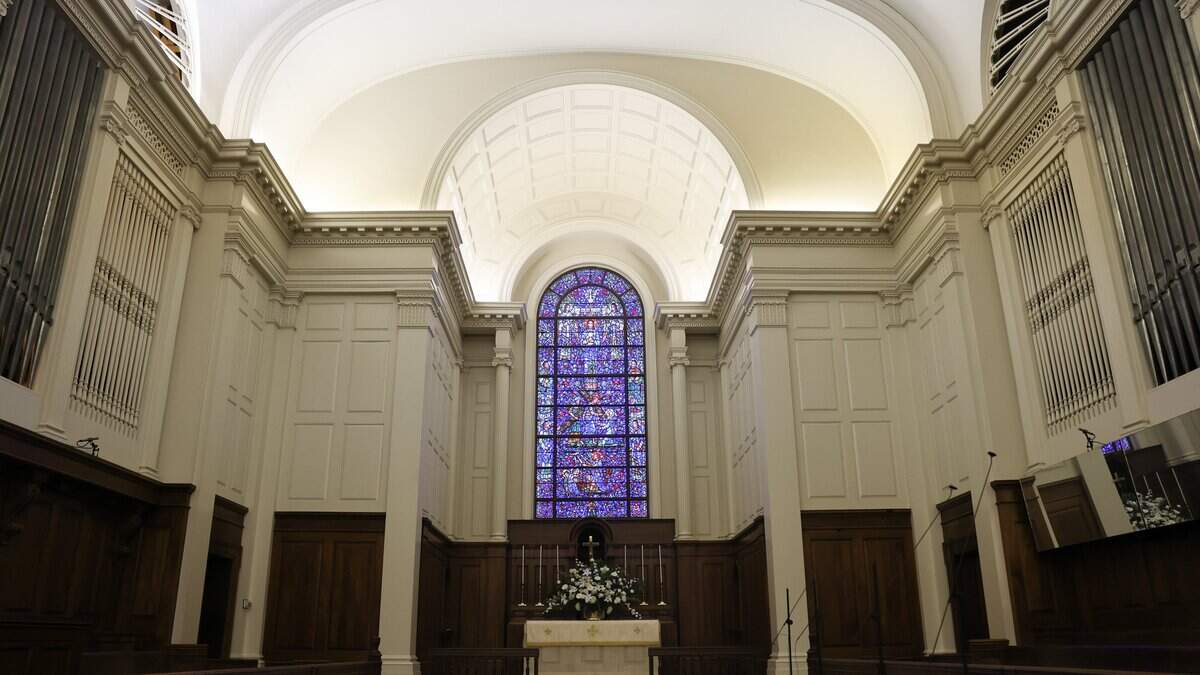
From Queens Road, Myers Park Covenant’s new identity isn’t visible everywhere just yet.
The old signs still stand while new ones are being fabricated. Moore recently filmed a welcome video for the church’s redesigned website, and he laughs while recalling that he simply positioned himself in front of the existing sign to block the words “Myers Park Baptist Church” from view.
As for whether removing “Baptist” from Myers Park’s name will achieve what church leaders hope, that remains impossible to know.
What Moore can answer is a different question: What did the decision free the church to do?
It didn’t change the church itself, he says; instead, it removed something that had become an obstacle to communicating who the church already was. It no longer asks visitors to look past a single word before they can begin to understand the congregation itself.
Moore has, in fact, lived through this debate before. As pastor of Sardis Baptist Church from 1995 to 2014, he says, the question of dropping “Baptist” surfaced “a couple of different times, and both times we said no.”
“But if you keep asking the question — which is what happened here,” Moore says, “sooner or later, you finally say yes.”
For Myers Park, though, finally saying yes to a new name didn’t mean saying no to the Baptist identity members like Marcy McClanahan still valued.
“We still believe very strongly in the historical Baptist freedoms,” she says. “I think that’s a core foundation of who we are as a church — but that’s simply not what people think of when they think of ‘Baptist.’ So our church itself is the exact same church it was when it was Myers Park Baptist Church. It’s just the name that is changing.
“And that is more for people outside of our church than it is for people inside our church.”
Whether Myers Park Covenant’s new name ultimately changes who walks through its doors won’t be known for years.
But as Charlotte continues to grow and newcomers arrive with different assumptions about faith, politics and denominational identity, the divide Myers Park confronted — between what a religious identity means inside a church and what it communicates outside — is unlikely to disappear.
Read more YMCA donors should reconsider until these Morrison questions are answered | Opinion