A Charlotte paradox: Is Plaza Midwood’s identity threatened by its own success?
On a recent Wednesday night at Sip City Market & Bottle Shop in Plaza Midwood, owner Yazan Humaideh watches the neighborhood keep spilling through — although “watches” probably isn’t the right word.
Read more NASCAR great brings craft brews, racing culture to new Lake Norman bar & taproom
He’s constantly getting pulled into things.
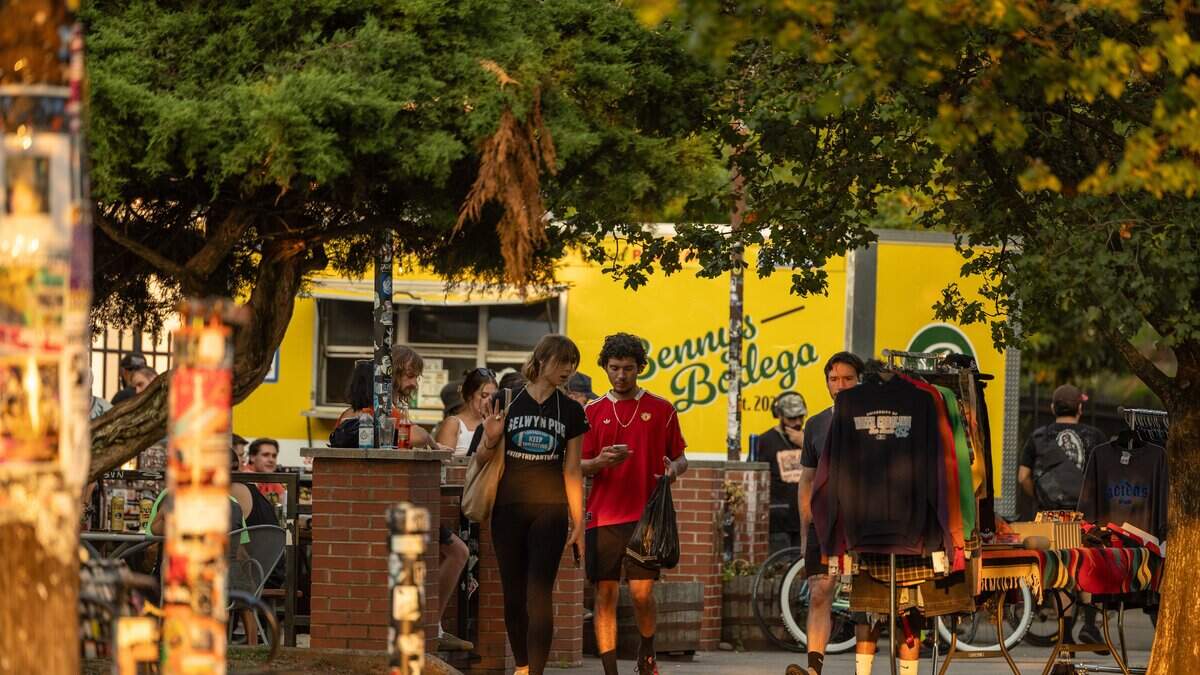
Lindsay Pruitt gives him a hug while checking out this week’s edition of Sip City’s Wine & Chill Wednesday, having walked the 500 steps from her front door. Victoria Brown, who does social media for Pilot Brewing Co. four blocks up Central, drops by to gift him a hard-to-find bottle of the brewery’s beer. Then Drew Durham says hey after another day of running his custom gear business out of his townhouse behind nearby Piedmont Middle School, before heading back to grab a table with friends on the patio.
Nobody seems to actually have a plan. They’re just there, to see, or to be seen, bouncing in and out of conversations, happily.
More than three years after opening — and surviving an early stretch when it nearly failed — Sip City still feels like an unfinished business.
Little about it is polished. There are rugs that don’t match, random seating arrangements, a haphazard collection of coolers, televisions, wine racks, murals and board games, a tiny stage here, a slightly larger one there. Like the crowd, it feels accumulated instead of designed.
Kind of like Plaza Midwood itself.
NoDa became known for artists, galleries and live music and is concentrated around one intersection. South End grew via large-scale development into a polished, linear corridor of apartments, breweries and restaurants connected by the light rail and its trail.
But Plaza Midwood has traditionally been a little harder to define. It grew more organically, block by block, its identity emerging from a patchwork of affordable storefronts that gave independent entrepreneurs room to experiment and felt more tightly woven into the neighborhood.
Along the way, some businesses failed while others became neighborhood institutions that, collectively, created a place where almost every storefront seemed to have a story behind it.
Today, though, many longtime residents and business owners worry Plaza Midwood is becoming a victim of its own success. Luxury apartments, rising rents and national chains have made the neighborhood wealthier and more popular than ever, while raising a new question: Can Plaza Midwood keep producing the kinds of independent businesses that made people fall in love with it in the first place?
Charlotte historian Tom Hanchett eases his Prius down Central Avenue, pointing from one storefront to the next.
Ostensibly, he’s providing a history lesson of Plaza Midwood while driving me around the neighborhood. Practically, it feels like he’s giving a tour of an old friend’s life. Here, a former barber shop. There, Charlotte’s first suburban bank branch. A thrift store that’s now apartments. A family-owned diner, John’s Country Kitchen, replaced by a local chain taqueria.
Then he begins describing the conditions that allowed Plaza Midwood to become one of Charlotte’s most beloved neighborhoods.
After its beginnings as one of Charlotte’s first streetcar suburbs, Independence Boulevard reshaped the east side and newer shopping centers pulled customers away in the 1960s and ’70s, leaving many of Plaza Midwood’s older commercial buildings vacant.
At the same time, that made the neighborhood unusually accessible to small businesses.
And because the district had grown over decades under many different property owners — not a single master developer — it offered storefronts of different sizes, conditions and rents.
Hanchett recognized those ingredients when he and his wife moved to Plaza Midwood in 1999.
The neighborhood wasn’t fashionable yet. “There was a little bit going on,” Hanchett recalls, including enough thrift stores to signal that rents were still cheap and commercial demand remained low. But after years studying traditional downtowns and neighborhood business districts, he recognized an affordable, walkable place where independent businesses could take root.
“That’s why I live here,” he says matter-of-factly, “because this is a place where an alternative exists.”
Hanchett is, in fact, describing the exact environment Blake Barnes found when he opened Common Market in 2002.
While the neighborhood was still rough around the edges — “It was real seedy over here, big time,” Barnes says — he also embraced his own rough edges. He treated Common Market less as a finished concept than an ongoing one, adopting a philosophy of “whatever customers ask for, I find it.”
Then came the record-setting snowstorm of February 2004. While much of Plaza Midwood sat without power for days, the store stayed open, with neighbors flocking there for supplies, conversation and a sense of normalcy.
“That,” Barnes says, “is when things turned.”
Common Market stopped being just a convenience store and deli, and it became the kind of neighborhood gathering place Barnes had imagined from the beginning.
Over the next several years, Plaza Midwood tipped, too. Hipster-focused businesses like Lunchbox Records, Zada Jane’s Corner Cafe, and Soul Gastrolounge opened along Central, quickly became iconic, then fed off one another, giving people more and more reasons to spend an evening there instead of simply running an errand.
By 2010, if you were coming from another part of Charlotte, you didn’t tell your friends you were going to check out Common Market, or to eat at The Penguin or Dish, or to catch a buzz and play ping-pong at Thomas Street Tavern.
You said you were going to Plaza.
Plaza Midwood did have some help along the way.
The city’s 2003 Plaza Central Pedscape Plan helped shape public investments in the corridor over the course of a decade, creating the streetscape that private development would later build upon by adding sidewalks, crosswalks, reverse-angle parking, landscaping and other pedestrian improvements while offering grants to help improve storefronts.
“It had all the ingredients of a walkable place,” says Monica Holmes, director of Charlotte Planning, Design & Development. “You had your businesses, houses, transportation, front porches, sidewalks — all the ingredients were already there to provide a perfect canvas.”
As a result, “people were like, ‘Oh, maybe that’s somewhere I should be investing,’” she says, “and it kind of snowballed.”
But those same conditions became irresistibly attractive to developers, too.
Perhaps most notably, between 2015 and 2020, roughly 1,300 apartment units were added in and around the neighborhood through a series of large mixed-use developments along Central Avenue and Hawthorne Lane.
The apartments brought thousands of new residents, many with the disposable income developers and national retailers covet. The national retailers who seized the opportunity, in turn, helped make the neighborhood still more attractive to affluent newcomers and investors. Each new wave reinforced the next.
Today, Plaza Midwood’s commercial real estate now commands the highest average asking rents of any Charlotte submarket when it comes to office and retail spaces.
Read more These are the 911 calls in the Juliana Nzita hanging death case
It’s a challenge Clifton Castelloe, who co-owns Moxie Mercantile and serves as president of the Plaza Midwood Merchants Association, says has fundamentally changed what it means to start a business in Plaza Midwood: “A three-year lease is a very short time for a business to take root and move toward profitability.”
Small business owners in Plaza do see some benefit to national chains.
Yazan Humaideh points to the large new mixed-use development known as The Rowe at Commonwealth, which is five blocks away from his Sip City: “They brought some chains — like Uchi (an upscale sushi chain) — that have brought the name of Plaza Midwood out to people that wouldn’t have come to Plaza.”
The fear is that those chains will keep coming, and eventually drown out places like Humaideh’s.
“We’re going to have more chains, there’s no doubt,” says Phillip Gussman, a longtime Plaza Midwood business advocate who helped launch the neighborhood’s social district. “If you’re a developer and you’re trying to figure out how to fill a building, the chain money is known … whereas the local person might be like, ‘I can’t handle rents going up.’”
He then mentions Soul Gastrolounge, which was in an old building at Pecan and Central that was bought and sold during Covid, at which point the new owner raised the rent. Soul’s owners balked, and left in 2022. The property has stayed empty since.
Says Gussman: “They’re asking for a rent that the historical businesses that would’ve jumped in and filled it immediately were like, ‘I can’t make that work. The math, it doesn’t math for us.’”
The former Soul space, in fact, became a flashpoint for the neighborhood’s anxieties earlier this summer, when mysterious “Mattress Center” signs appeared in the windows of the vacant building. Whether prank or marketing stunt, vitriol spread rapidly online — because the signs seemed to symbolize a larger worry that one of Charlotte’s most distinctive commercial districts could eventually lose the independent identity that made it successful in the first place.
It remains a sensitive subject for some. When contacted for this story, Charlotte hospitality entrepreneur Andy Kastanas, co-founder of Soul, declined to discuss the circumstances surrounding the restaurant’s departure, instead offering this statement:
“Plaza-Midwood was built on the backs of independent businesses. Once real estate and developers noticed their success, they wanted a piece of it and began appropriating and exploiting it. With their big money, they started buying, building paper-weight buildings, bringing in corporate chains, and raising rents — thus shutting out small business, all of which diluted the cultural fiber and diversity of the neighborhood. The fate of Plaza-Midwood is now left up to the limits of their greed.”
For city planners, it’s a tension has no easy answer.
Planners can influence the kinds of spaces new developments create, Holmes says. But she acknowledges that city government can’t dictate commercial rents or decide which businesses ultimately sign leases. They also can’t — right now, at least — give independent entrepreneurs the time they need to build success when overhead is so high and they’re hemorrhaging money in start-up costs.
Castelloe, the Merchants Association president, says he feels fortunate his family was able to purchase the building at on Commonwealth Avenue where they opened the boutique in 2015.
“If times had shifted,” he says, “and we were entering the neighborhood now, it would probably be impossible for us to buy a spot.”
Historian Tom Hanchett is less nostalgic — and far more receptive to development — than you might imagine.
“Cities are about change,” he says, as he drives through The Commonwealth, the sprawling mixed-use redevelopment that replaced an aging shopping center. “Cities always change. You cannot freeze a city without killing it.”
Hanchett has spent decades watching Plaza Midwood reinvent itself. He wouldn’t be surprised if it does again.
As for fears that Plaza will reinvent itself, say, as the next South End, Holmes gets them. But she thinks those concerns aren’t really about South End at all. She believes they’re an expression of a broader fear: What if it is just all the same thing and all the same type of people and all the same type of businesses?
“I think people want a diversity of choices,” Holmes says. “Vintage clothing stores mixed with new clothing stores.”
Again, she gets it. What she’d also say, though, is that “people thought The Commonwealth would drastically change Plaza Midwood. … It has evolved, but Plaza Midwood is still Plaza Midwood.”
And Yazan Humaideh and Sip City may be the best proof of that.
His Sip City wasn’t born as the business it is today. Like Barnes’s Common Market — like Plaza Midwood itself — it became that business through trial, failure and listening.
When Sip City opened in May 2023, it looked, in his words, like a “hodgepodge.” Three weeks later, he overheard someone at Thomas Street Tavern dismiss it: “Man, that place sucks.” Instead of taking offense, Humaideh treated the criticism as free consulting. He added TVs, replaced the furniture and kept reshaping the business around what customers wanted.
“It’s literally all these small things that we did over and over,” he says, “over time.”
Figuring that out nearly broke him. To keep Sip City alive, he exhausted his savings, sold personal assets and picked up a second job.
But by late 2024, he realized he’d built more than a bottle shop or event venue. He’d built the kind of neighborhood gathering place where people stop without quite knowing how long they’ll stay — or whom they’ll run into.
Today, Sip City still feels unfinished, if only because Humaideh treats it as something that can and will keep changing.
In fact, while giving me a tour of Sip City recently, he leads them back to a room behind one of his two event spaces that looks a bit like a dumping ground for unused equipment and furniture right now — but is being renovated into a reservation-only speakeasy for the date-night crowd.
“These just got delivered today,” he says, as he shows off a rendering in his phone photo library of ornate ceiling panels. “I’ll be putting them up overnight tomorrow myself.”
Three years after opening, he still behaves as though Sip City is a work in progress.
Which is fitting, because unfinished businesses are how Plaza Midwood became Plaza Midwood.
Read more How a breakfast phone call led to a ‘grateful’ return to Panthers training camp
This story was originally published July 27, 2026 at 5:00 AM.