Charlotte revives I-77 toll lanes to SC line after legislature required payback
Charlotte restored its support for the Interstate 77 South toll lane project on Monday, caving to a pressure campaign from state lawmakers despite lingering concerns.
Read more Vote for The Observer’s high school football defensive player of the week
The City Council voted 7-4 during a raucous meeting to reverse its previous stance against the project and direct the city’s delegate on the Charlotte Regional Transportation Planning Organization to vote in favor.
With Charlotte’s change of heart, the plan now has enough support to move forward. The CRTPO will vote on Wednesday to make that decision official. Charlotte carries a big share of the CRTPO’s weighted votes, and a number of other voting members already support toll lanes or are expected to flip because of a provision in North Carolina’s budget passed this year.
Council members Malcolm Graham and Joi Mayo, whose west Charlotte districts fall in the interstate’s footprint, flipped their votes in favor. They cited a new guarantee the state would supplement the project with at least $300 million toward community benefits in impacted communities, which the state guaranteed through a binding memorandum of agreement it plans to sign Tuesday.
“Sometimes you fight. Sometimes you negotiate. We negotiated a plan in the best interests of the community,” Graham said. “No one gets 100% of what they want … But what we have is a giant step forward and more work to do.”
The city set off a four-month-long battle between local governments and the General Assembly when it voted to yank support for the project’s funding mechanism in May. Other towns followed, and the plan was shelved.
Lawmakers quickly intervened. The state budget, passed in July, threatened to make any local jurisdiction who voted to kill the project repay the North Carolina Department of Transportation for around $69 million the agency already spent on planning.
City officials were skeptical that the repayment provision is legal, including the timeline. The state is making local government repay fees dating back to 2018, six years before the CRTPO approved the funding agreement. City Attorney Andrea Leslie-Fite said the city was exploring “all legal remedies.”
But the council wanted to avoid a legal showdown with the state, and Charlotte would’ve had to budget for the repayment regardless while a lawsuit worked through the courts. That likely would have meant raising property taxes, reducing debt capacity for future affordable housing bonds or both, according to city staff.
Council members Dante Anderson, Dimple Ajmera, Ed Driggs, Graham, Mayo, James Mitchell and Kimberly Owens voted to reinstate support for the project. Council members LaWana Mayfield, JD Mazuera Arias, Renee Perkins Johnson and Victoria Watlington voted against.
NCDOT plans to add toll lanes to an 11-mile stretch of I-77 from uptown to the South Carolina border in an effort to ease congestion. The project is estimated to cost somewhere between $3.2 billion and $4 billion, and a not-yet-selected private company will shoulder a majority of the cost.
The CRTPO approved a public-private funding agreement in 2024. Opposition galvanized about a year later after the NCDOT released early design maps that showed the interstate expansion running through historically Black neighborhoods.
“What has changed? Transportation’s needs have not changed. Our community needs have not changed. The concerns raised by residents have not changed. The burden tolls would place on working families have not changed. The risk of disrupting established neighborhoods and forcing neighbors out of their homes has not changed,” Rev. Janet Garner-Mullins said during the public comments at Monday’s meeting.
“What has changed has been the pressure put on council and local government to reconsider their decision.”
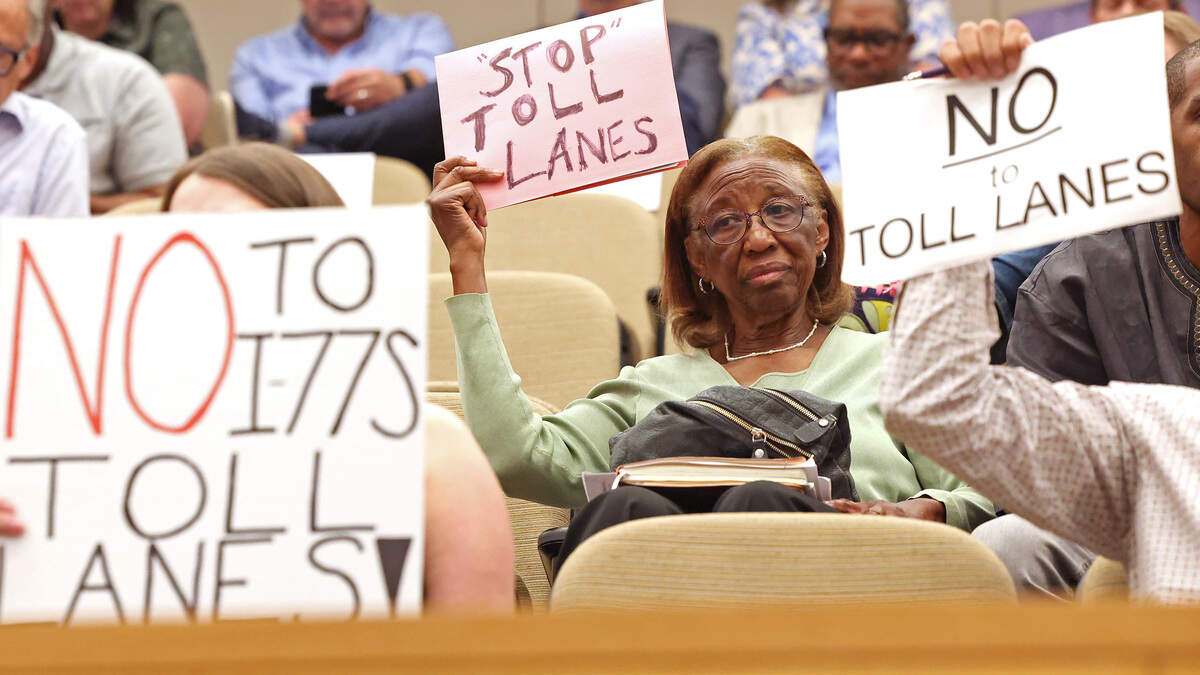
In the city hall atrium about 60 people sat and stood watching the public hearing. Among them was Cole Garde. He said next steps involve going to the polls.
“It definitely kills morale, but I think it motivates people to get out, you know, in November and next November, really, and try and flip Raleigh and flip the council at this point,” Garde said.
Speakers in opposition to the toll lanes outnumbered supporters two-to-one.
Those who spoke in favor of the project were mainly from Charlotte’s business and development community including Sagar Rathie, the managing director with Crescent Communities; Tim Sittema, managing partner of Crosland Southeast; André Collins with First & Early Partners; Allen Dargins, president-elect of Canopy Realtor Association; and multiple leaders with the Real Estate and Building Industry Coalition.
Dargins started his comment off by noting he was from the west side. He added that the city could not give up the opportunity to reconnect the west side neighborhood.
“We’re focused on the community benefits that could be lost for those living near the highways and many others,” Dargins said. “We cannot miss the opportunity to reconnect people and neighborhoods with an intentional approach.”
They were joined in their support by community advocates, too, including Rickey Hall with the West Boulevard Coalition and Corine Mack, president of the Charlotte-Mecklenburg branch of the NAACP.
Read more Vote for The Observer’s high school football offensive player of the week
“I take no elation in the fact that people thought that they lost and somebody else won,” Hall told The Charlotte Observer. “If we work together, it can be a measurable improvement…because of what the benefits will do to improve quality of life, reconnect communities and open up opportunities in areas that have long sought for investment and opportunity.”
Mayfield, who serves council at-large, motioned to keep Charlotte from changing its previous vote against the toll lanes. Only Mazuera Arias, Perkins Johnson and Watlington supported her.
“Doing something that you know is wrong is never the right thing to do. It may be more comfortable. It certainly would help to avoid conflict. But none of that makes it right,” Perkins Johnson said.
Once Mayfield’s motion failed, and it became clear the council was headed in the direction of reviving the project, the audience began to shout jeers at the council. Some stood up and left. A brief “no more tolls” chant broke out, and Mayor Robert Harrington had several people removed for being disruptive.
The council’s decision was shocking, according to Shannon Binns with the nonprofit Sustain Charlotte.
“It’s so clear that the majority of people in this community do not want this project and yet the majority of this council ignored them,” Binns said. “I was maybe naive in thinking that we had finally turned a corner and the old Charlotte way of putting big business ahead of people was starting to crack. And maybe it did start to crack because we did have four council members who voted against the Charlotte machine. But we didn’t get far enough.”
Council members who supported the project said their votes would ensure west Charlotte got something out of the improvement. Rejecting NCDOT’s investment would leave the community empty-handed, and would leave infrastructure upgrades — including 17 rebuilt bridges, streetlights and sidewalks — unfunded.
“More resources came to the table. More flexibility came to the table. And today, there’s a much bigger opportunity to shape what this investment could mean for the people actually living along this corridor,” Mayo said.
Sean Langley, president of the McCrorey Heights Neighborhood Association, expressed disappointment in Mayo and Graham’s switched stance. He doesn’t think touting community benefits will be enough to buy back votes.
After the meeting, Mayo told the press she has been “working on some solutions” regarding displacement, particularly in Wilmore, but she isn’t comfortable sharing details yet.
Rebekah Taff has lived in the Wilmore neighborhood for six years. Her home isn’t in the highway’s path, but she was still baffled by council’s decision.
“The few people that were there that did speak in support of moving forward had a very similar commercial real estate business background mindset,” Taff said. “I understand that viewpoint, but it felt like (council) was putting them over what the communities are ultimately going to be feeling and how they will be impacted. Traffic is an inconvenience for sure, but it doesn’t feel fair that now it’s going to be at the cost of neighbors.”
In November, NCDOT’s initial plans included the removal of homes from several historically Black neighborhoods along the highway including McCrorey Heights, Wesley Heights and Wilmore.
Now, the agency’s plans include the removal of about 29 homes in the Wilmore neighborhood. Wilmore Park would also be removed.
Four companies are shortlisted for the contract. Councilwoman Anderson said she thinks that competition will inspire innovation, which she hopes will help save more homes.
“We still have time to have even more decreased, and so there’s plenty of space for us to do the best that we can to make sure that the number of residents who are impacted are as low as possible, and those who are made whole-plus as it relates to their homes and what they feel like they’re due,” Anderson said.
But Taff isn’t confident and she’s unsure what comes next. Wilmore is a historic neighborhood, Taff said, and that designation comes with rules regarding what homeowners can do to their homes.
“Now, (the state) is going to bulldoze it,” Taff said. “Our neighborhood is very sweet. It’s quaint… We bought in Wilmore and I wanted it to be our forever home. I genuinely felt that way for such a long time. Now it feels like if we’re just going to have these losing battles left and right. We’re not going to have council people who hear us and listen to us when so many of us are in opposition of something, then it feels like it’s not the future I originally had in mind.”
Read more Vote for The Observer’s high school athlete of the week (09.25.26)
This story was originally published September 21, 2026 at 9:46 PM.