Charlotte community hearing probes lingering impact of federal immigration raids
Nearly a year after a major federal immigration enforcement operation swept throughthe Charlotte region, immigrant families, students and community organizations gathered last week to document what they say has lingered long after federal agents left the city.
Read more Vote for The Observer’s high school athlete of the week
The Charlotte event was part of the People’s Hearing on Immigration Enforcement, a national project collecting testimony about the effects of federal immigration operations in cities across the country.
Organizers said the goal is to create a public record of how enforcement has affected families, schools, businesses and communities, and eventually use those accounts to push for government oversight and accountability.
Charlotte was the latest stop in a series of hearings that have also been held in St. Paul, Minnesotta, Chicago, Los Angeles, San Antonio and Dallas. Organizers said another is planned in New York City in October.
At a press conference before the hearing, organizers said they plan to produce individual reports on each city as well as a broader report compiling testimony from across the country. Some witnesses testified publicly while others were allowed to remain anonymous because of continued fears surrounding their immigration status or enforcement.
Marty Castro, a former chair of the U.S. Commission on Civil Rights who helped moderate the Charlotte hearing, said organizers hope the records eventually reach Congress and other government officials.
The purpose, he said, was not simply to listen to community members but also to document what happened in a way that could later be used to seek accountability.
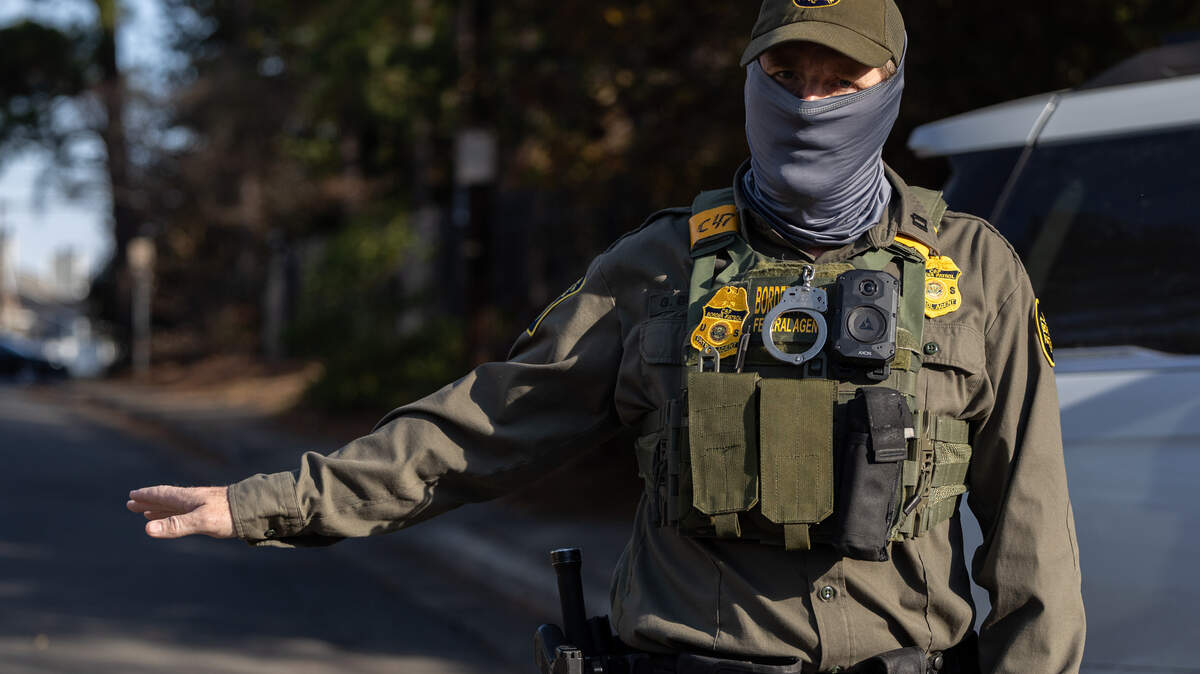
Much of the Charlotte testimony centered on Operation Charlotte’s Web, the federal immigration enforcement surge that brought U.S. Border Patrol agents to the region in November 2025. But speakers also described consequences that they said continued after the operation itself ended.
“We’re going to take Charlotte’s Web and we’re going to pull it apart, and we’re going to see what truly happened here,” Castro said. “It is extremely important that what we do today is not merely listen to the community, but that we take the evidence, that we gather the data, and that at the end of the day we document it.”
Alma Vasquez described a different kind of lingering impact. The oldest child of two undocumented parents, she said Operation Charlotte’s Web made her afraid that similar enforcement could reach her family.
Her father works in construction and drives a work truck, she said, and as reports of immigration enforcement circulated, she began constantly checking community pages for ICE sightings and asking where he was working each day.
When he left home in the morning, Vasquez said, she found herself wondering not when he would return, but whether he would return at all.
The fear changed the family’s routines. When there were reports of ICE activity nearby, Vasquez said her parents stayed home while she and her siblings took on more of the grocery shopping and driving.
Even now, she said, she often drives when the family goes somewhere together while her parents sit in the back seat.
Read more Charlotte Knights ask city, county to cover $26.6M in Truist Field renovations
“My brother and I used to be the children sitting in the back seat while our parents drove us and took care of us,” Vasquez testified. “Now we’re the ones in the front trying to protect.”
The family also shares locations, passwords and other important information in case something happens, she said. Vasquez described mentally running through what she would do if her parents did not come home: who would care for her younger sister, how she would find her parents and how the family would afford an attorney.
Those habits have continued months after the operation ended.
“The fear didn’t disappear when the immediate tension around Operation Charlotte’s Web faded,” Vasquez said. “I still check community pages for reports of enforcement. My parents still ask me if something they’ve heard is real.”
Amanda Valle, a junior at UNC Charlotte, told the panel that a close family member — her younger sister’s father, who she described as a stepfather figure in her own life — was detained by ICE in November 2025 and later deported.
Valle said the family member had applied for asylum and attended court hearings before his detention. While her family tried to find an attorney and navigate his case, Valle said she was simultaneously trying to continue college and support her younger sister.
“I had to watch her hurt and try to make her feel like everything was going to be okay when I couldn’t promise that,” Valle testified.
Valle said the effects she witnessed extended beyond her own family.
One student she knew left school for a semester after money previously used to help pay for college instead went toward an immigration attorney, Valle said. Another stepped back from a student organization and began working more shifts at their job because her parents were afraid to go to work.
“It wasn’t just something we saw in the news,” Valle said of the federal operation. “It changed the atmosphere around us.”
Organizers said those individual accounts are precisely what the People’s Hearing project is designed to preserve.
Rochelle Garza, chair of the U.S. Commission on Civil Rights, said during the press conference that testimony gathered through the project could also inform what issues the commission investigates. Other organizers said they hope the records can be provided to Congress and, where appropriate, officials at the state and local level.
Garza said the hearings also give people affected by immigration enforcement an opportunity simply to have their experiences heard.
“I believe that it’s been in some ways really healing for the communities that we’ve gone to, just to be heard, to feel seen, and to know that someone cares,” Garza said.
Read more Immediate suspension, dead pests: Worst Charlotte restaurant inspections in August