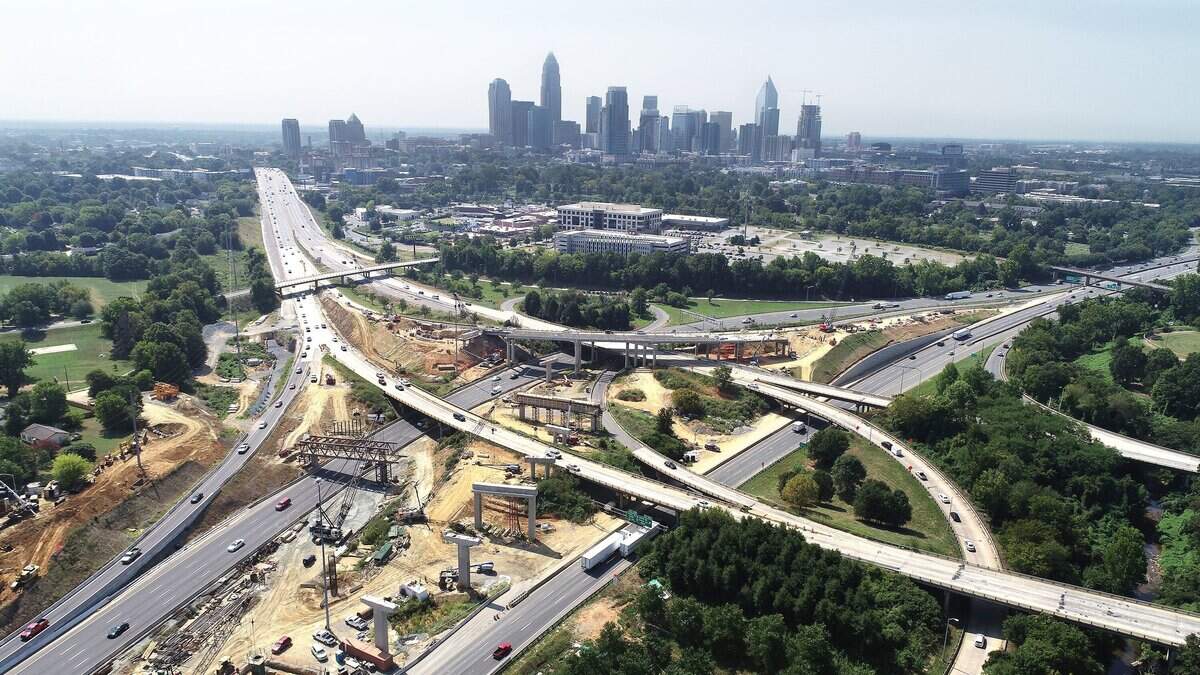
How a decades-old fight is shaping the I-77 South toll lane debate today
In the final days of August, the Charlotte City Council heard pleas from both sides to either stand against the Interstate 77 South toll lanes project, or show support.
Read more US House votes nearly unanimously to censure NC’s Chuck Edwards as he looks on
It came as the stakes could not be any higher for everyone involved. Supporters maintain the project will be key to addressing congestion, while opponents question the design. And looming over local officials’ head is a possible multi-million dollar penalty.
Rev. Janet Garner Mullins urged the council to remain firm on its decision to rescind support for the project.
“For some residents and neighborhoods this proposal is not merely about traffic patterns,” she said before the council last week. “It’s about the potential disruption of established communities, families losing their homes they’ve worked for many years, and sometimes generations, to build.”
Other residents and business leaders like Robert McCutcheon, president and CEO of the Charlotte Regional Business Alliance, emphasized the importance of keeping the project on track and continuing the conversation.
“The debate over I-77 South has too often become about winners and losers,” McCutcheon said.
Just a decade ago, a similar fight was held. And in many ways it’s shaped some of the discussion today.
A controversial toll lane project. A regional transportation board in the crosshairs. Closed community meetings to garner support. One would not be able to tell the difference on the surface.
But beneath the surface there are differences. Notably, Charlotte’s current position in all of this, said Kurt Naas, a Cornelius resident who led the opposition to the project in north Mecklenburg County.
“The difference is that Charlotte was fine with private toll lanes going through Lake Norman, but they’re not fine with toll lanes going through Charlotte,” Naas said.
The idea of “managed lanes” or toll lanes were proposed from Mooresville to the South Carolina border nearly 20 years ago. North Carolina’s first toll lane project would become the I-77 North Express Lanes, which runs 26 miles from Charlotte to the Lake Norman area.
It also would be North Carolina’s first major road project that was financed, built and managed by a private company, in what’s called a public-private partnership, or P3.
Similar to today, a groundswell of residents came out in opposition to the project last decade.
Back then, Naas said Cornelius was “ground zero” for the opposition. He would go on to lead the group “Widen 77,” which didn’t buy the state’s toll plan as the sole solution to address congestion.
They would pack out Mecklenburg Union Metropolitan Planning Organization meetings, the predecessor to today’s Charlotte Regional Transportation Planning Organization. The contentious discussions included protests that at times even devolved into shouting matches. Despite that, the regional transportation board would unanimously approve the plan in 2013.
Naas said, in hindsight, by the time the P3 framework was first approved by the state in 2013 their fight had already been lost.
“We spent three or four years trying everything we could to try and stop it,” he said. “But once that law was passed and the contract was being written, it was too late.”
Then-Gov. Pat McCrory would call on the regional transportation board to reaffirm its vote after the outcry of residents.
In early 2016, after years of opposition, some of the most affected local governments would go on to oppose the project. That included the towns of Davidson, Cornelius and Pineville, as well as Mecklenburg, Union and Iredell counties. But the city of Charlotte remained a yes.
When the possibility of scrapping the project was floated months later, Huntersville Commissioner Rob Kidwell said Charlotte’s position was significant due to its weighted vote on CRTPO.
“Charlotte tends to vote with what DOT wants,” Kidwell told the Observer at the time. “They have never not voted together.”
When the state came up with the idea of using a public-private partnership for the Interstate 77 South toll lane project, regional transportation officials immediately considered what had occurred before.
Bill Thunberg, executive director of the Lake Norman Transportation Commission, said officials’ more cautious approach came due to the fallout from the north’s project.
“They’ve got a lot more experience, and so the negotiations, as far as the contract goes, are going to be a lot more informed,” said, Thunberg, a former mayor of Mooresville.
Read more Victim in York County bedroom-camera case asks judge to keep suspect jailed
Charlotte City Council member Ed Driggs said one problem in the north was that the project’s bid process wasn’t competitive and went to the sole-bidder: Cintra Infraestructures, a Spanish transportation construction firm. Another was that once the project was completed, the company’s pricing formula resulted in fewer cars paying higher tolls on the express lanes.
“One of the biggest knocks on I-77 north was that the utilization of the pay lanes was not enough to provide any real relief to the people in the free lanes,” Driggs said. “Therefore it fell short on one of the principal objectives of the project.”
Some of the changes the project in the south would include are a low-income discount and exemption program, and a cap in pricing for the toll lanes. Regional officials also warned against allowing another single-bidder situation like before, Driggs said.
CRTPO would go on to approve the public-private funding mechanism for the project in 2024.
“The vote in 2024 included a provision, a commitment by CRTPO, that that would be the last time they would involve themselves in the project,” Driggs said. “The Charlotte vote to rescind was a direct violation of that commitment that had been made in ‘24.”
Perhaps the most glaring difference between the two projects is what’s in part at the heart of the opposition: the project’s design.
After the funding mechanism was approved by regional authorities the state began the initial design process. Concerns grew to a fever pitch when the N.C. Department of Transportation unveiled project design maps last year that showed homes in historically Black neighborhoods subject to demolition.
“The North did not have this social discussion,” Driggs said. “It did not have the discussion about impact on historically disadvantaged communities, and that is the biggest issue in the South.”
Some 29 homes in or around the Wilmore neighborhood could be taken by eminent domain. Driggs, who’s made clear he sees the project as needed to address congestion, said the state’s approach to answering concerns early on wasn’t the best.
NCDOT has since touted a $300 million community benefits package to bring residents back on board. However, neighbors and community advocates who stand against the project maintain that addressing the design is their primary concern.
Driggs said the issue the state faces is now two-fold: It’s past communication and trust.
“I think NCDOT recognizes that with hindsight, knowing what we later learned, there were things they could have done differently,” he said.
Through many local and state steps, and in a bipartisan fashion, the north toll lane project was approved despite a similar public outcry that’s been seen today. The political blowback was felt by many.
From Huntersville, where then-Mayor Jill Swain and two town commissioners lost elections to toll-lane opponents, all the way up to Pat McCrory, who lost support in north Mecklenburg County and some say could be the reason he lost his gubernatorial reelection bid.
Since that time, residents and officials opposed to the toll lane project’s fears were confirmed.
“It’s played out exactly as we thought,” Naas said “And we’re about eight years into a 50-year contract. So we have 42 more years before we can widen I-77 with anything but toll lanes.”
This time around, officials face not just political headwinds, but also a possible financial penalty. A provision in the approved state budget would force local municipalities to pay for the planning and design work that’s been completed so far for the I-77 South toll lanes project.
Unofficial estimates discussed are that the payback costs could be upwards of $60 million, but local officials have said that they have not been given a clear answer. NCDOT did not confirm an official total when contacted by the Observer.
“The final number has not been determined as we are still processing and paying invoices for work performed,” a NCDOT spokesperson said.
Charlotte and Mecklenburg County have so far both indicated they’ll remain strong against the toll lane project in the south. But several towns have already announced they will now support the project due to the financial risk, including Cornelius, where Naas lives.
And while there are differences between the south and north projects, a familiar feeling has begun to creep up: defeat.
“The fact that the state’s already spent millions doing design work and wants to come after the towns if they don’t do this, indicates to me that this train has left the station,” Naas said.
The Charlotte Regional Transportation Planning Organization is expected to vote on the I-77 South toll lanes project at its meeting on Sept. 23.
Read more Meet a few of the newest families helping to shape Charlotte’s food scene
