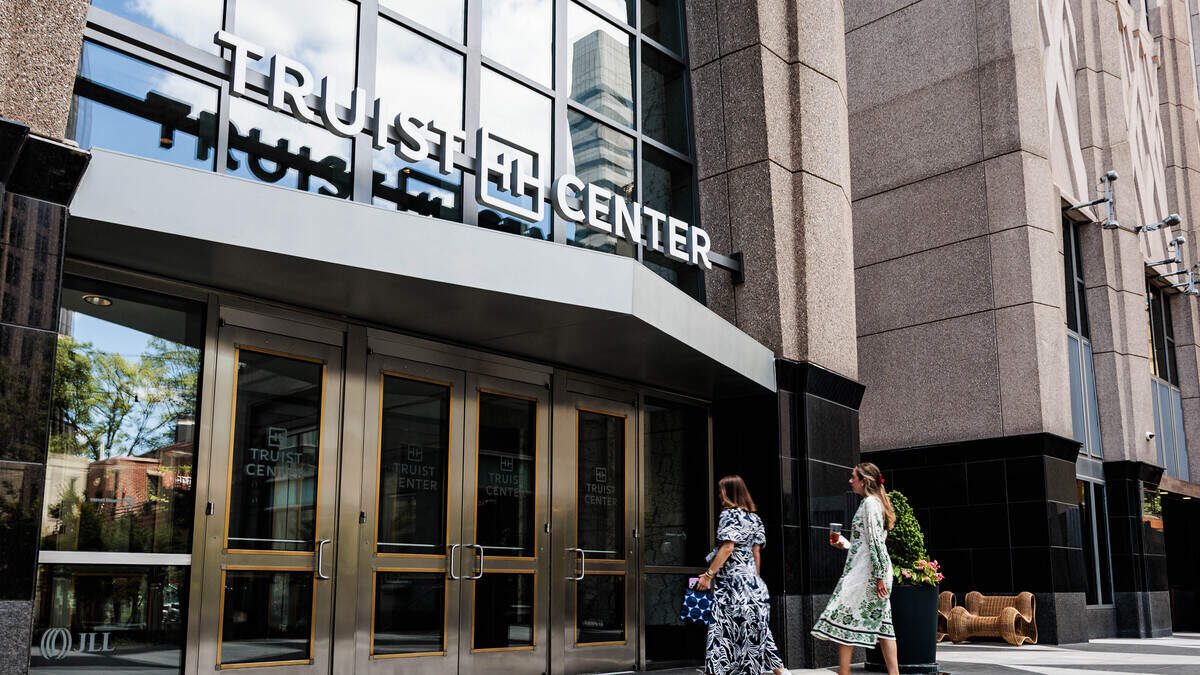
Truist just tapped a new CEO. We look back at key moments for the Charlotte bank
On Monday, Truist named its third CEO in seven years to lead the Charlotte-based bank — and it hired the first outsider to lead the company.
Read more A Tex-Mex closure, a new upscale restaurant and Charlotte’s best Greek food
Truist ranks ninth by assets in the U.S. with $549 billion. Michael Lyons will begin leading the company that employs about 40,000 workers on Sept. 1. Truist has about 3,000 workers in Charlotte.
Here are some key dates to know about Truist.
In February 2019, Winston-Salem-based BB&T and Atlanta-based SunTrust banks announced their $66 billion merger deal to form what would become Truist.
The new bank, which would be headquartered in Charlotte, bolstered the city’s banking hub status after losing other bank headquarters in the years leading up to the deal. Bank of America was the only bank headquartered in Charlotte in early 2019; San Francisco-based Wells Fargo has its largest employment hub in Charlotte.
Following the merger announcement, the banks revealed its new name: Truist. The June 2019 announcement underscored the banks’ reputations for trust, transparency and honesty, BB&T chief digital client experience officer Dontá Wilson told The Charlotte Observer at the time.
The same month, Winston-Salem-based Truliant Federal Credit Union filed a lawsuit for trademark infringement, arguing that the name Truist was “clear and intentional appropriation” of its brand. A year later, in July 2020, Truist settled with Truliant, reaching an undisclosed agreement.
As the next step toward merging BB&T and SunTrust, executives appeared in an almost three-hour Congressional hearing in July 2019. Former BB&T CEO Kelly King and former SunTrust CEO Bill Rogers argued that the new bank wouldn’t be too big to succeed.
The merger was finalized. It was the largest bank merger since the 2008 financial crisis. Less than a week later, Truist bought its new headquarters in uptown Charlotte for $455.5 million at 214 North Tryon St.
King, the former CEO of BB&T, continued serving as Truist CEO as the company entered this transition period.
During the first quarter, Truist cut 800 jobs because of the merger. While the reductions were shared in a presentation of its quarterly earnings report, the bank said the changes happened “early” in the quarter.
According to the bank, the eliminated positions were “duplicate, non-client-facing roles” in management, support and administrative roles.
After initially announcing a $25 million donation to COVID relief efforts in March 2020, Truist doubled its contribution to $50 million. Donation recipients included the CDC Foundation, the Community Education Alliance and various small businesses.
Internally, Truist employees making less than $100,000 were given a $1,200 pre-tax bonus, extra paid leave and more benefits in March.
In September 2021, Truist announced that former SunTrust CEO Bill Rogers would replace King as CEO. The leaders agreed on this change as part of merger negotiations in 2019. King served as chairman of the board until retiring in March 2022.
Read more A daughter of Tiawana Brown pleads guilty to conspiracy in COVID fraud scheme
By October 2021, Truist had closed 413 branches. As a part of its consolidation mission, the bank planned to shutter 800 total locations by the end of its first quarter of 2022.
At the time, Truist had brought 7 million customers to its digital platform, with a new mobile banking app and online banking platform set to launch by the end of 2021.
Truist launched its AI-enhanced virtual assistant, Truist Assist, in its mobile banking app and online banking platform in September 2022. The assistant, which was made available to personal banking clients, helps respond to questions and gives financial information with natural-language processing and natural-language understanding.
In an effort to cut $750 million in expenses, Truist announced that it would make “sizable reductions” to its workforce. Without specific details about who would be laid off, Rogers shared that the changes would occur between the third quarter of 2023 and the first quarter of 2024.
As restructuring continued into 2024, an unspecified number of technology department jobs were planned to be cut over a three-to-four month period.
After Truist employees sent messages on unapproved platforms including WhatsApp, the bank was charged over $8 million in penalties. While federal regulators reduced the bank’s fee for self-reporting the violations, Truist was required to pay $5.5 million to the Securities and Exchange Commission and $3 million to the Commodity Future Trading Commission.
Following Hurricane Helene, Truist announced a three-year plan dedicating $725 million to “support and sustain hurricane recovery and resiliency,” according to the bank’s website. The initiative, called Truist Cares for Western North Carolina, was established to help housing, small business and infrastructure efforts in the affected region.
The plan included $25 million reserved for philanthropic grants to nonprofits and a challenge of 10,000 volunteer hours among Truist employees.
In August 2025, the bank announced a five-year plan to expand Truist by opening 100 branches, renovating more than 300 existing branches and hiring additional advisors. The company aimed to focus on high-growth markets like Atlanta, Austin, Texas, Dallas, Miami, Orlando, Philadelphia and Washington, D.C.
The bank informed employees that they were required to return to the office five days a week starting in early January 2026. After the COVID pandemic popularized the work-from-home format, this change affected more than 3,000 local employees.
Before this change, hybrid employees were required to work in the office four days a week, with investment banking workers required to be in the office five days a week.
On Monday, June 15, Truist announced Lyons as its new CEO. Lyons resigned as CEO of Fiserv Inc., a Milwaukee, Wisconsin-based payments and financial services technology company, after 18 months.
He will start at Truist on Sept. 1, and current CEO Rogers will become executive chair. Rogers will retire in April 2027.
Read more When will the Stanley Cup come to Raleigh? How can you see it?