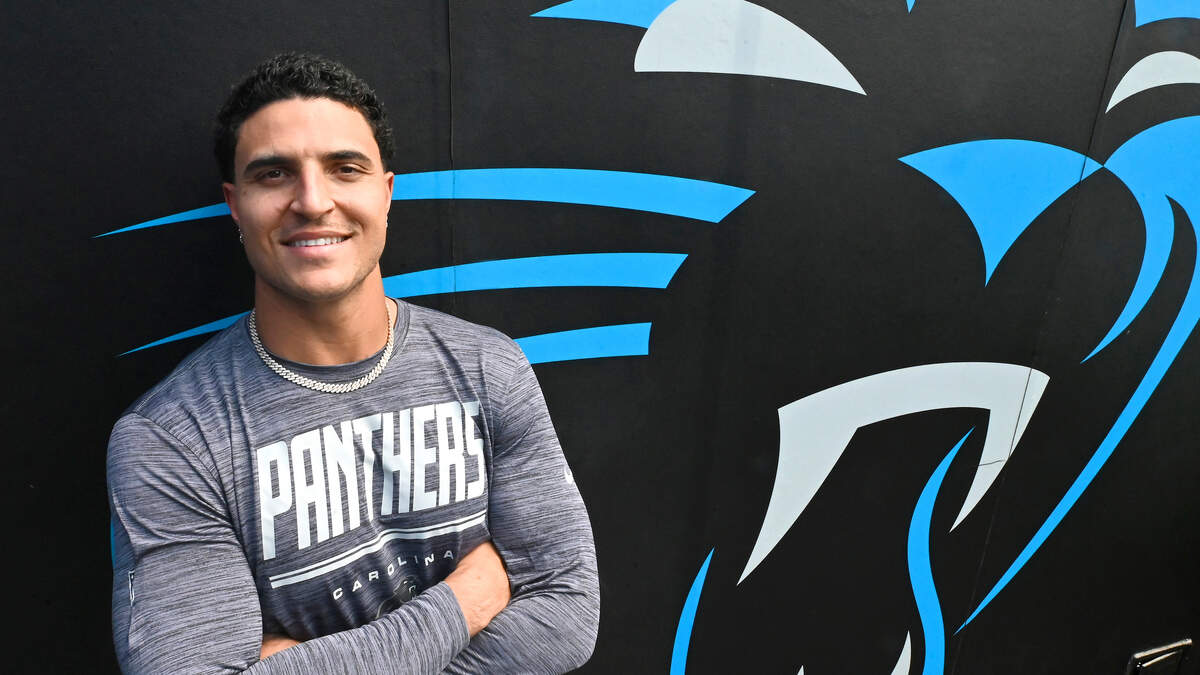
Panthers star Jaelan Phillips once lost himself in football’s pain. Music saved him
In eight years, Jon Phillips will understand that this is necessary.
In eight years, the father might be right that this is a phase, that his son Jaelan will return to the field, that Jaelan’s boiling resentment toward football is temporary.
Read more Carolina Panthers’ Jonathon Brooks says he’s ‘ready’; one key starter is out
In eight years, Jaelan Phillips will wake up as one of the NFL’s premier pass rushers, a $120 million man the Carolina Panthers wanted more than anyone else in free agency, whose presence lifts last year’s beleaguered defense into relevance, whose bumpy path to Charlotte by way of Redlands, California, and Los Angeles and Miami and Philadelphia is not a source of pain — it’s a source of power.
But that’s not today.
Today is a morning in the winter of 2018. Today, Phillips is a sophomore at UCLA. Phillips was once a smiley, 260-pound behemoth, the No. 1 overall high school recruit in the country, the 18-year-old kid who before even playing a single collegiate snap was described as the “true savior” of the Bruins football program. But today, he’s losing weight, losing sleep, anxious; when the alarm clock goes off, Jaelan pulls the sheets over his eyes, feels despair sink in his stomach and wonders something ridiculous:
Should I just … run away?
And today, Jon is a worried parent.
“You just started to feel like he’s distancing himself from us to some extent,” Jon said, reflecting on that miserable 2018 winter. “And that’s difficult as a father.”
It’s not that Jon doesn’t sympathize with his son. The hard part is that he understands what’s going on. Jaelan has been sidelined because of injury and has dwelled in “excruciating pain” the past two years — his first and only two at UCLA. He’s only played 11 games. What’s worse is that, in his latest attempt at rehabilitating, he’s been self-isolating; he’s in the Bruins’ facility getting treatment, but living a parallel life to his friends and teammates. He’s surrounded but alone.
The newly appointed Chip Kelly-led coaching staff is suggesting he medically retire. Jaelan finds relief in that idea. But today, Jon is resisting. He thinks that the game of football hasn’t passed his son by, and that Jaelan’s indignation isn’t appropriately placed. God doesn’t only open doors, Jon tries to tell his son; he closes them, too, and forces us to discover what we’re truly made of.
Eventually, Jon will relent. Jaelan will plan to leave football and all of its pain behind. He’ll move out of UCLA, out of public view, and into a new world.
And then somehow, eight years later, Jaelan will be here: on a leather couch in a field-level suite in Bank of America Stadium, days away from his debut with the Carolina Panthers, with a beaming smile and a confidence and an openness that’s striking.
Jaelan will reflect on that strange and terrifying time and refer to that miserable winter of 2018 in a particular way:
“The first time music really saved my life.”
Before you figure out how music saved Phillips, you need to understand:
Phillips didn’t discover a passion for music in college.
Music was always in his soul.
On his father’s side, musical roots run deep. His paternal grandparents were musicians, and, thanks to an Adventist upbringing, they raised Jon and his two siblings on classical music and gospel. In college, Jaelan’s father earned a Performance Bachelor of Music as well as a master’s degree in musicology. He played trumpet at both schools he attended, La Sierra University and UCLA.
Music weaves through his mother’s side, too. Sabine Robertson-Phillips’ father is Maestro Jon Robertson: a prodigy turned Juilliard pianist turned internationally acclaimed symphony conductor. He’s graced the podiums of the most prestigious orchestras worldwide, including the San Francisco Symphony, the Beijing Central Philharmonic and symphonies across America. Jaelan’s mother was an instrumentalist — a cellist — and she met Jon at the La Sierra Symphony.
Music took a while to take hold in Jaelan’s life, he said. He and his sister, Brenna, played hand chimes in church. Jaelan took up the piano, but mostly out of obligation. He picked up the guitar briefly, too, a product of listening to his father’s ‘80s and ‘90s rock and roll. But it would be years until he’d expand his palate, branching out to alternative rock, hip-hop and singer-songwriter folk, to the oldies he’s fascinated with now from the ‘60s and ‘70s. He also likes gospel, soul, Motown.
His favorite album is Frank Ocean’s 2016 treasure called Blonde. It would find itself on repeat whenever Jaelan needed to be tethered to something.
It’s hell on Earth, and the city’s on fire, Ocean belts on the chorus of the album’s track named “Solo.”
Inhale; in hell there’s heaven.
Still, early on, Phillips’ life was sports. Baseball first. Then football.
Then, by his sophomore year of high school, only football.
He wasn’t on the radar of any college programs, but that changed quickly. The newly sprouted 6-foot-5 athlete attended his first recruiting camp the summer of his junior year. He left with an offer from Washington University. More high-profile camp invitations arrived. So did more phone calls.
You can choose any successive story to encapsulate the mania of the next two years: Phillips once recorded eight sacks with a cast on his hand to protect his broken thumb in a high school game, his father remembers. Phillips, once in the car on the way to an unofficial visit to Oregon, received calls from the coaching staffs at Michigan and Alabama and got offers from both of them. At one practice at Redlands East Valley High School, at the peak of Phillips’ prep intrigue, UCLA head coach Jim Mora took a helicopter to see Phillips practice.
“I really didn’t even see myself as a big-time athlete until that stuff kind of started happening,” Phillips said. “And so when that would happen, it’s like, ‘Dude, this is surreal.’ It literally felt like I’m in a movie or something like that.”
Phillips chose UCLA.
“All of it didn’t inflate my ego as much as it just gave me a lot of confidence when I was in high school,” Phillips said. “When I was playing, I would still have nerves and stuff like that. But you know, I didn’t have any anxieties. No social anxieties.”
He shrugs: “I really didn’t doubt myself at all.”
This is when everything was perfect. It’s also when everything was dangerously fragile. Phillips’ life was getting larger than it ever had been and, as a result, his focus narrowed. Football was the vessel for his meteoric ascent; what would happen if it broke down in the air?
Phillips referred to this time period as the “first time music saved my life.”
He also referred to it as something else:
The time “everything went to s—.”
It didn’t start immediately. Phillips put together a solid debut with the Bruins. He notched 1.5 sacks in a game in which UCLA defeated Texas A&M and completed the largest comeback in FBS history. But then the injuries piled up. A doubt that had never been there before crept in.
Phillips suffered a high ankle sprain in the third game against Memphis. He came back, then sprained his other ankle. He came back from that, then suffered a concussion. He played only seven games his freshman year.
Immediately following UCLA’s season-ending loss to rival USC, the Bruins swapped coaches. Mora was out; Kelly was in. The program’s tenor changed.
Then, in January 2018, before his sophomore year, Phillips got hit by a car as he was cruising on Sepulveda Boulevard in Los Angeles on his moped. Broken scaphoid; three surgeries; months of missed workouts. He was anxious now, embarrassed, depressed.
Read more Panthers owner Tepper talks Bryce Young, team progress in rare media appearance
“I came back for the season in time but was just in excruciating pain,” Phillips said of that 2018 season, prior to that cursed 2018 winter. “Played three or four games, and then got another concussion. So at this point, I was like, ‘Yeah man. This is just not for me anymore.’ I was already in a bad headspace and then that kind of sealed it.”
No football meant a strange reckoning with who he was. But it also simultaneously paved the way for rediscovery. His wrist injury led to a leave of absence and free time. And that free time led to recording sessions.
Music, in Phillips’ terms, started taking over his life. It was almost like he was once co-dependent on football, and now that such a stabilizer was gone, he needed something else to latch onto, something else with which to identify. He assembled a bare-bones home studio — a $50 USB mic set up in his bathroom — and virtually never slept.
He described a “crazy juxtaposition” of being so tired when the sun was out, when he had to be the former version of Jaelan. But when he was creating sounds on a keyboard controller, he could stay up until 4 or 5 a.m. He could dive into the tedium of editing vocals, of discovering new sounds by slowing down their tempos. His published work is all instrumental, but he wrote lyrics to his earliest stuff, and Phillips himself said there was relief in writing those words down and marrying them to a song: He was reaching into his soul, and instead of finding a hollow football player, he found a real person.
There were arguments with his father during that time. Jon, concerned, wondered whether a change of environment would help, if a fresh start with football was the remedy — not the elimination of it altogether. But Phillips was steadfast: “No, football is the problem.”
Eventually, Jon softened. Phillips medically retired in December 2018 and joined Los Angeles City College, studying music engineering and composition. Phillips interned at iHeart Radio and worked part-time at his father’s law firm. He stopped working out and at his lightest dipped to 210 pounds “soaking wet” — 50 pounds below his playing weight. He was becoming content again.
But then, just as his life’s spiral slowed, Phillips felt something was missing. Phillips said his father had encouraged him to “leave that door open a crack” — to “put your name in the transfer portal instead of retiring and saying that you’re done forever.”
So he did. And coaches called him.
Stanford’s David Shaw was the first to ring. Offers trickled in. Phillips eventually got an offer from the University of Miami, home of the esteemed Frost School of Music. A new start was ahead of him; a new mindset was, too. He was still a “nervous wreck” about returning to football. But he was also using football as a means to his end of studying music production this time around. This was a difference, he said. An important one.
“It gave him the freedom to fail without it being something that would devastate him,” Jon said. “And I think that was the only way he was able to go back and give football another chance.”
Then came the practices. Being in a locker room again. Trusting his body, his mind, his instincts. He shook off the rust. An emotion was building. It all came out the second game of 2020, when Phillips made play after play. And then, at long last, in the second game of that season against Florida State, Phillips hauled in an interception and celebrated so long, possessed by a catharsis, that he earned an unsportsmanlike conduct penalty on the play. Long after the play was done, and the flag was thrown, Phillips stood on his bench wearing the notorious Miami turnover chain. He screamed “West Coast!” over and over and over again.
Watching a replay of this moment, in all of its context, with him at a healthy 265 pounds, with his confidence restored, with an identity unattached to anything that can be taken away from him — you’re reminded that there’s always a way back.
He credits that way back to music.
“It allowed me to understand that I had more talents, and that I had more passions outside of football — outside of going to the league,” Phillips said.
He added: “It was just always there for me.”
It’s been eight years. Eight years since Phillips’ medical retirement. Eight years since he got hit by a car and lost weight and “everything went to s—.”
There have been highs. Phillips was drafted No. 18 overall by the Dolphins in the 2021 draft. He played in all 17 regular-season contests in his first two years in the league. He had 8.5 sacks in Year 1; seven in Year 2. He started his foundation — the Jaelan Phillips Foundation — that is run by his mother and ensures that kids have access to music resources and are educated about the vast opportunities in the music field. He welcomed a baby boy, Shiloh, into the world with his fiancée, Samantha. He was the Dolphins’ Walter Payton Man of the Year nominee in 2022.
There have been lows, too. He tore his Achilles in 2023. He came back from that and then suffered a season-ending knee injury in 2024. He was traded to the Eagles in November 2025 and was a free agent in 2026.
Injury concerns still follow him in Carolina. Pressure does, too. The Panthers finished 27th in QB sack percentage in 2025, according to Team Rankings. Phillips, who has yet to notch a 10-sack season but has some of the best pressure stats in the league, is asked to change that — and that’s with his fellow starting pass rusher, Nic Scourton, out for the season.
But watching Phillips this summer, there’s something undeniable about him. He’s in a good place, coaches say. He’s gracious. Confident. Open. His story is uniquely personal, but that’s what makes him among the most relatable players in the locker room. Pass rushing teammate Trevis Gipson calls him “a phenomenal leader and an even more phenomenal person.” Devin Lloyd calls him “a stud.” Scourton, before the injury, said Phillips could unlock this defense; moments after Scourton’s injury, Phillips said he ran to speak to his fallen teammate because, somehow, in such inexplicable circumstances, he knew exactly what to say.
“Just a very resilient guy,” Darren Waller said of Phillips. Waller can probably relate to Phillips’ story more than anyone else. The 33-year-old tight end medically retired himself not all that long ago, and has also created music in his lows, which included a public bout with addiction. “Through those seasons, you can tell he’s been able to keep a positive energy about him. And it’s really hard to do that.”
Waller added: “We play the game, we love the game, but you gotta have things that express who you are outside of the game. It makes you more of a whole individual — and makes you a better player in a lot of ways.”
At his locker, six days away from the Panthers’ Week 1 matchup with the Chicago Bears, Phillips reflected on what he’d tell the version of himself from eight years ago.
“Oh man,” he said. “I would probably tell him that he was the one responsible for his actions. I felt like I was young. I wanted people to save me.”
He was stuck in the pain of losing football, of losing himself. But that forced him to clear everything away and find a path for transformation.
Read more Girls flag football kicks off as official sport in North Carolina on Wednesday
“Back then, bro,” Phillips said, “I was just lost.”
But Phillips found himself.
He inhaled, and ultimately found heaven.