Midwest bank’s rapid growth in the Carolinas has it betting big on Charlotte
Ohio-based Huntington National Bank has been aggressively growing across North and South Carolina, anchoring much of its regional leadership and strategy in Charlotte.
Read more Charlotte-area storms with ‘damaging’ 60 mph gusts expected Saturday, NWS says
The bank has committed to opening 55 branches across the Carolinas and adding 350 employees by 2027. What began in 2023 as a modest commercial banking operation on half a floor at 101 S. Tryon St. has quickly scaled to two floors there and a major regional build-out.
The bank has 11 branches in the Carolinas, with three in Charlotte including uptown. SouthPark and South End. The bank employs hundreds of workers across the Carolinas, including several hundred in the Charlotte area.
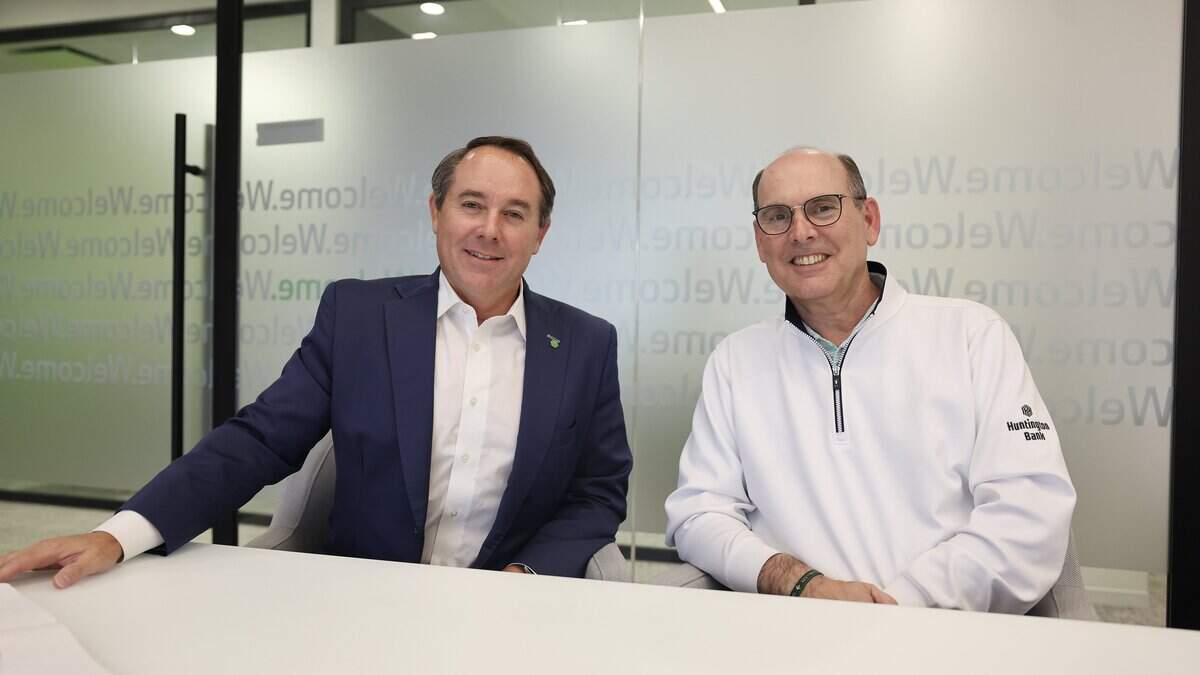
Recently, Scott Kleinman, president of Huntington’s commercial bank, and Heath Campbell, executive managing director of middle market banking for the Southeast, sat down with The Charlotte Observer from the bank’s 18th-floor corporate offices in uptown Charlotte.
They discussed Huntington’s rapid growth, market competition, community investments and why the Carolinas have exceeded company expectations.
“The initial success that we had commercially gave us the confidence to continue to expand and ultimately led to the decision to build 55 branches across the Carolinas,” Kleinman said. “One every other week seems like a good pace for us.”
The 160-year-old bank has made bold moves, including the merger with Cadence Bank this year to become a top-10 U.S. commercial bank with total assets of $284 billion and deposits of $228 billion. Kleinman expects the bank’s commercial business will quickly more than double.
The interview has been edited for clarity and brevity.
Why is Huntington expanding here, while facing growing competition that includes local titans like Bank of America and Wells Fargo?
Scott Kleinman: When you see expansion and competition, it’s usually a sign of the vibrant market that’s growing rapidly. That’s Charlotte and the broader Carolinas. The way these markets grow creates opportunities for lots of market entrants.
We came in 2023, and entered into the market by bringing on a lot of bankers who had extensive local experience. So while Huntington was new to the market, our bankers weren’t. We had a platform that we had built over decades that we thought could be very effective, especially in working in the middle market (mid-sized businesses) and working with private business owners. Some of the titans don’t focus as much there.
We’d much rather be in markets that are competitive but growing dynamically and expanding versus in markets that are shrinking.
How do you see the traditional role of commercial banking evolving, and why is an expanded physical presence in new markets necessary?
Heath Campbell: The physical presence enables and unlocks the entire franchise. When you open up a retail branch, it also unlocks our mortgage capabilities, our credit card, our checking accounts, our wealth platforms, our life insurance, assets under management. We have the ability to deliver expertise locally through product expertise, through industry expertise and through the full suite of investment banking capabilities, such as financial and debt advisory.
We’re never going to sell anything or pitch anything. We’re going to show up and ask thought-provoking questions and see how we can help.
New retail locations in Charlotte, the Triad and the Triangle will be smaller rather than the traditional large-scale branches. How does this cater to your commercial and middle market clients in high-growth urban area hubs such as SouthPark and South End in Charlotte?
Campbell: Branches are designed to be more intimate and conversational. It relaxes our guests and allows for a natural conversation that enables us to better understand and customize their needs.
Read more Avoid these Charlotte roads this weekend: Closures, heavy traffic for Pride
Kleinman: They’re signs of permanence. We’re investing in local communities. Branches are more often now about advice and guidance. They are also places where the community can come together.
Every time people drive by, they see Huntington. From a commercial perspective, digital is great, but it’s the interaction between people that gives comfort and builds trust.
Huntington recently established a 10-person Fund Finance banking team split between New York and Charlotte. How does a specialized team impact Charlotte, and what industry trends are driving this?
Kleinman: There are certain spaces that specialization is required. Funds banking involves capital call and subscription lines, supporting sponsor-driven private equity. The team is primarily based and led out of Charlotte with broad-based experience from other larger institutions.
There’s a tremendous amount of talented finance professionals who call Charlotte home, and we want to tap into that. They’ve done exceptionally well and they have not disappointed us.
What are Carolina business leaders telling you about their primary concerns and opportunities for the remainder of 2026?
Campbell: I would describe it as optimistic, regardless of the industry or business. Concerns typically are growing pains to keep up with the growing population and economies.
Because we need to be part of the communities that we serve, we chose to lean in quickly and contribute to affordable housing in Charlotte and Charleston with Ascent Housing projects. (Ascent, a for-profit organization founded in 2020, preserves affordable housing through The Housing Impact Fund.) We also leaned into education with Ignite the Classrooms program where we can give additional training and experiences to our teachers across Charlotte.
Kleinman: There’s a resiliency in our clients. The economy is still growing, and investment is still being made. In the Carolinas. What is happening here is unique — not every market has this type of growth that creates a wealth of opportunity.
How is the planned regional build-out progressing, and what milestones have the bank achieved in Charlotte and the Carolinas so far?
Kleinman: We are progressing as we expected, and you see that in the continued investment in people and the 55 branches that we’re in the middle of constructing. Financial performance and growth in the Carolinas have exceeded our expectations. The talent we’ve attracted propels us forward. I think the Carolinas as a whole are going to be a really important part of our future. The opportunity here is different than it is in other parts of the country.
How does Huntington distinguish itself for both clients and attracting employees in this highly competitive local market?
Campbell: What enhances our capabilities is focused collaboration. We don’t work in silos, we work together to bring a think-tank approach to serve our customers. That is a differentiator.
Kleinman: At the end of the day, the product set is loans, deposits and advice. The differentiator is in the people and how solutions are delivered. Culture can be a major competitive edge.
Scott Kleinman, 56, has worked his entire career with Huntington.
Heath Campbell, 50, has had a long banking career that includes over 14 years at Charlotte-based Truist.
Read more After years-long revitalization process, NASCAR isn’t returning to NC racetrack