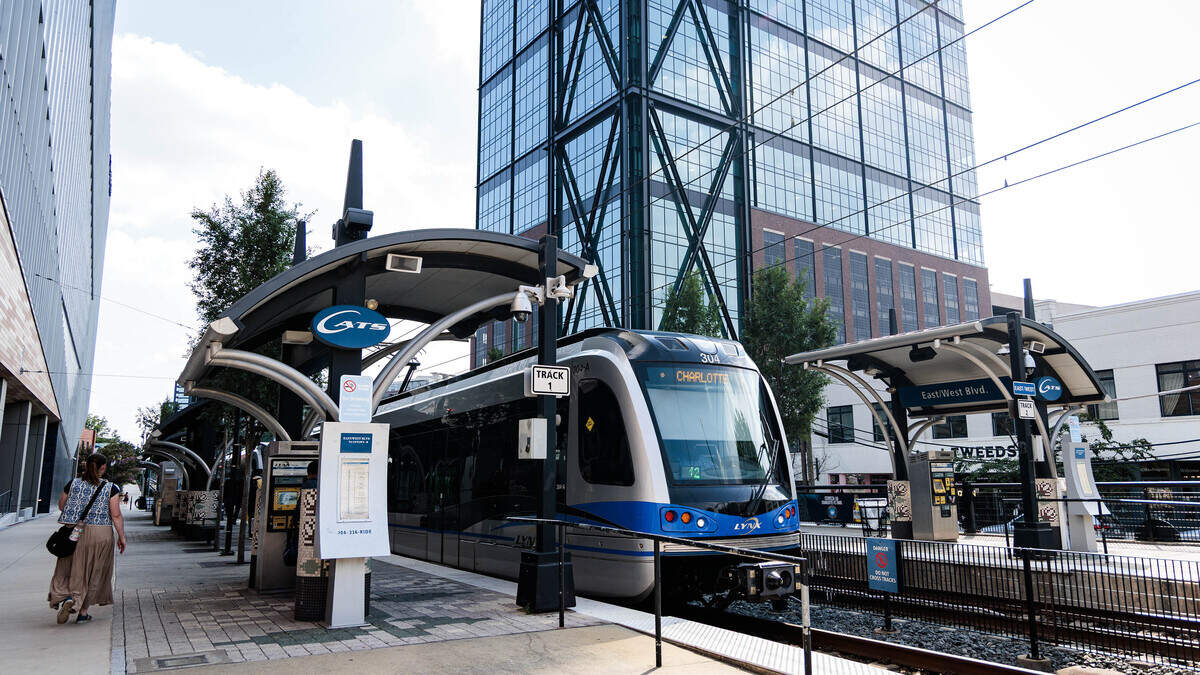
Charlotte transit fare evasion, gaps in security cited as major concerns by state
The North Carolina State Auditor’s Office on Monday released a new report on the Charlotte Area Transit System that found gaps in security, revenue loss from fare evasion and $1.7 million in unspent funding for safety and security equipment updates.
Read more Novant Health secures approval for $324M hospital in the Charlotte region
The report follows a preliminary review released last September that questioned security on the system following the fatal stabbing of Iryna Zarutska on the LYNX Blue Line. DeCarlos Brown Jr. was charged in the case, but was found “incapable to proceed” in the trial due to mental illness. This Saturday marks one year since the deadly incident.
In the special report, State Auditor Dave Boliek’s staff note that CATS should install gates or turnstiles to deter non-ticketed passengers, especially on the light rail.
CATS estimates losing up to 6.5 million annually due to fare evasion, the report said. And nearly half of bus riders and light rail riders do not pay to ride.
“Up to $6.5 million may be lost annually to fare evasion, but only $550 in fare evasion fines for the light rail system were collected in State Fiscal Year 2025,” Boliek said in a statement.
“The taxpayers of Charlotte pay the bill for CATS, and they’re asked to buy tickets to ride the bus or light rail. Moving forward, CATS and the Metropolitan Public Transportation Authority should implement effective measures to stop fare evasion.”
The MPTA approved a new fare policy in June that aims to streamline payment methods and prices. It also will expand electronic fare validation across the entire system.
Most of Charlotte’s light rail stations are at street level making it difficult to install gates or turnstiles.
Bill Lindeke, an urban geographer specializing in non-motorized transportation, previously told the Observer turnstiles are easier to install if there are stairs or escalators to a subway, for example.
But “at surface level transit, it’s really hard to do that, almost impossible,” he said.
According to the report, fare-evasion citations fell from 4,763 in 2023 to 2,018 in 2025. CATS collected just $750 in light rail fare-evasion fines in fiscal year 2024, and $550 in fiscal year 2025.
CATS told auditors that bus drivers were instructed not to enforce fares, in order to protect operators.
Read more Popular band brings back ‘iconic’ tour. When & where to see them in Charlotte
A Charlotte Observer investigation found that while crime on public transit is rare, violent incidents were more likely to occur on buses rather than light rails.
The audit also found CATS had budgeted $2.2 million for safety and security equipment updates in fiscal year 2025, but only spent around $470,000.
“CATS’s underspending in FY 2025 represents a significant deferral of planned safety and security work into later years, rather than completion as budgeted for FY 2025,” the report said.
The audit also raised concerns about the coordination between the Charlotte-Mecklenburg Police Department and CATS. The report said only two CMPD officers are currently assigned to the department’s Metro Transit Unit. It added at the time of Zarutska’s murder there “was no direct connection between CMPD’s Real Time Crime Center an CATS’s surveillance camera systems.”
However, the city of Charlotte said that connection was completed last October.
In a response letter included in the report, Mayor Rob Harrington listed several changes made by CATS over the past year to address concerns. This included the change to the system’s fare policy, and a new fare enforcement ambassador team of more than 60 uniformed personnel that will begin in October.
“We recognize these individuals are not armed security officers, and we are not trying to compare the advantages of the aforementioned law enforcement officers,” Harrington wrote. “The benefits are additional deterrents to those looking to use the transit system for illegal purposes.”
He said CATS has also increased its security services contract from $5.8 million in fiscal year 2022, to $23.1 million in fiscal year 2027. That’s led to contracted staff growing from 110 to 262 personnel. Transit security investment has also increased by $10 million in the recent budget, he added.
“These combined efforts have led to measurable improvements,” Harrington wrote. “In the first quarter of 2026, crime on the Blue Line decreased by approximately 69% compared with the same quarter in 2025, and bus-related assaults declined by roughly 67%, with zero major assaults recorded.”
The city also clarified that the $1.7 million unspent for safety and security equipment updates was related to timing, multi-year project complexity and incomplete work.
Among some of the possible changes to come, CATS Interim CEO Brent Cagle said earlier this year that CATS is working alongside UNC Charlotte and Central Piedmont Community College to develop a new artificial intelligence system to improve security.
The system wouldn’t be facial recognition, but would identify “suspicious activities or movements,” Cagle said. The plan would see the technology paired with CATS’ security cameras and have the ability to alert authorities when needed.
Read more Rising 20-year-old NASCAR star and Charlotte native signs with Hendrick Cup team