‘Wait for children to fail.’ NC parents say schools leave special needs kids behind
Editor’s note: This story contains reporting about suicide, a topic that will be disturbing to some readers. If you or someone you know are having thoughts of suicide or other mental health struggles, call or text 988 for a 24/7 hotline.
Read more Dr. Rob Heyer, the Carolina Panthers’ lead physician for over 20 years, dies
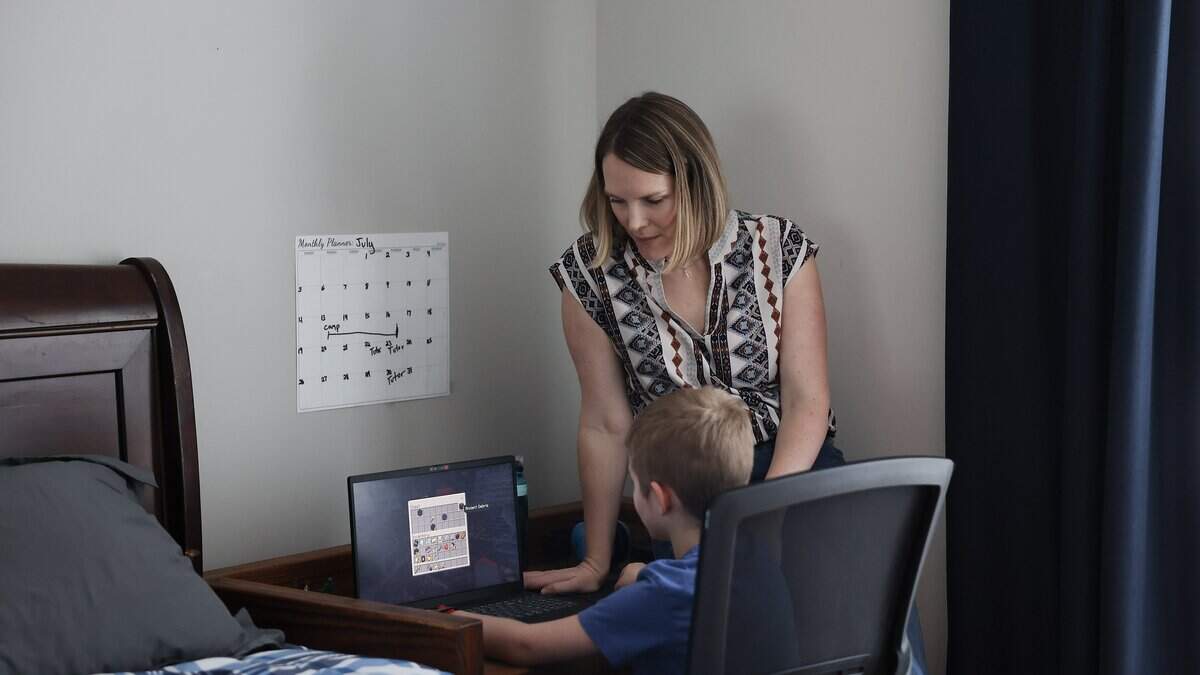
Jack Davis in many ways is a typical 7-year-old: He likes Minecraft, Legos and painting at his grandmother’s house. He’s fascinated with the military and has framed pictures of airplanes on the walls of his Waxhaw bedroom.
But in 2024 — the last year Davis attended public school in Union County – he was evaluated for suicidal thoughts around seven times in three weeks, his mother Anika Davis said. He was 5 years old.
“He was in a really bad place, and it was autistic burnout,” Davis told The Charlotte Observer.
It was the climax of what Jack’s mother Anika said was a prolonged struggle to get her son the accommodations he needed as a child with pathological demand avoidance, a variant of autism.
With it, Jack’s nervous system shifts easily into fight-or-flight mode. When it does, Anika said, Jack often resorts to aggressive behavior. On his last day in Union County Public Schools two years ago, he left the playground and clambered up a fence, attempting to get into a pond adjacent to the school building.
Afterward, a substitute teacher assigned to watch Jack that day said she could not continue working with him.
Now, Jack is homeschooled by a tutor a few times a week, and Anika and her husband hired a live-in nanny to help watch Jack and their other two children while they’re both at work. The nanny alone costs about $26,000 to $28,000, not including housing and food costs, Anika said.
Davis is one of four Union County Public Schools parents who spoke to the Observer about what they said have been repeated obstacles in accessing special education services their children require.
A spokesperson for UCPS told the Observer the district’s “support for students is provided through an individualized process,” which is “based on the student’s unique educational need.”
The district declined the Observer’s request to interview Director of Exceptional Children’s Services Laura Beachum and provided emailed responses to questions.
But it’s not just Union County: experts said special education services remain a challenge for districts across North Carolina. In 2025, the federal government cited the state as “needing assistance” in meeting federal special education standards. It’s one of 32 states and territories to be cited.
Federal and state law entitles every student to a “free, appropriate public education,” regardless of disability status. But funding and staffing constraints make it difficult for many N.C. districts to fulfill their legal obligation to meet every student’s needs.
For children like Jack, clinicians often recommend one-to-one support: that means a trained worker who can accompany Jack throughout the day and monitor his needs and triggers before they progress too far.
But Davis said she had to fight to get the district to agree.
“The principal said that one-on-ones really only get approved for extreme situations,” Davis said. “But how extreme does it have to get? My 5-year-old was suicidal.”
Peggy Nicholson is a supervising attorney at Duke University’s Children’s Law Clinic, where law students and attorneys often represent families in cases involving access to EC services. She said, when it comes to getting services like one-on-one support, the burden of proof falls on parents.
“For a family to make the case that their child requires one-on-one support, for example, to make progress in a school setting, you often need doctor’s notes or recommendations from experts,” Nicholson told the Observer. “If the school disagrees, it is the parent’s burden to prove with expert testimony and data that their child requires that support…So, just that burden of getting the school team to agree that a one-on-one is necessary is incredibly high for parents.”
Then there’s the issue of funding.
North Carolina allocates $5,309 in supplemental funding for each student with an individualized education plan, or IEP, which is required for all students with special needs. That is regardless of the type of disability or student needs, which vary greatly.
Exceptional Children’s services are also funded, in part, with federal dollars and Medicaid reimbursements, a spokesperson for UCPS told the Observer.
“The amount is based on the number of students served as opposed to the need of the students,” the spokesperson said. “The funding amount varies based on child count and Medicaid reimbursement allotments.”
But North Carolina caps state EC funding at 13% of a district’s student population. So, even if more than 13% of a district’s students have IEPs, it will only receive supplemental funding for 13%.
Only 21 of North Carolina’s 115 school districts have a proportion of disabled students at or below 13%.
Nationally, an average of 15% of public school students have an IEP, according to the National Center for Education Statistics.
Union County is one of the exceptions – around 10.7% of the district’s 2025-26 student population had disabilities. That comes out to almost 4,500 students.
And districts are required by law to provide fully for the academic needs of all students with disabilities, which can stretch limited resources thin.
“I think, a lot of times, even well-intentioned principals and school teams are under enormous pressure to serve so many students with very few resources,” Nicholson said. “And even though when you’re sitting in that IEP meeting, you’re only supposed to be thinking about what this individual child needs, it’s almost impossible to not think about ‘If I say this child needs a one-on-one, who’s going to do that when I only have a certain number of staff people?’”
Read more Charlotte renters need nearly 4 times minimum wage, new report finds
Glynnis Hagins is an attorney with Disability Rights NC, a nonprofit that advocates for the legal rights of people with disabilities across the state. She told the Observer school districts can’t deny services to a student because of cost, but they have to weigh how best to serve the students they have with the resources they have.
“I always like to say that money shouldn’t matter, but we all know that it does,” Hagins said. “When you’re in the IEP process, legally, the school district can’t say ‘We don’t have the money for this,’ because they have to take a strong assessment of the child’s needs.”
State lawmakers introduced Senate Bill 960 this spring, which would raise the state funding cap from 13% of a district’s student population to 16%. It stalled in committee in early May.
Even when there’s money, there may not be staff. And even when there’s staff, they may not stay.
“Special education teachers and service providers are difficult to recruit and retain in public schools. Many of our current force enter on alternative licenses,” Jeanie McDowell, communications director for the state Department of Public Instruction, told the Observer in an email. “This requires extensive professional development and technical assistance to support the delivery of special education services statewide.”
A huge gap sits between the supply of EC teachers in North Carolina and vacancies. In 2022, just five out of 100 of UNC system graduates studied education – and less than 9% of those had majors specific to special education.
North Carolina public schools had a total of 632 vacancies for EC teachers at the start of the 2025-26 school year, according to data from the North Carolina School Superintendents’ Association. That accounted for about 10.2% of total teaching vacancies in the state at the start of the year.
Cynthia Lang has a son named Sebastian, who has Skraboff-Deardorff syndrome, a rare, genetic, neurodevelopmental disorder. As a result, he has intellectual disabilities and is nonverbal. She believes staffing shortages are part of the reason her son hasn’t made sufficient progress in UCPS.
Lang said UCPS denied her requests for a referral to Melmark, a school for students with intellectual and developmental disabilities, because they said UCPS staff could meet her son’s needs at his home school. Melmark is state-funded, and without a referral, Sebastian cannot attend.
“This whole process has been very frustrating,” she told the Observer. “It’s difficult enough being the parent of a special needs child, and then you have all these hurdles and barriers put in your way when all you’re trying to do is make sure that your child has access to a free public education, which they’re entitled to, in a setting that supports them.”
In the end, Lang moved away from Union County to another school district. Her son had a new teacher each of the last three years he was in UCPS due to turnover.
UCPS currently has 12 vacancies for EC teachers, a district spokesperson told the Observer. There are currently 223 K-12 EC teachers and 20 pre-K EC teachers employed by the district. A state annual report found that one in five teaching vacancies in North Carolina during the 2023-24 school year were for EC staff.
“A lot of the education programs that used to graduate most of our state’s teachers have seen a decrease in enrollment,” Nicholson told the Observer. “And for people who may want to enter the teaching profession through another route, that can be really difficult, sometimes costly, and definitely time-intensive.”
Districts are competing for the best talent, which contributes to turnover and puts rural counties especially at a disadvantage.
“Since every district wants high quality teachers and is searching those out, the best teachers who have the most experience and expertise can move from district to district based on what can pay the most or what gives them the best quality of life,” Nicholson said. “Some of the more rural counties – counties that can’t pay much on top of the state base salary – are at a real disadvantage in trying to recruit and retain experienced teachers.”
All of the parents who spoke to the Observer said they felt the district did not take parents’ concerns seriously enough, instead waiting for issues to arise before giving services.
Davis said UCPS told her if she wants her son Jack to return to the district in the future, for example, he can’t start out with one-on-one support. Instead, they would monitor his performance and bring one in if they determine he needs one.
“That’s three to four weeks into the school year, and he’ll probably have lost it by then,” she said. “So, it just feels like there’s not an option for him to re-enter.”
Amanda Brandenburg is a Waxhaw psychologist whose daughter, Madelyn, began attending UCPS in 2022. Madelyn also has pathological demand avoidance, like Jack Davis, and sensory processing disorder, a neurological condition. But because Madelyn is academically gifted, Brandenburg said the school district didn’t recognize she needed more support.
“They wait for children to fail and struggle before they implement support, and they don’t give weight to parent data,” Brandenburg said.
But UCPS contested it works with parents to modify students’ IEPs. First, a meeting is scheduled with parents and school staff to review records. Next, IEP team members will make recommendations about what modifications to make.
“Parent concerns are taken seriously,” Tahira Stalberte, UCPS assistant superintendent of communications and community relations, said in an email.
Both Brandenburg and Davis tried private school options, but private schools are not required by law to meet all of their children’s needs. Brandenburg said she elected to pull her daughter from two private schools that didn’t work for her. Davis said her son attended a private school for a few months before he had an outburst and staff called the police. She was then informed he was not welcome to return.
For N.C. parents who want to appeal a school or district’s decision about their child’s EC services, the only recourse is usually taking it to court, Nicholson said. That makes things especially hard for low-income families.
“For families who can’t afford an attorney, who don’t have the funds to hire experts,” she said. “It’s just unreachable.”
Read more NC governor says ABC’s proposed price floor for liquor is ‘off the table for now’
This story was originally published August 19, 2026 at 5:00 AM.