Théoden Janes: Can you drive across Charlotte without Flock seeing you? I tried.
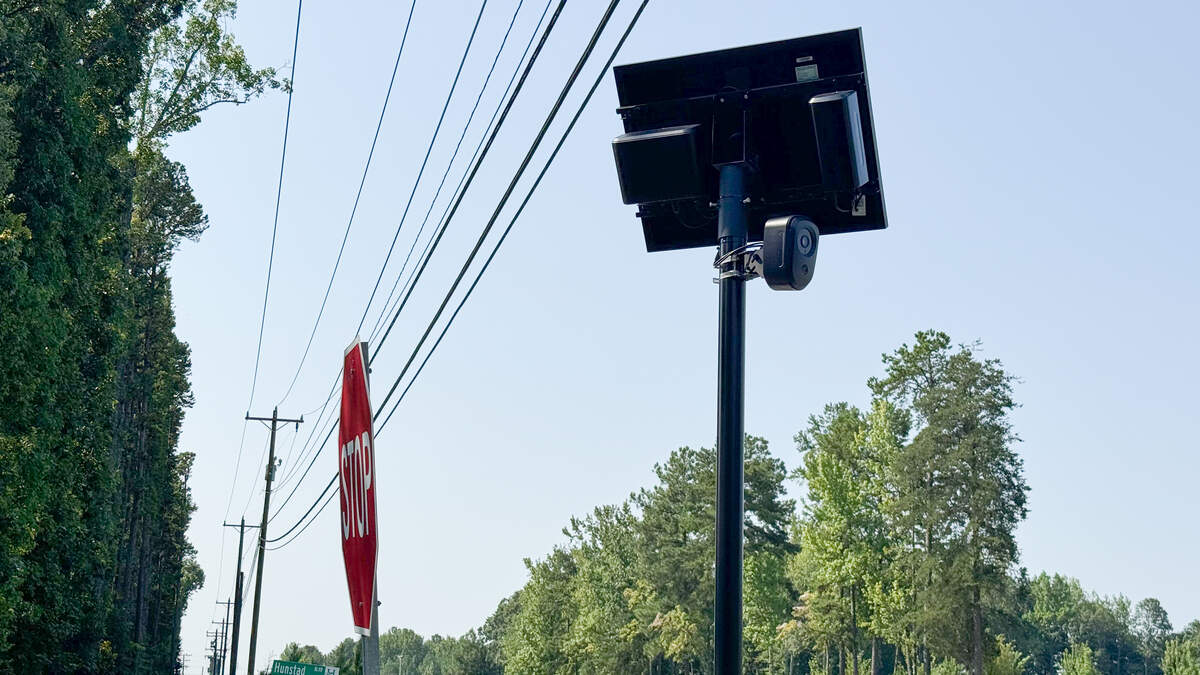
I have driven past the cameras at the entrances to the Christenbury neighborhood in Concord more times than I could possibly count. They’re mounted on poles along Christenbury Parkway. There’s even a sign warning drivers that license-plate readers are in use.
Read more Ven-Allen Lubin returns to NC State. He could go ‘5 for 5’ in more ways than one
The cameras are aimed at cars entering the private neighborhood, not those simply passing by.
Still, there they were, hiding in plain sight.
I discovered they were the closest automated license-plate readers to my house thanks to DeFlock, a crowdsourced map of the devices around the country.
DeFlock has drawn increasing attention amid the growing backlash against Flock Safety, a company whose cameras automatically photograph and record license plates and associated vehicle information. Law enforcement agencies use them to identify vehicles linked to Amber Alerts, stolen cars and criminal investigations. Homeowners associations, including Christenbury’s, also use them for security.
Once I knew what I was looking for, I went hunting. DeFlock led me to another reader positioned to clock vehicles entering the Concord Mills parking lot, then to one aimed at northbound traffic on U.S. 21 in Huntersville.
Huntersville Police Chief Brian Vaughan later told me his department alone has 34 — “all on main roadways. None in neighborhoods.”
To be fair, it’s not terribly remarkable that somebody can see your license plate while you’re driving on a public road. We’ve had red-light cameras, toll readers and security cameras for years.
What’s different now is the ability to collect those individual sightings and make them searchable.
Which got me wondering: If I didn’t want my SUV photographed by one of these cameras, could I actually drive across Charlotte without encountering one?
DeFlock has a routing feature built for exactly this sort of exercise. It compares the most direct route between two points with a “privacy route” designed to avoid the license-plate readers on its map.
And I had an actual errand to run: I had agreed to buy a couple of chairs on Facebook Marketplace from a seller in Fort Mill, 32 miles away.
DeFlock calculated that the direct route — 31.7 miles — would take me past two cameras. The privacy route added 4.2 miles and an estimated eight minutes. But there was a catch. DeFlock doesn’t account for real-time traffic. And I was leaving at 4 p.m., basically the start of Charlotte rush hour.
At that point, Apple Maps was saying the fastest route there would take me 50 minutes. So I crudely estimated the privacy route at 58 minutes.
Unfortunately, I couldn’t easily figure out how to get DeFlock via its phone app to generate the privacy-optimized route with turn-by-turn navigation. Instead, I resorted to bringing my laptop and using DeFlock’s route much like I once would have used a paper map — studying the route in chunks before driving each stretch.
Along the way, Apple objected multiple times.
First, it wanted me to take I-485 in the opposite direction, toward I-85. Nope. I’d soon learn why: There was an accident on the outer loop near the airport, and a few miles out from it Apple tried again, directing me onto I-85 to avoid it. Nope. I was determined to follow the privacy route. So I sat in the backup of traffic.
Once through it, Apple said to stay on 485 till I-77 South. Nope again. To stay on DeFlock’s privacy route, I’d need to get off at Steele Creek Road.
Then the increasingly absurd final miles took me off the main roads and through a couple of subdivisions I probably would have gone my whole life without ever entering if not for this little experiment. At some point, it started feeling less like navigation and more like one of those stealth video games where the object is to cross the map without being spotted.
I arrived at the seller’s driveway at 5:10. It had taken me 70 minutes.
After loading the chairs into my SUV, I plugged into DeFlock the next leg of my journey — to a track workout, at Alexander Graham Middle School in SouthPark — only to find that the privacy route would make me 15 minutes late. And that wasn’t even based on live rush-hour traffic.
Read more Danielle Fishel Had ‘Rough Time’ After Leaving ‘Unhealthy Relationship’ at 19
I had a choice. I could protect my privacy. Or I could be on time.
I took the direct route.
Experiment over.
When I described all this to Jolynn Dellinger, who teaches privacy law and policy at Duke, I asked whether I’d ultimately chosen surveillance over privacy.
She didn’t see it that way.
“I don’t think that anyone in your situation — taking the shorter route to get where you need to go — could in any sense be accurately described as choosing to give up your privacy.
“You’re just trying to get through your day.”
Dellinger said American privacy protections have traditionally put much of the burden on individuals to protect their own information. In a world saturated with data collection, she argues, that increasingly isn’t realistic.
“If you were really trying to protect every single shred of your own information all the time,” she said, “you would quickly feel like you were drowning.”
I then wondered aloud whether there was something ridiculous about my privacy crusade. “The entire time I was trying to prevent cameras from recording where my car was,” I said, “I was carrying an iPhone and asking Apple to tell me exactly where to go.”
Dellinger saw a meaningful distinction. I gave Apple my location because I wanted something in return — directions. Ideally, she said, consumers should retain control over what happens to that information afterward.
But convenience itself can normalize surveillance. A technology makes our lives easier, we adopt it, and eventually we stop thinking much about what we’re giving it.
“The more you use your face to open your phone,” she said, “the less it occurs to you, Why shouldn’t I use my face at the airport?”
There is, of course, a reason people care who gets access to all this information.
Earlier this month, a Mooresville police officer was arrested and accused of misusing a license-plate reader database to track her boyfriend’s ex-wife, according to court records.
A broader audit by the department found no additional criminal misuse but did identify several policy violations. The department says it subsequently tightened its rules. One change: Previously, officers selected a reason from a pre-populated list when using the system. Now, they also must provide an associated case number and a brief explanation for using it.
Flock itself announced new safeguards Thursday amid the national backlash, including requiring case codes for law-enforcement searches, mandatory auditing for unusual activity and reducing its default data-retention period from 30 days to seven.
The potential for human misuse, in other words, isn’t hypothetical.
But Dellinger said the larger privacy concern isn’t simply that a camera can photograph your license plate on a public road. It’s what happens when individual sightings can be searched across a much larger network.
While Flock says agencies control their own data and decide whether to share it, police departments can opt into its National Lookup network, which allows them to search for a specific, full license plate across camera data shared with the network by other participating departments.
To Dellinger, that’s “just a very different scenario than having an image available of you being in one place at one time in a little town.”
Which brings me back to the Christenbury cameras that started all of this for me. Until Monday, I’d driven past them countless times without noticing them. Now I’m looking for them everywhere.
Dellinger suspects that won’t last. “Eventually,” she said, “it’ll just become part of the landscape.”
Read more Sen. Kyrsten Sinema Reveals Details About Affair With Married Bodyguard
Maybe that’s how surveillance really becomes ordinary.
Eventually, we stop seeing it.