NCDOT pushes $300 million in community benefits if I-77 tolls project restored
The North Carolina Department of Transportation says up to $300 million in community investments could be unlocked if the Interstate 77 South toll lane project moves forward.
Read more New subpoenas target Nolan Wells’ social media, location-tracking accounts
The benefits could assist communities that would be negatively impacted by the controversial project.
“Should this project move forward, success cannot be measured solely by transportation improvements,” NCDOT Secretary Daniel Johnson said in a letter to community leaders on Tuesday. “It must also be measured by whether we leave the community along the corridor better than we found it.”
The letter was first reported by WSOC-TV, the Charlotte Observer’s news partner. NCDOT allocated $600 million for the project and has already spent around $64 million. The agency also planned to provide an additional $100 million that would have been spent on transportation projects of the city’s choosing.
According to Johnson’s letter, the project’s model allows NCDOT to incorporate community feedback in developing a Request for Proposals. It comes after state officials privately met with community leaders earlier this month, WFAE first reported.
“The pillars for community priorities shared during our meeting last week can serve as a strong foundation for NCDOT and developers to use should this process resume,” Johnson said.
According to the letter, the project could deliver “several hundred million dollars” to small businesses while supporting 5,700 jobs each year in construction. NCDOT would require the developer in the project to meaningfully engage with small businesses along the corridor. The state would also “prioritize corridor hiring and workforce development opportunities into project delivery where appropriate.”
Other priorities include reducing impacts to residents. This could be done by coordinating relocation efforts, ensuring property owners impacted receive just compensation and that renters impacted receive relocation assistance and support.
“Reducing impacts to corridor residents will remain one of our highest priorities, and we pledge to work closely with the city to ensure that the people affected are properly supported,” Johnson said.
The state would also look to improve connectivity for residents, and “help close the funding gap for efforts to address the West Side food desert.”
The Charlotte Regional Transportation Planning Organization plans to hold a vote in September on whether-or-not to support the I-77 South tolls project. CRTPO voted to rescind support for the project in May. Charlotte officials have also called for independent studies to find alternatives.
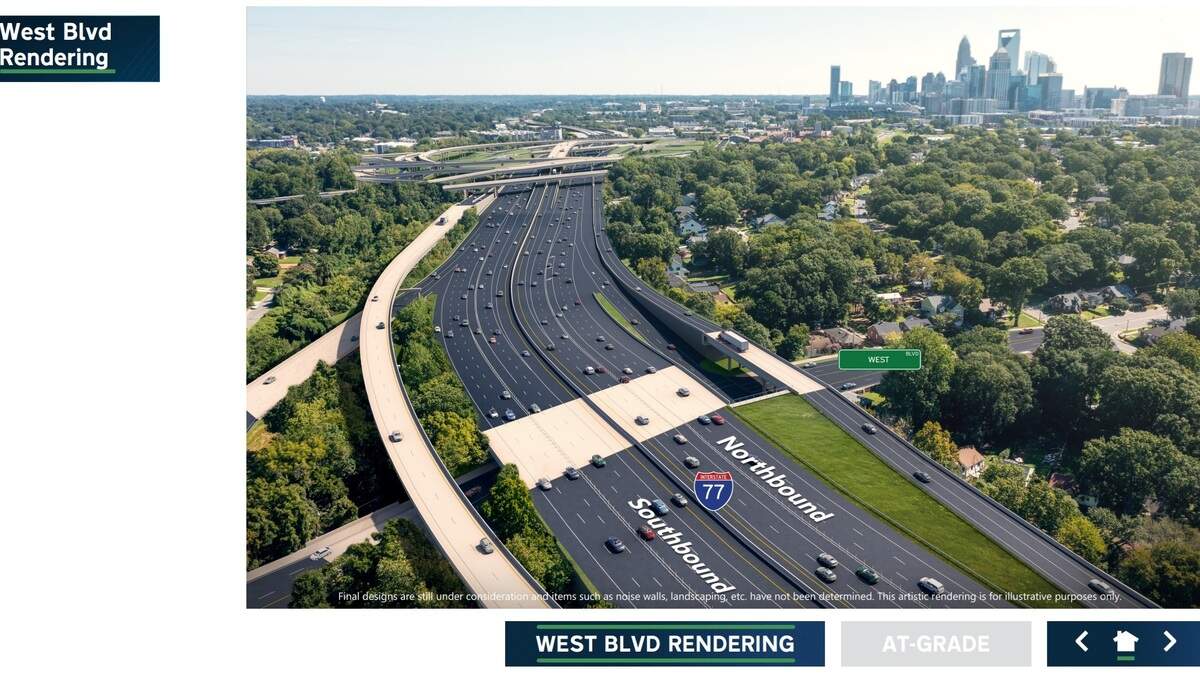
NCDOT had planned toll lanes on an 11-mile stretch from uptown to the South Carolina border in order to address crashes and congestion on I-77. The long-discussed project has been in the work for years, with a public-private funding agreement approved in 2024. However, the project drew increasing scrutiny when the state released design maps last year that showed homes in historically Black neighborhoods were subject to demolition.
Black community leaders met with state officials last week to share what they would like to see addressed in order for the project to move forward.
Read more Fists, a helmet and Jonathon Brooks fly in first Carolina Panthers padded practice
Charlotte-Mecklenburg NAACP President Corine Mack said in an email to the city council last week that the meeting with state officials instilled “a sense of optimism” about finally addressing long-standing concerns within Charlotte’s West Corridor communities.
But the meeting also sparked concern from some community advocates.
“It is deeply concerning that, after local elected officials voted to rescind their support, NCDOT appears to be continuing its efforts to build support for reversing those decisions through private meetings with selected stakeholders rather than through an open and transparent public process,” Sustain Charlotte executive director Shannon Binns said in a statement.
“The individuals invited to these discussions represent important voices in our community, but they do not speak for every resident of West Charlotte, nor do they replace the role of the elected officials entrusted to make decisions on behalf of the broader public.”
The group is calling for more transparency from NCDOT as conversations continue.
Sean Langley, president of the McCrorey Heights Neighborhood Association, said last week’s meeting should’ve included all the neighborhood leaders that live along the 11-mile stretch. While some of these neighborhoods have been underinvested in historically, many of their leaders are not going to be lured just by benefits alone, he said.
“If you’re going to destroy the community that was once there just to give us grocery stores or recreation centers, well I don’t think that’s a fair deal,” Langley said.
His neighborhood’s main concern continues to be the project’s design, he said. The question also remains if toll lanes is truly the best way to address congestion on the major thoroughfare, he added.
“The community has never made any concessions; what we’ve continued to ask for is an independent analysis,” Langley said.
The high stakes conversations continue as the city faces a major deadline in the coming months.
New mayor Robert Harrington spoke to the Observer about including the community engagement and transparency surrounding I-77, but added that time is of the essence to get it done. “We have a runway now that we need to pull together the community, work on building trust … convening people, and coming up with the best outcome that we can come for the city… I don’t want to prejudge that outcome.”
The recently approved state budget includes a provision that would force Charlotte and other local governments to be on the hook for millions of dollars unless CRTPO reverses its decision. The deadline to make that change is Oct. 5.
State law requires a 90 days notice before a project is removed from the State Transportation Improvement Program list. The notice will be delayed until after CRTPO revisits the project in September, according to Johnson.
“Between now and then, we remain committed to listening, sharing information openly and working alongside our partners to determine whether there is a path forward that balances growth, public safety, and community needs,” Johnson said in his letter.
Read more NC quietly ends decades of tracking racial disparities in policing
This story was originally published July 28, 2026 at 6:06 PM.