ACC football is revising its tiebreaker system — and preparing for more change
AI-generated summary reviewed by our newsroom.
The ACC has decided to change the tiebreaker system that resulted in a 7-5 Duke team making it to — and ultimately winning — the conference’s football championship in Charlotte in December.
Read more Former Gaston County teacher sues after district fired her over Charlie Kirk post
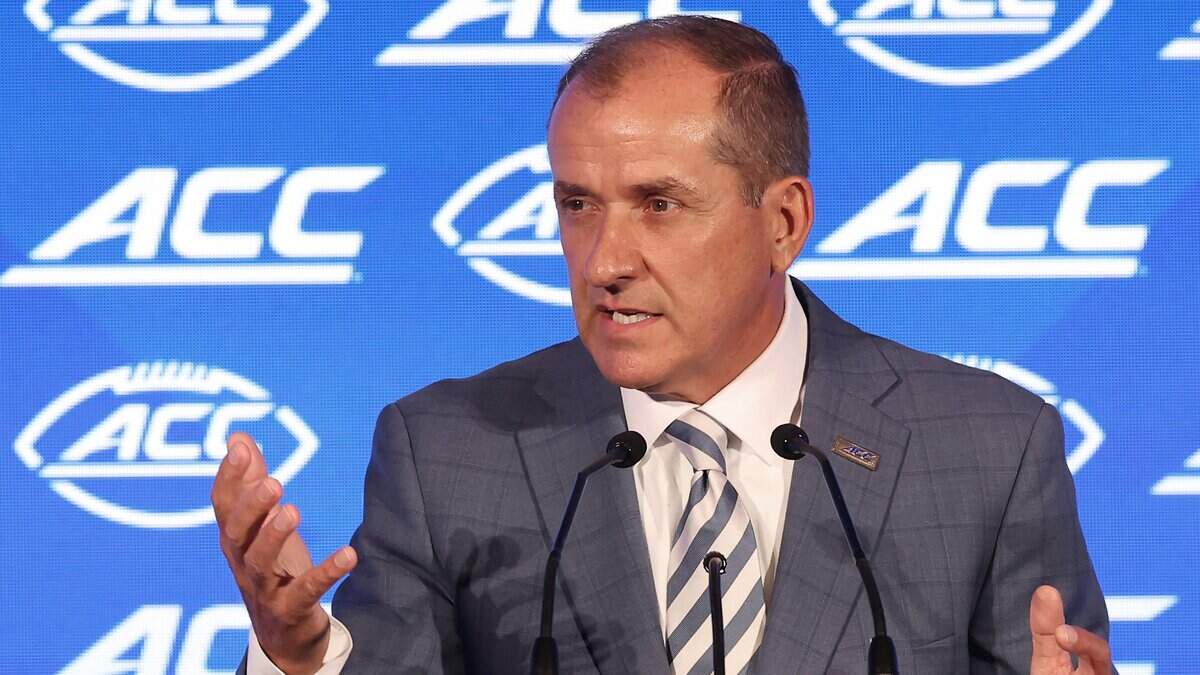
Commissioner Jim Phillips made that announcement and touched on all sorts of other college football issues Wednesday as he opened “ACC Kickoff 2026,” the league’s annual series of meetings that traditionally serves as a preview to the upcoming football season.
Phillips also reiterated his support for a 24-team College Football Playoff in 2027 — one that would replace the current 12-team model that remains a constant target for debate. But it was the new tiebreaker format that may be most relevant to ACC fans in the short term.
To review:
In 2025, the ACC faced a quandary as to which two teams should compete in Charlotte for the football title. At 7-1, Virginia had won the regular-season championship and was clearly in. But the second spot was a mess. Five teams finished at 6-2: Duke, Miami, Georgia Tech, SMU and Pitt.
Miami was the highest-ranked of those teams by most metrics. But the Hurricanes were left out of the game entirely, as Duke (7-5 at the time) qualified instead based on the ACC’s fifth tiebreaker — conference opponent win percentage. No one really understood the convoluted tiebreaker system the ACC was using, but it was pretty apparent the best team in the ACC hadn’t made the game at all.
Duke then justified its presence in the ACC championship by beating Virginia 27-20 in overtime. But the Blue Devils rightly didn’t make the CFP and Virginia didn’t, either. Miami nearly got left out, too, which would have left the ACC with an embarrassing zero teams in the field.
Instead, Miami barely qualified, won three straight games and made a run all the way to the CFP national final, where the Hurricanes lost to Indiana.
Said Phillips of the new tiebreaker system that will be utilized in 2026: “It will come down to ‘body of work.’ Who you play, when you play, the games you win. Conference and non-conference will matter. That’s a major change in college sports and certainly for the ACC…. We talked a lot about it. Used a lot of consultants. Did 10,000 algorithms of different scenarios. It warranted that kind of time and commitment so that we can position ourselves to put those two best ACC teams forward.”
Head-to-head matchups will remain as the No. 1 ACC tiebreaker.
But if two teams don’t play each other — quite possible in the 17-team ACC — then the teams will be separated by winning percentage. With 12 teams playing nine conference games in 2026 and five of them playing only eight, that could be problematic (for instance, if one team finishes 7-1 in league play and one finishes 8-1, that would be considered a tie because no team will be rewarded or penalized based on the number of conference games it plays).
Then, SportSource Analytics comes in — an analytics service also utilized by the CFP. That service will break a tie like the one in 2025, if necessary.
Phillips noted that this year the ACC winner in Charlotte will receive an automatic bid to the 12-team playoffs in 2026, so it was even more important than before to make sure the league’s top two teams play on the first Saturday in December in Charlotte.
Of course, this new tiebreaker system might be just a one-year thing.
If the CFP expands further, it’s quite possible that conference championship games will become extinct because of the extra weeks needed to finish the playoffs. But, for 2026 anyway, the conference has improved what had been a serpentine system. There is still some potential for confusion, but less than there was.
Read more New call for extras for ABC show filming in NC. Here’s when and the pay
Three other things I found interesting in Phillips’ meeting with the press:
Charlotte will again host the ACC championship game, but at a different time. Rather than a traditional nighttime start, this year’s ACC title game will be played on Saturday, Dec. 5, at noon.
“I’m excited about the championship game time this year,” Phillips said. “We have been (having nighttime kickoffs) at Bank of America Stadium, and it’s been great. We have a tremendous relationship with the Teppers and the folks over there at Bank of America Stadium.
“But the weather is dicey,” Phillips said. “It just is. It can be 70, or it could be 38 degrees. To be able to play at noon, unencumbered by any other Power Four games, I’m interested to see what happens there.”
Last year’s ACC title game in Charlotte kicked off at 8:15 p.m.
With a relatively low-profile matchup between No. 17 Virginia and then-unranked Duke, it drew only 41,672 fans, one of the smaller crowds in ACC championship game history. There were 30,000 empty seats, with tarps covering significant portions of the upper deck end zones at Bank of America Stadium.
The weather also didn’t help. The temperature when the game began at 8:15 p.m. was 39 degrees, which was the lowest temperature at kickoff in the ACC title game’s 21-year history. The game didn’t finish until 12:09 a.m., and by that time the temperature had dropped even further.
Phillips continued to push for the CFP to expand to 24 teams as early as the 2027 season, a position that is far from universally agreed upon.
“I have been vocal about the idea that if you have a championship, and you have teams that truly could win a championship, and they’re not invited, which we experienced a few years ago, and others have experienced the last couple years, you don’t have the right format,” the commissioner said. “So it is about greater access, if you’re going to have a true national championship. I have continued to advocate that we should increase.”
Continued Phillips: “There’s a debate between 16 and 24. I’ve gone on record that I believe 24 is the right number for us. It would absolutely have to alter the regular season, when we start, and the calendar is really compressed. We’d have to deal with that. There’s good momentum. In our room, our coaches were unanimous, our athletic directors were unanimous coming out of the spring and into the summer. Nothing has changed.”
One thing the ACC received near-universal praise for last season was being the first major league to show the conversations between football officials on the field and the league’s replay booth in real time, giving far greater transparency about how those decisions are made. Phillips said this was such a hit that the ACC has made a commitment to showing those interactions for a greater percentage of ACC games this season.
“We’ve got, I think, a couple of new elements to it,” Phillips said. “It’s really about volume and having more of our games be administered that way… I think it’s cool as a flat-out sports fan, to see how those decisions are made. Just really proud we took that step. I think a couple other conferences are going to do it.”
Read more ‘We all lose’ if Octapharma’s $1.5 billion deal in Rock Hill collapses, exec warns