NC senator ‘being kind’ with proposal forcing Charlotte to repay I-77 toll costs
When Sean Langley heard a state senator wanted Charlotte and surrounding communities to repay $64 million spent on the suspended Interstate 77 South toll lane project, he dismissed the claim.
Read more One of these people will be Charlotte’s next mayor. Many won’t even be considered
“We don’t owe anything,” said Langley, who is president of the McCrorey Heights Neighborhood Association. McCrorey Heights was one of several neighborhoods along the I-77 corridor that would have been impacted by the toll lane project.
“Why would we owe the state? What are we paying them for,” Langley continued. “I don’t think all that money that has been used to do preliminary work… was all in vain. What we’re asking for is alternative options.”
“It’s political theater.”
This week, Sen. Vickie Sawyer, a Republican representing Iredell and part of Mecklenburg County, proposed a draft amendment to a bill being debated by the General Assembly.
The amendment would require Charlotte and other local governments that voted to rescind the funding agreement for the I-77 South project — effectively killing it — to reimburse the North Carolina Department of Transportation for money it already spent on the plan.
Until those governments pay up, the state wouldn’t start new transportation projects and would withhold Powell Bill funds, which is state aid that pays for road maintenance.
Her proposal landed in local leaders’ inboxes Thursday afternoon. Charlotte City Council members say they’re waiting for guidance from the city attorney’s office on how to proceed amid ongoing discussion about I-77’s congestion issues.
Some say they weren’t surprised the General Assembly wanted to insert itself into discussions on a local project business leaders say is needed to continue the region’s economic growth. Others, such as Langely, scoffed at the idea of repaying NCDOT.
But Sawyer isn’t mincing words when she says her draft should be taken seriously.
“This has been vetted, supported, and will be in the budget. This is me actually being kind to the City of Charlotte, and to those communities who did vote to rescind,” Sawyer said in her weekly radio show on WAME in Statesville. “And I am communicating to you right now that this will happen. This is not a joke. You will lose this, and you will have to pay back the money to the state, and until you pay back the money from the state, your Powell Bill dollars will be frozen.”
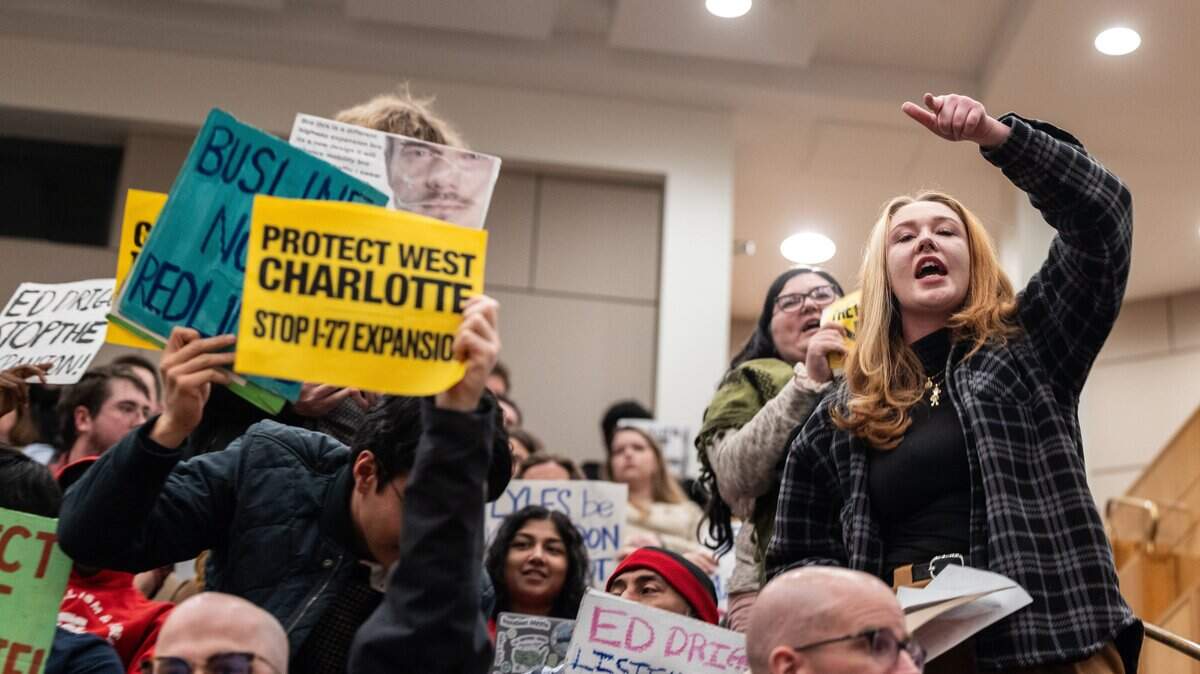
Charlotte set off a chain of events in May when the City Council voted to rescind its support for the I-77 project’s funding agreement. The Charlotte Regional Transportation Planning Organization quickly followed suit, shelving the project that had been in the works for over a decade and ruffling feathers at the state level and among business leaders.
CRTPO member and Mineral Springs Mayor Rick Becker cautioned that the General Assembly could get involved during the board’s May meeting. He wasn’t surprised by the amendment because it tracks with how the General Assembly has inserted itself into local politics in recent years.
“I didn’t think that (the General Assembly) were going to just let it drop,” Becker said. “We’ve seen what the General Assembly does. As a municipal official, I kind of don’t like it but we have to work with what they do…. I see this as being perfectly in line with their feelings. If (the General Assembly) wants the road built and the municipalities are standing in the way, they’re going to handle it.”
The claim that the state should recover money for sunken costs “has merit,” said Ed Driggs, the Charlotte delegate on the CRTPO. He was the only Charlotte City Council member who took a vocal stance in favor of the project.
“But I hate to think Charlotte is liable for a big chunk of it,” Driggs said.
Sawyer’s draft would divide the reimbursement based on the weighted value of CRTPO votes.
Charlotte is on the hook for the most with 41% of the vote. Representatives with Mecklenburg County, Davidson, Monroe, Cornelius, Matthews, Mint Hill, Huntersville and the Metropolitan Transit Commission also voted to rescind.
Like Langley, Charlotte City Councilmember Victoria Watlington doesn’t think Charlotte should be liable for any reimbursement.
Charlotteans voiced concerns about the project, and council members acted, Watlington said.
“There shouldn’t be a punishment or a penalty for exercising our authorized authority,” Watlington said. “It’s not even just about 77. It’s about a much broader precedent that’s being set for the state of North Carolina. If I’m Asheville, Wilmington or Duck, I’m looking at this like, wait a minute. Does this mean that we’re subject to, not just in transportation, but in any topic to then be retroactively punished for decisions that we make that are within our authority, especially as new information comes to the table.”
Read more The 10 best places to watch World Cup matches in Charlotte
Sawyer initially took a softer stance following the CRTPO vote. She told WBTV at the time she hoped the General Assembly wouldn’t get too involved in the issue. She supported Charlotte and wanted to keep the funding in the area, she said.
Her tenor hardened during her Friday radio interview. Businesses along I-77 such as Carowinds need the expansion project to move forward, she said.
“When you are 15 years into a project, and then on a political whim, overnight, rip it out, you are doing a generational damage to your community,” Sawyer said. “I don’t like tolls. I don’t. But this is the only way the community will receive relief.”
Sawyer directed The Charlotte Observer to her radio interview when asked for a comment.
Driggs hopes Sawyer’s proposal will nudge the project back on track because the community benefits it would bring are a “no brainer,” especially compared to “warfare with the state.”
Driggs noted a provision in Sawyer’s draft that would block NCDOT from removing the I-77 project from the state transportation improvement program or otherwise changing its position on that list until January when the department is already planning to review the list and reprioritize.
That could give the city and NCDOT more time to work through their differences and open a window to address the concerns that derailed it in the first place, Driggs said.
But NCDOT is already in the process of removing the project from the list, according to an agency representative. It’s unclear if the agency will halt that process, but NCDOT said it “can’t speculate on what would occur if or when this amendment becomes law.”
NCDOT planned to add toll lanes to an 11-mile stretch of I-77 from uptown to the South Carolina border. A private-public partnership funding agreement was approved in 2024.
I-77 South, according to NCDOT, has the state’s highest congestion levels, seeing over 160,000 cars a day. The toll lanes would address congestion and crashes, NCDOT said.
But residents heavily opposed the I-77 South project after NCDOT released preliminary designs for the roadway in November. Those designs showed roadways through people’s homes, particularly in historically Black neighborhoods that have borne the cost of growth before. Residents wanted to see more transparency and engagement from NCDOT.
And the agency tried. It opened a community engagement center and held several community benefits meetings. But the trust between residents and NCDOT was already lost, according to District 2 Councilman Malcolm Graham.
Residents of McCrorey Heights still want to see improvements to areas along I-77, Langley said. And again, something should be done to the corridor to address congestion concerns.
Charlotte has already allocated $300,000 toward a study looking at alternative designs, modeling and simulation techniques for land use planning, Watlington said.
“Some people think we’re saying do nothing and that’s not what we’re saying,” Langley said. “We’re saying do something that also doesn’t cause harm.”
That was the reason Charlotte City Council voted to rescind the funding agreement, Watlington added.
But an amendment to pay back funds for the project isn’t a bridge to collaboration, she continued.
“This has been an opportunity to really step back and say what about this process needs to be adjusted,” Watlington said. “ … I hope that we all can be adults about this and disagree respectfully while also coming together for the ultimate end goal.”
Read more Lake Norman development plans face votes and pushback. Here’s what to know.