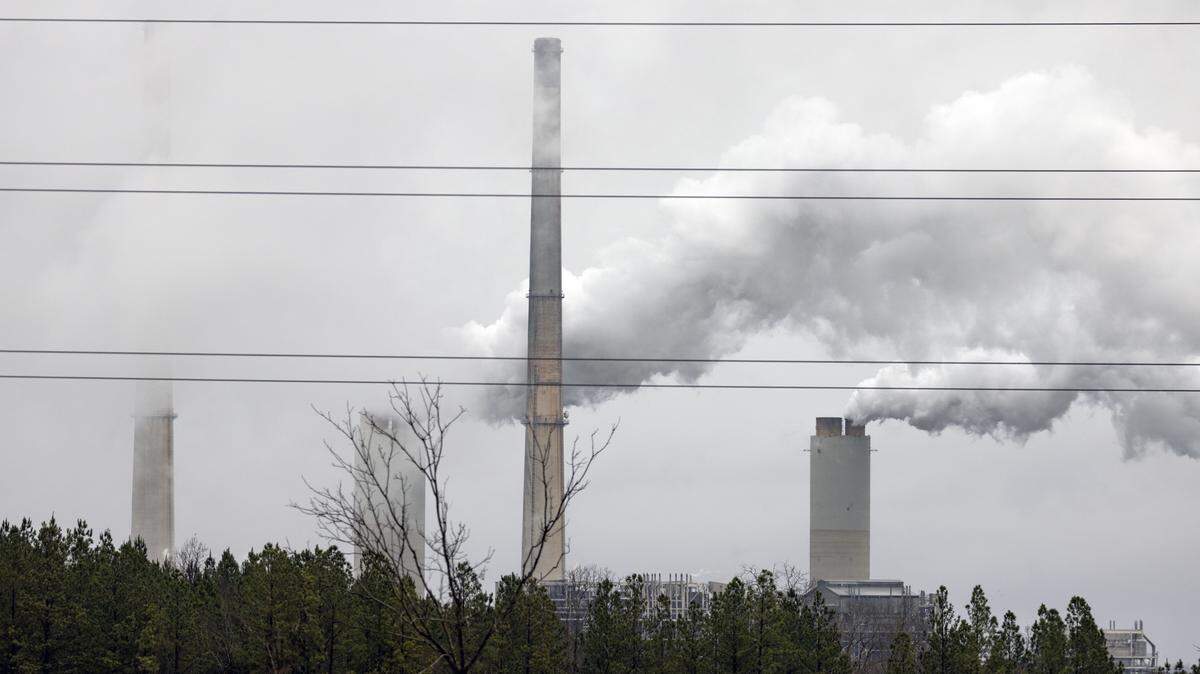
Without greenhouse gas limits, Duke Energy claims it will save $10 billion
AI-generated summary reviewed by our newsroom.
A major new EPA decision will save Duke Energy about $10 billion across North and South Carolina, the company says, as it will allow the utility to build more gas-powered plants and reduce the money it had planned to spend on renewable energy.
Read more NC announces first flu death of 2026 season. Here’s when to get a flu shot
However, that savings estimate doesn’t appear anywhere in Duke Energy’s public filings to North Carolina regulators, and experts say it leaves out the health costs of climate pollution that will come from fossil fuel energy.
The EPA’s decision, which removed key limits on greenhouse gas emissions from power plants, also faces a legal challenge from N.C. Attorney General Jeff Jackson and 20 other state attorneys general, who say the move violated the Clean Air Act.
“The EPA is giving companies a green light to pump pollution into the air we breathe, put our health in danger, and harm our state’s natural resources,” Jackson said in a Monday news release.
The EPA announced last month it was repealing several rules, enacted in 2024 by the Biden administration, that limited how much greenhouse gases can be emitted by coal- and natural gas-fired power plants.
The limits were seen as a key way to curb the United States’ contributions to climate change. The nation’s power plants emit over 1.5 billion metric tons of greenhouse gases each year. Scientists agree that these gases trap heat in the Earth’s atmosphere, causing rising global temperatures and more frequent extreme weather events.
Under the Trump administration, however, new EPA officials have argued that greenhouse gases do not pose a significant public health risk, and that using fossil fuel energy would be cheaper and more reliable.
After the announcement, Duke Energy CEO Harry Sideris issued a statement celebrating the move, and saying that it would save the company $10 billion.
That number, Duke Energy representatives later told The News & Observer, is an estimate of how much less the utility will spend on energy resources. In a long-term resource plan submitted to state regulators last year, Duke Energy modeled how much it would invest in each type of energy through 2050 under different policy conditions. It included several scenarios that assumed the EPA’s greenhouse gas limits would be repealed under the Trump administration.
Under the old EPA rules, the utility would have planned to add 9.7 more gigawatts of solar energy, 2.4 gigawatts of offshore wind energy, and 500 megawatts of battery storage, in addition to not building two new natural gas plants that would’ve totaled 1.8 gigawatts.
If the new EPA rule survives legal challenges, Duke will likely build less solar capacity, and would move forward with building more gas plants. It will still continue to build some battery storage and onshore wind, and will leave three coal plants open about two years longer, according to the company’s models.
The company didn’t detail how those changes would generate a $10 billion saving.
“It’s frustrating to try and understand where Duke is pulling these numbers from. Even in their resource plan, it doesn’t appear anywhere,” said Sue Sturgis, research and communications manager for the Energy and Policy Institute.
“Anytime you see these nice round numbers, I think it’s cause for some reasonable suspicion about where they came from,” said Jackson Ewing, director of energy and climate policy with Duke University’s Nicholas Institute for Energy, Environment and Sustainability.
Read more Will Isaias match Helene? National Weather Service forecasters address concerns.
Ewing and his colleague, Martin Ross, recently modeled how much it would cost utilities like Duke Energy to still reach their net-zero emissions goals after recent policy shifts under the Trump administration.
Seeing “very radical policy shifts” from year to year, Ross said, creates uncertainty for companies like Duke. If greenhouse gas limits for power plants are restored in the future, it could end up costing utilities much more to switch back to limiting their emissions, the study found.
“There is every reason to think that we have not seen the end of carbon-constraining regulations in the country, and so … there could be a pretty significant price tag to just moving really rapidly into expanding fossil generation in the near term,” Ross said.
Those shifts have already had an impact on Duke’s plans. In 2022, the utility had paid $155 million to lease a coastal area in the Carolina Long Bay to build offshore wind turbines, but earlier this year, the federal government paid Duke $129 million to abandon that lease — and with it, its plans for offshore wind to become a major resource for customers.
Other analysts have found that the EPA’s decision could result in health and environmental impacts that will cost billions to manage.
Emissions from power plants can include harmful pollutants, like nitrogen oxides and sulfur dioxide, that can lead to higher rates of asthma and weaken the immune system.
Using modeling published by the EPA itself, the Environmental Defense Fund estimated that the decision could lead to between $800 billion and $1.2 trillion in health costs, and over $1.8 trillion in climate damage, by 2047.
“Although EPA claims the rollback will lead to cost savings for industry, it refused to estimate the much more massive health costs — including premature deaths, hospital visits and illnesses — that the American people will have to bear because of being exposed to higher levels of power plant pollution,” the Environmental Defense Fund’s analysis reads.
“In the future, Duke’s buildouts will need to be vetted really closely by the Utilities Commission to make sure that they’re in the public interest,” Ewing said.
This story is available free to all readers thanks to financial support from the Hartfield Foundation and Green South Foundation, in partnership with Journalism Funding Partners, as part of an independent journalism fellowship program. The N&O maintains full editorial control of the work. If you would like to help support local journalism, please consider a digital subscription, which you can get here.
This story was originally published October 8, 2026 at 1:34 PM with the headline “Without greenhouse gas limits, Duke Energy claims it will save $10 billion.”
Read more Man came 2,600 miles to see 15-year-old NC girl he met on Snapchat, sheriff says