Wesley Heights neighbors noticed new home construction. Then came the ‘No’ signs.
In May, Dan Crawford and Dean Forbis saw the renovations going on at a house across the street on Woodruff Place in Charlotte’s Wesley Heights neighborhood.
Read more How it unfolded: A timeline of CMS Superintendent Crystal Hill’s leave and return
“I thought it was going to look really nice, and I noticed, what a huge addition,” Forbis said.
Then, in early June, a woman named Dominique Rice came by with a video crew.
“I just walked up on the sidewalk and asked her, ‘What’s going on,’ and she said, ‘Well, you know, we’re building this thing,’” Crawford said. “She invited my wife and I to go inside and check it out. She was very pleasant and showed us these rooms, and they were, you know, very small rooms.”
At the time, Rice was an account executive for PadSplit, an online co-living rental marketplace, where users can rent rooms in shared living spaces.
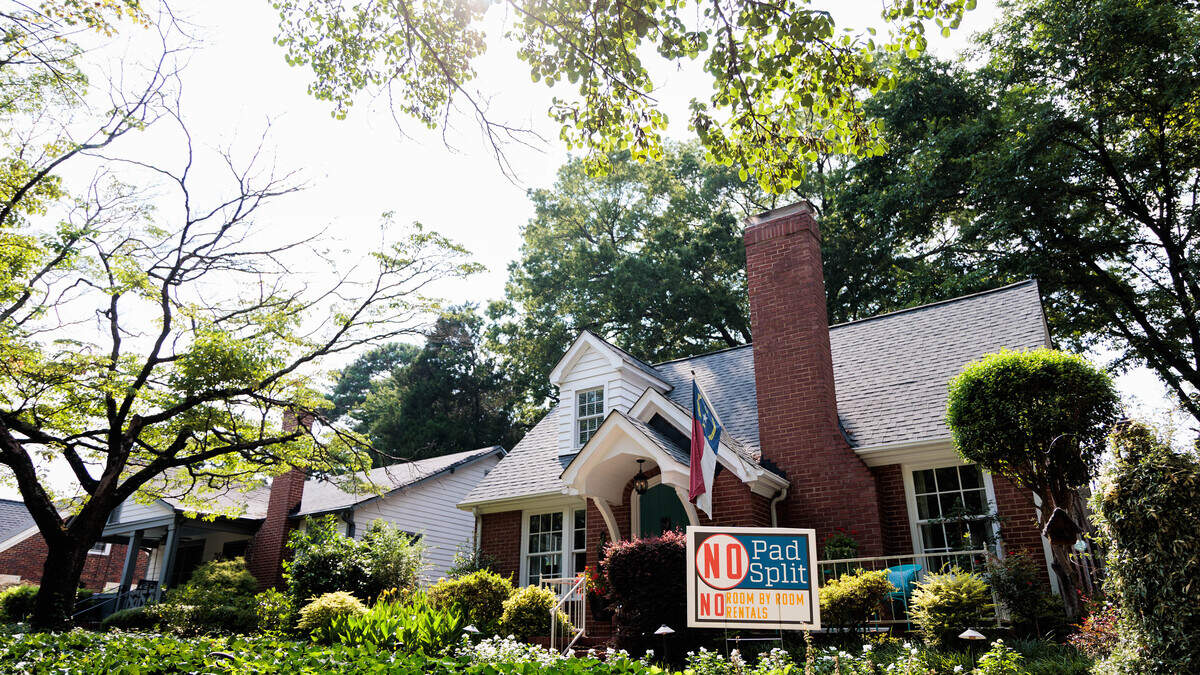
Word traveled quickly through the quiet residential neighborhood, which is zoned primarily for single-family residences. By mid-July, front yards in Wesley Heights were dotted with lawn signs.
“NO PadSplit, NO room by room rentals.”
“Protect our community, NO single room rentals.”
“We’re not fooled, PadSplit is NOT single family.”
Residents allege that the houses at 701 and 705 Woodruff Place are being developed into six-bedroom properties to be listed on PadSplit, raising concerns about zoning violations in a historic neighborhood intended for single-family homes.
Think of PadSplit, an Atlanta-based start-up founded in 2017, as if boarding houses met Airbnb. Owners can list individual, furnished rooms in their properties on the platform. Tenants pay a one-time fee and provide some background information to become a member, after which they’re able to book PadSplit’s listings.
The platform touts itself as an affordable alternative to traditional renting models, and advertises its relatively low weekly cost, lack of required minimum credit score and flexibility in lease terms.
Unlike vacation rental platforms, PadSplit is a 12-week minimum commitment with the option to pay to leave early, after which the agreement switches to a week-by-week basis.
The company highlights the median annual income of its members — $32,500 — and their working-class backgrounds, billing its model as a way for tenants to gain financial and personal stability.
“PadSplit is a social impact company — we believe that the people who serve our communities should also have an opportunity to live in them,” a spokesperson for the company wrote in a statement to The Charlotte Observer.
The model is not without its limits and controversies. It falls in a gray area of zoning regulations, although PadSplit CEO Atticus LeBlanc maintains PadSplit “adheres to all federal, state and local laws.” Prospective tenants are not allowed to tour the place before renting, and residents have long reported dicey roommate situations and ambiguous policies surrounding tenant rights and eviction.
PadSplit expanded into Charlotte around two years ago, according to LeBlanc. Since then, nearly 500 rooms in the Charlotte metro area have been listed on the site.
The average monthly rent of a one-bedroom apartment in Charlotte is $1,324, according to the real estate platform Zillow. In comparison, the average PadSplit room with a shared bathroom in the Charlotte metro runs at $243 per week, or approximately $1,040 per month — a price that includes furniture and utilities, a spokesperson told the Observer.
The two properties on Woodruff Place are not currently being advertised as PadSplit properties, nor do public records tie the company to the homes. But videos posted on social media appear to tell a different story.
The two-bedroom, one-bathroom home at 705 Woodruff Place, was purchased in June 2022. The nearby home at 701 Woodruff Place, which had three bedrooms and one bathroom, was just purchased in May.
According to property records, the deed for both 701 and 705 Woodruff Place are held by Michelle Harrison — a Charlotte-area real estate agent — under two separate LLCs.
Harrison did not respond to multiple requests for comment. PadSplit did not provide a response to the nature of Harrison’s relationship with the startup.
Renovations are ongoing to 705 Woodruff Place. Permit applications filed with Mecklenburg County Code Enforcement said the two-bedroom, one-bathroom property will become a “6-bedroom, 6-bathroom single family home” when work is complete.
Although no work is currently being completed at 701 Woodruff, Wesley Heights resident Chris Allred — who has been vocally against the developments — said there had been demolition inside the house, which has since stopped.
In a social media video from June, Rice — the PadSplit account executive — identified herself with her company role, and referred to 705 Woodruff Place as a “six-six PadSplit.” In another video, the two houses are identified as linked projects.
“It was a two [bedroom], one [bathroom], and we converted it to a six-six,” she said in the video.
Rice has since left PadSplit and co-founded a consulting firm dedicated to co-living development, according to her LinkedIn. She did not respond to a request for comment.
Read more Charlotte man accused of shooting near school bus is sentenced
LeBlanc, the company’s CEO, wrote that PadSplit was not involved in the purchases, selection, development or permitting processes of the properties.
When asked to clarify Rice’s appearance and statements in the video, a PadSplit spokesperson denied that the house in the video was in the Wesley Heights neighborhood.
“PadSplit is not affiliated with the construction taking place at 705/701 Woodruff, and we do not currently have any homes in Wesley Heights currently on our marketplace,” the company wrote.
Wesley Heights residents have steadily raised concerns about the two properties, questioning their adherence to Charlotte’s Unified Development Ordinance (UDO) and their impact on “the fabric of the community.”
At a community meeting on July 14, around when the lawn signs started appearing, neighbors brought up these questions to City Council member Malcolm Graham and Nan Peterson, a development services relationship manager with the city. A pen-and-paper petition was circulated at the meeting, and a Change.org petition about the issue has reached over 500 signatures.
Allred, who is an architect by trade and the Wesley Heights representative to the city’s Historic District Commission, told the Observer that he’s concerned about the prospect of six unrelated strangers living in the same house — especially in a “residential community, where people have their kids, raising their kids next door.”
While a rooming house is technically permitted in Wesley Height’s zoning district, Allred noted that the owner was required to live on the property of a rooming house under the UDO.
“They’re stretching the definition of ‘family’ to include six individuals who don’t know each other, haven’t chosen to live together, [and] aren’t under a single lease agreement to qualify as a family,” Allred said.
Under Charlotte’s zoning code, up to six unrelated people can live together in a single-family home.
He also pointed out that PadSplit’s minimum stay length of 12 weeks falls just within North Carolina’s legal definition of transient occupancy, which defines a stay as “transient” if it’s less than 90 consecutive days.
Edward Peugh, the co-owner of CLT Buyers LLC and a PadSplit host in Charlotte, characterized his tenants thus far as people who generally “needed a place just to stabilize.”
Other neighbors expressed concerns about the potential influx of cars, especially on a street as narrow as Woodruff Place, where cars frequently have to pull over to let other cars pass.
Peugh said it’s expected for people to have “heartburn” over co-living properties, and that “the NIMBYism in this space happens.”
“Their concern isn’t really the appearance. Their concern is they don’t want a drug dealer hanging out on the corner of the house every day,” Peugh said. “I think that’s a complete mischaracterization of most of the people who I’ve interacted with, whether it’s through the PadSplit platform or co-living more broadly. These are individuals who work at Amazon. These are individuals who work at Walmart. One of the guys staying in one of my properties is an assistant manager at a Papa John’s.”
As to whether a renovation like the one proposed at 705 Woodruff Place was in alignment with the city’s UDO, Peugh was blunt.
“If the housing solution meets Charlotte’s zoning and ordinances for these areas, what’s the concern?”
Crawford said that construction is still ongoing at 705 Woodruff Place, despite the social media video featuring Rice that mentioned a targeted completion date of Aug. 1.
City spokesperson Jack VanderToll wrote in a statement Wednesday that the issue is still under review.
Graham, the City Council member representing Wesley Heights, said the situation was “concerning” in an interview with the Observer, but added that he was waiting on more feedback on whether the properties adhered to zoning ordinances.
KT Wilson, a Wesley Heights resident who facilitated the PadSplit discussion at the community meeting and started the Change.org petition, expressed frustration about the city’s reactive approach.
“It is frustrating to have someone say, ‘Well, just let us know if things aren’t being done properly,’” Wilson said. “When that is the sole purpose and reason for your existence, you should be ensuring things are done properly.”
Read more Cabarrus County high school football preview: Which teams could wind up on top?