Charlotte data center’s expansion plan no longer includes saving historic facade
Redevelopment of an existing data center in uptown Charlotte may start soon. But with that change, the city will be losing a building that’s more than a century old — and its historic facade
Read more 5 places to celebrate the Fourth of July in Charlotte — without fireworks
There had been a chance that the facade would be saved. But no longer.
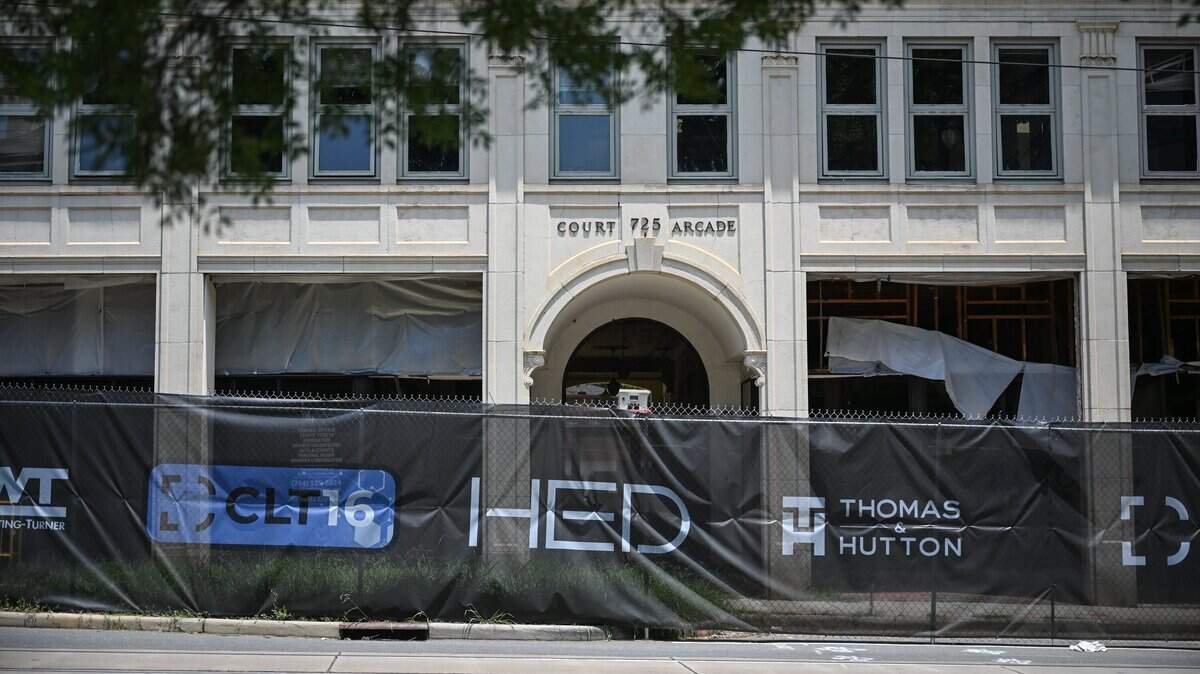
The Trade Street building is part of the Court Arcade, which was built in the mid-1920s by architect William Peeps, according to the Charlotte-Mecklenburg Historic Landmarks Commissions. Digital Trade Street 2 filed a land disturbance permit on June 22, for 725 E. Trade St., city records show.
Digital Trade Street 2 is the limited liability company of Texas-based Digital Realty Trust, a major data center builder with over 300 centers in more than 25 countries.
Digital Realty already operates a data center at the site, as well several others in the area at 731 E. Trade St.; 113 North Myers St.; and 125 North Myers St. But the data center developer wants to expand its operations in Charlotte.
Digital Realty filed a demolition permit for the site in October. Photos within the permit indicated that Digital Realty intended to preserve the facade, which includes the arched entryway and covered setback.
The company had worked with the Historic Landmarks Commissions for a few months this year to save the facade, according to commission director Stewart Gray. Digital Realty already began demolishing the inside of the building, so Gray believed the agreement was set.
But that’s no longer the case.
Digital Realty will demolish the entire building. The developer is requesting a new demolition permit from the county noting the complete removal of the building, including the facade, according to Mecklenburg County records obtained by The Charlotte Observer. That paperwork was submitted last week.
Digital Realty attempted to save the facade but determined it wasn’t feasible, according to a statement from the company.
“We care about preserving the historic character of Charlotte,” the company stated. “Going forward, we are working on a community benefits strategy to support the work of historic preservation in Charlotte.”
Gray had been unaware Digital Realty would no longer be saving the facade until informed of the change by the Observer.
“We’re disappointed,” Gray said. “We try to help property owners realize the potential in maintaining properties with historic character… Preserving the facade would have allowed preservation of history.
“The compromise (to save the facade) would have given them the opportunity to use the property but also protect the heritage of the city,” he added. “We’ve got plenty of plaques and plenty of old pictures. But once the arcade is gone, it’s gone.”
It’s unclear when the facade demolition or subsequent construction will start.
The city land disturbance permit indicates that the developer will begin site work on the property, such as grading, along with soil erosion and sedimentation control.
And the work will begin even as data centers remain a point of contention in Charlotte and nearby regions. Many residents have opposed the data centers. They cited concerns about noise, water usage and the significant power needs of the centers, which often appear in communities with limited public disclosure.
Last October, Digital Realty also filed a land development construction plan for the Court Arcade that called for a new four-story data center building with a mechanical yard for supporting electrical equipment and a truck delivery driveway off East Fifth Street.
It will be a 12-megawatt data center, which is equivalent to what could power about 10,000 U.S. homes annually, according to Congressional Research Service. It’s unclear how much the
Read more Calling wildlife lovers: New NC license plate could help this endangered animal
Digital Realty has a right to demolish and expand the site. Court Arcade isn’t a historic landmark. And while Charlotte is the latest city to enact a moratorium on data center development and rezoning, this project began well before the moratorium’s June start date.
But the removal of the Court Arcade is the latest in an ongoing series of Charlotte’s disappearing historic buildings.
For instance, the 94-year-old Midwood Elementary School at 1817 Central Ave. in Plaza Midwood is being torn down for apartment buildings. And several properties in Steele Creek near Charlotte Douglas International Airport have been demolished for airport expansion.
The landmarks commission is trying to save Charlotte’s history, Gray said. It is looking into deed restrictions and increasing staff members. But a landmark designation could take about nine months and ultimately buildings can still be demolished, under state law.
“We’re trying very hard to save the buildings because historic places, historic buildings, bring history to life,” Gray said.
A century ago, the Court Arcade was an office building for attorneys who needed to visit the Mecklenburg County Courthouse along East Trade Street.
The building is split into two. The front-portion is two floors and the back is one level. The back portion is where the arcade architecture shines.
The ceiling is arched and lined with skylights to allow for light in walkway. And each office door mimics a storefront similar to shopping arcade structures. The design is part of the “arcade” architecture, which is where the building gets its name.
Peeps designed two arcade buildings in Charlotte: the Court Arcade and Latta Arcade.
Digital Realty has owned and operated data centers in uptown Charlotte for about 20 years
In 2005, Digital Realty purchased three parcels around the Court Arcade for about $17.3 million, according to county property records.
Digital Realty is also building one of the biggest data center in North Carolina, in west Charlotte, after receiving rezoning approval last year.
The 3-million-square-foot data center will go up on 156 acres at 12899 Moores Chapel Road, near the Catawba River. The site will house two buildings that could support up to 400 megawatts of IT capacity. Digital Realty purchased the property two years ago for $160 million.
In March, Digital Realty closed on a $3.25 billion equity fund that will go toward owning and building in major markets, including Charlotte, commercial real estate news outlet Commercial Property Executive previously reported.
But with Charlotte’s 150-day data center moratorium, Digital Realty won’t be spending part of that fund in Charlotte anytime soon. That moratorium ends in November but could be extended.
Read more Massive quakes in Venezuela impacted groundwater levels in Carolinas, USGS learns